
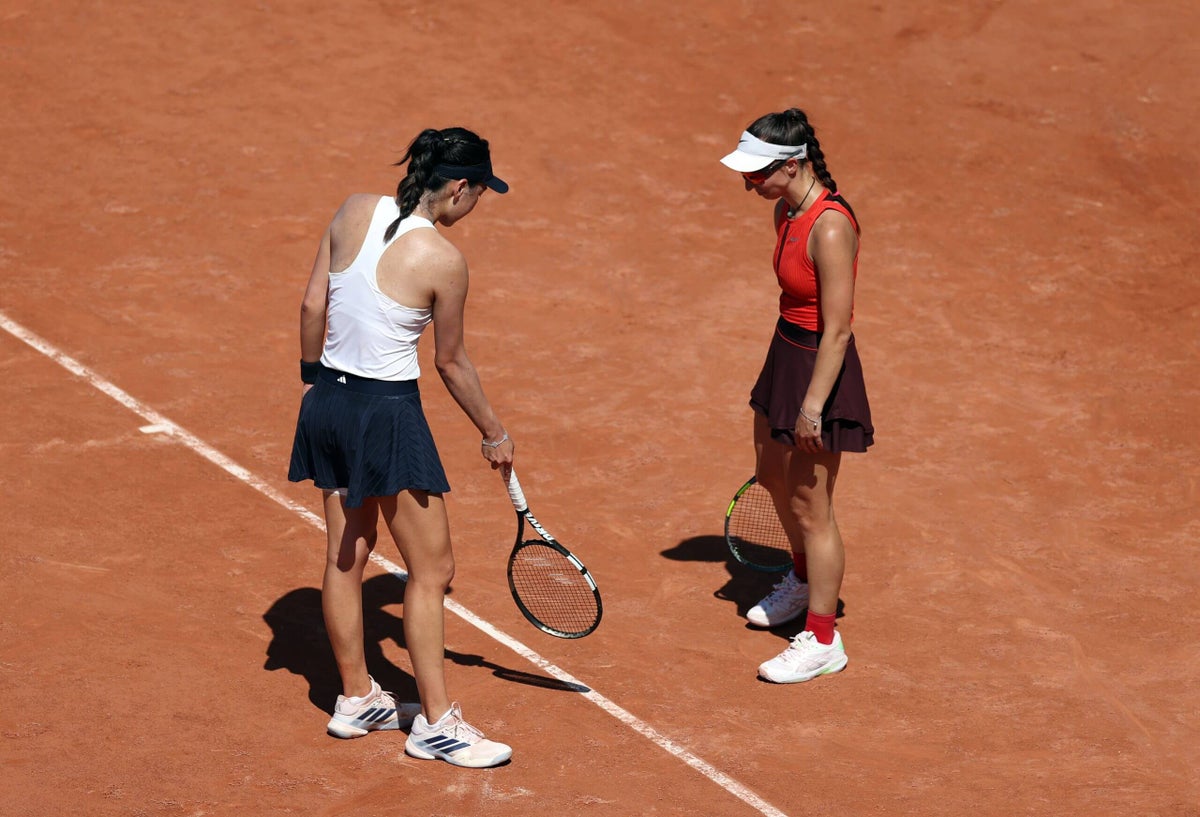
The Athletic has live coverage of the 2026 French Open.
PARIS — As Wang Xinyu stood at the net under the relentless heat on Court 7, things were about to get even hotter.
Serving at deuce and trailing to Germany’s Tamara Korpatsch 5-2 in the first set of their second-round match at the French Open, the Chinese No. 32 seed saw a forehand called out by a line judge. After the call, Korpatsch had walked forward to where it landed, before moving a little to her right and pointing to a mark.
Per Roland Garros custom, chair umpire Aurelie Tourte descended from her chair to check. Roland Garros is the only Grand Slam not to use electronic line calling, with line judges, the chair umpire, and the players using the traces left by their shots to see whether the ball was in or out.
After consulting the mark, Tourte ruled that Wang’s forehand was out.
Wang was not happy. After asking the umpire — who told her she would get a code violation — she went over to Korpatsch’s side of the net to see for herself. The crowd booed as Wang gestured to her team, who sat right above the baseline where the ball landed.
Once Wang got there, the two players argued over which ball mark should be considered. That tension carried through to the end of a 6-2, 2-6, 6-3 win for the German, when Korpatsch refused to shake hands with Wang after three sets full of incident, including a code violation issued to Korpatsch for celebrating too early.
A cold encounter in the Paris heat 👀
Tamara Korpatsch refused to shake hands after beating Wang Xinyu 🚫 pic.twitter.com/WVB06XZHiq
— TNT Sports (@tntsports) May 27, 2026
“She (Korpatsch) showed her (the chair umpire) another mark,” Wang said in a mixed zone after the match.
“It was not the ball I hit. In the end, I think she admitted that. She said the chair umpire checked the other mark, not the one she showed her first.”
Korpatsch responded in a news conference: “There were two ball marks, one was the old one, and the other one was the new one. Both of them were out. So it doesn’t matter.
“I didn’t know which one was the right one, but the umpire came down and showed the mark and it was out. She came on my side because she didn’t believe it, because I think her team talked too much, because they thought it was in.”
Wang acknowledged that she knew her shot was out, but felt aggrieved by how, in her view, Korpatsch had tried to influence the umpire.
“If I wasn’t sure which mark it was, then I wouldn’t show anything to the chair umpire,” she said. “I would just wait there, wait for her to come and make a decision.
“I don’t know why she did it. Not a big fan of it but I don’t want to make any more comments.”
Wang, who said she respects Korpatsch as a player, told Korpatsch at their non-handshake: “I would have done it differently with the ball marks.”
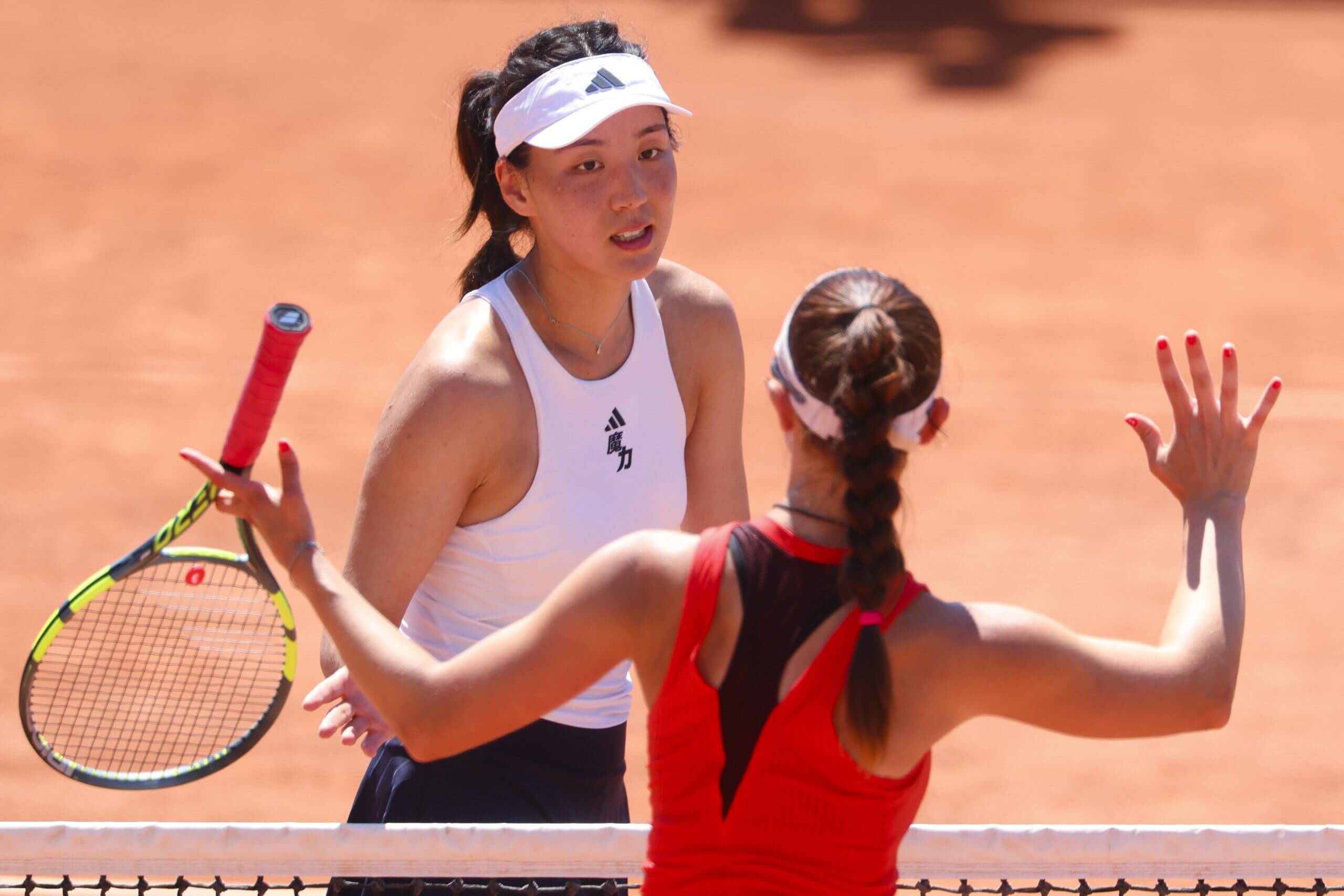
Wang Xinyu, left, and Tamara Korpatsch’s disagreement continued at the handshake. (Frank Molter / Getty Images)
“She told me she’s not OK with the ball marks and everything but I cannot say I gift her the point for nothing,” said Korpatsch in her news conference.
“I’m a bit surprised because normally we have a good relationship, we are not ‘enemies.’ I didn’t give her the hand because that’s not fair for me. She was unfair to come on my side, and I’m not an unfair player.
“She said she thought I’m an unfair player or something like that. We have one of the best chair umpires on the court. I don’t know how to cheat, honestly. There are many cameras on court and they can check everything. It would be embarrassing to cheat like that.”
Wang said the debacle did not affect her game, while Korpatsch was delighted to make the third round of a Grand Slam for the first time — even via such a strange match on a frazzling day at Roland Garros.