
In recent years, as climate change has driven more frequent and intense wildfires, winter storms and extreme heat, many Pacific Crest Trail hikers have abandoned the idea of a “continuous footpath” — the goal of walking the 2,650-mile trail sequentially end-to-end, from Mexico to Canada. In any given year, the expectation now is that sections of the trail might be closed during a wildfire or rendered impassable by record-setting snowfall.

But the longest-running Pacific Crest Trail closure, a 3.5-mile section in Angeles National Forest that’s been closed for over 20 years, isn’t the result of fires or floods or heavy snow. It’s to protect a tiny endangered frog.
The U.S. Forest Service first closed the Williamson Rock area in 2005 to protect the endangered southern mountain yellow-legged frog and its habitat, which has also been pummeled over the years by climate change, wildfires and drought. The closure area includes from around Mile 390 to Mile 394 of the Pacific Crest Trail, an area just off Highway 2 in Angeles National Forest where the trail crosses and parallels Little Rock Creek, one of the few remaining habitats for the mountain yellow-legged frog.
Article continues below this ad
The 1.5- to 3-inch-long frogs used to be extremely common across multiple streams in the San Gabriel Mountains, but at the time of the closure, only an estimated five to 10 frogs were present in Little Rock Creek specifically.
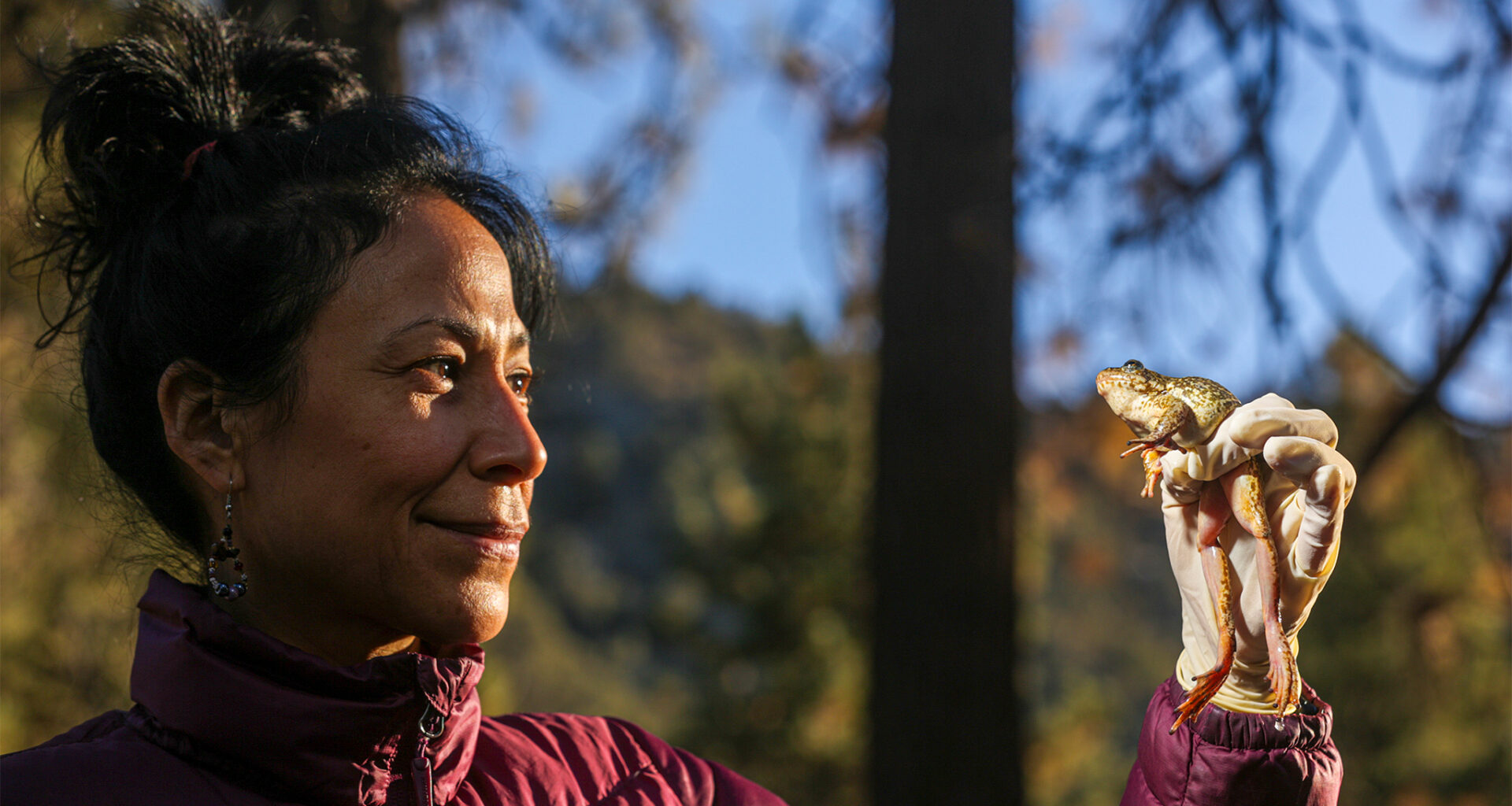
FILE: USGS biologist Elizabeth Gallegos holds an endangered mountain yellow-legged frog recovered from a fire-ravaged stretch of Little Rock Creek, just off Angeles Crest Highway 2 near Wrightwood in the San Gabriel Mountains, Oct. 29, 2020, in Wrightwood, Calif.
Irfan Khan/Los Angeles Times/Getty Images
FILE: Los Angeles Zoo keepers gather southern mountain yellow-legged frog tadpoles from the critically endangered frog’s breeding room on Tuesday, Oct. 2, 2018, before releasing them into a forest stream in the San Gabriel Mountains, their natural habitat.
MediaNews Group/Getty Images
Article continues below this ad
“They were super prevalent throughout the range historically and then kind of all of a sudden they disappeared, so a lot of people that hiked in the area say, ‘Oh, I used to play with these frogs in this creek back in the day, and now they’re just not there,’” said Sean Bruce, assistant curator of fishes and invertebrates for the Birch Aquarium at Scripps Institute of Oceanography at UC San Diego, which has worked on efforts to reintroduce the frogs in the wild.
The combination of low water availability, poor water quality after wildfires, predation from nonnative fish and the chytrid fungus, a fungus impacting amphibians across the world that makes it difficult for them to breathe and absorb water, all add up to a series of overlapping threats for the frog population, according to Bruce.
“When you get all four of those in a really small population, it’s like the perfect recipe for these populations to not do well. So there’s been like an insane, really, really, really drastic decline,” said Bruce.
Article continues below this ad
FILE: USGS biologist Adam Backlin hops a pond in a search and rescue mission of endangered mountain yellow-legged frogs on a fire-ravaged stretch of Little Rock Creek, Oct. 28, 2020, in Wrightwood, Calif.
Irfan Khan/Los Angeles Times/Getty Images
Violation of the closure order could result in a fine of up to $5,000, up to six months in prison, or both, according to the U.S. Forest Service. The Pacific Crest Trail Association has no recommended detour for the closed section (nicknamed the “frog closure”); many hikers walk alongside zooming cars on Highway 2 for a few miles until connecting with the poorly maintained Burkhart Trail, which reconnects them back to the PCT.
“We understand the frustration of hikers & trail users that this impacts the trail experience, but also understand and support the consideration and effort to protect the environmental and biological resources that make the trail so special,” Chris Rylee, director of communications for the Pacific Crest Trail Association, wrote in an email to SFGATE.
Historically, the frog was found across at least 166 separate population groups in four different Southern California mountain ranges. Now, the frogs are believed to be present in just 19 small populations “distributed disproportionately” across three mountain ranges, according to an August 2024 review of the species from the U.S. Fish and Wildlife Service.
Article continues below this ad
In the years since the Williamson Rock closure, it seemed like the local population of frogs was on the upswing in Little Rock Creek, which plays an outsize role in the species’ overall recovery because more frogs are typically found there than in any other creek. Scientists counted just six frogs in 2005, and by 2011, the population was at 51. For the next five years, the annual population count topped 100, then went up and down from 2017 through 2021, with anywhere from 32 to 84 frogs in any given year.
FILE: A team of USGS biologists on a mission to rescue, search for endangered mountain yellow-legged frogs in a fire-ravaged stretch of Little Rock Creek, just off Angeles Crest Highway 2 near Wrightwood in the San Gabriel Mountains., Oct. 28, 2020, in Wrightwood, Calif.
Irfan Khan/Los Angeles Times/Getty Images
But by 2022, things were looking up again, with 92 frogs that year and 140 in 2023. But in 2024, only one adult frog was observed in the creek that has been “long considered a stronghold” for the species, according to the 2024 review document.
“While new populations are being established through the release of captively propagated frogs, all populations are still extremely fragile, as evidenced by the low occupancy observed at Little Rock Creek this year,” states the document.
Article continues below this ad
The reasons for the sudden drop are unclear, but likely include recent wildfires.
“While the cause of a decline in the mountain yellow-legged frog population at Little Rock Creek is not certain, we do know that disease and wildfire are both significant threats impacting the species in other parts of the species’ range,” wrote Olivia Beitelspacher, a spokesperson for the U.S. Fish and Wildlife Service, in an email to SFGATE.
Efforts to save the species include releasing frogs that were raised in captivity into the wild, such as at Bluff Lake near Big Bear. More than 350 frogs were released into the lake last year, following the introduction of over 70 frogs into the lake in 2023. Those efforts have resulted in the mountain yellow-legged frogs calling the lake home for the first time since 1951. Even those reintroduction efforts have been tricky, said Bruce, because so few sites beyond Bluff Lake have the consistent water availability for the frogs to survive.
FILE: Critically endangered southern mountain yellow-legged frogs gather together in a tank in a breeding room at the Los Angeles Zoo on Tuesday, Oct. 2, 2018, as biologists gather tadpoles to release in a San Gabriel Mountain stream, their natural habitat.
MediaNews Group/Getty Images
As for the Williamson Rock area, climbers have long pushed for its reopening, and there’s repeatedly been talk over the years about adding a pedestrian bridge over Little Rock Creek to limit recreational impacts on the frog population. For now, the timeline for that plan remains up in the air.
Article continues below this ad

Stay informed, and entertained.
By signing up, you agree to our Terms Of Use and acknowledge that your information will be used as described in our Privacy Policy.
“Reopening and proactively managing Williamson Rock—including the potential development of recreation infrastructure to separate recreation activities from sensitive species—remain long-term goals for the area,” Keila Vizcarra, a spokesperson for Angeles National Forest, wrote in an email to SFGATE.
According to Vizcarra, plans have been delayed in part due to recent disasters. A draft environmental impact statement for reopening Williamson Rock was released in 2018, “but the analysis must be updated to reflect current on-the-ground conditions resulting from previous wildfires and winter storm impacts, such as the 2024 Bridge Fire and 2025 winter storms, according to Vizcarra.
Until then, the handful of remaining southern mountain yellow-legged frogs in Little Rock Creek will have a section of the PCT all to themselves.
Article continues below this ad