
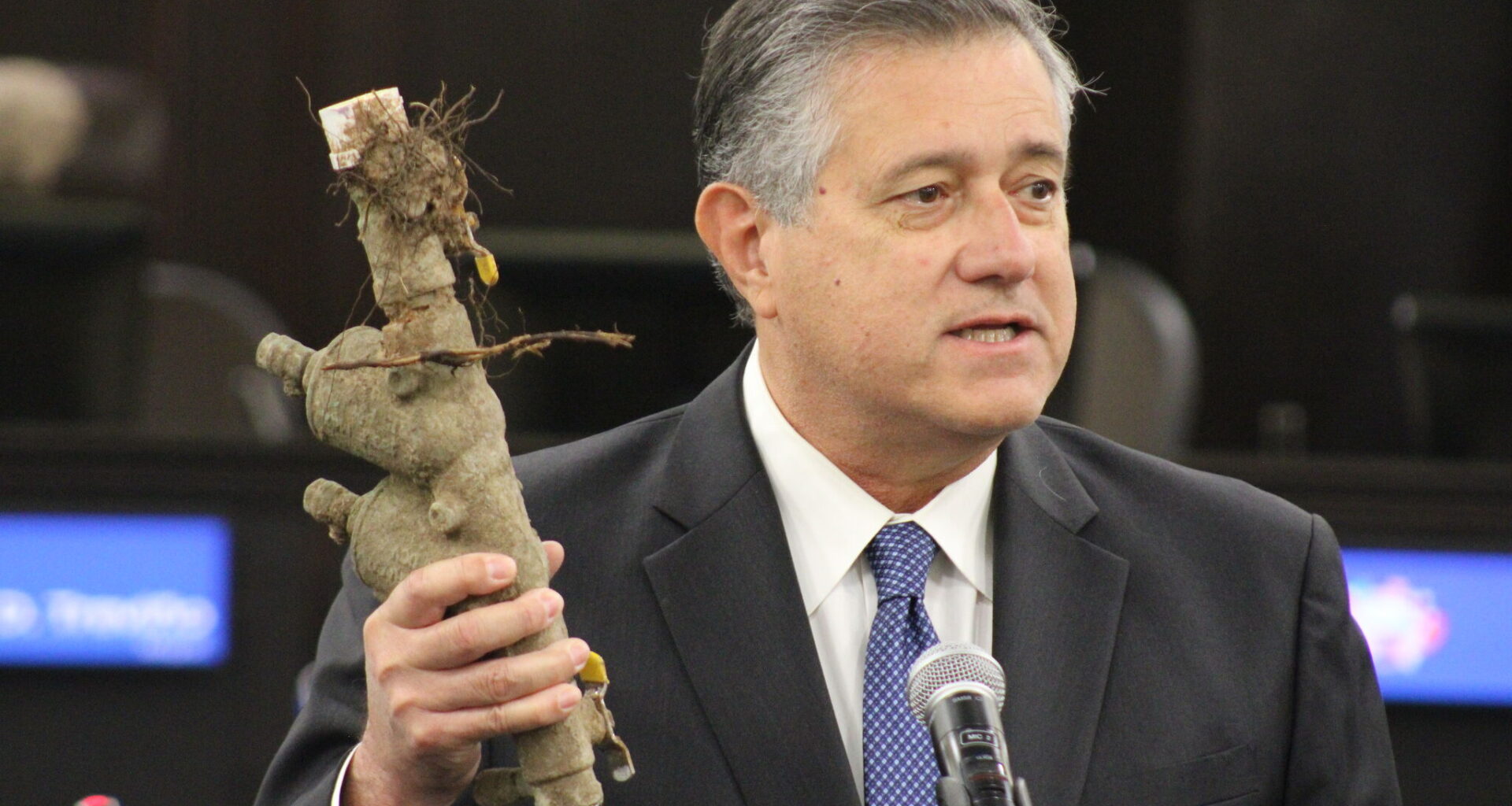
State Rep. Richard Raymond holds up the makeshift pieces responsible for a partial boil water notice on May 29, 2026, at City Hall.
David Gomez Jr. /Laredo Morning Times
Laredo Mayor Dr. Victor Trevino on May 29, 2026, at City Hall.
David Gomez Jr. /Laredo Morning Times
Laredo Mayor Dr. Victor Trevino holds up the makeshift pieces responsible for a partial boil water notice on May 29, 2026, at City Hall.
David Gomez Jr. /Laredo Morning Times
State Rep. Richard Raymond, utilities director Tareq Al-Zabet, Laredo Mayor Dr. Victor Trevino and public information manager Noraida Negron during a Q&A on May 29, 2026, at City Hall.
David Gomez Jr. /Laredo Morning Times
City officials said Friday a failed backflow prevention device at a single residence triggered last weekend’s partial boil water notice, while emphasizing that recent investments in Laredo’s water infrastructure helped contain the issue and prevent a citywide event.

Laredo Mayor Dr. Victor Trevino and utility officials outlined findings from the precautionary boil water notice that affected customers served by the Jefferson Water Treatment Plant from May 22-25.
Article continues below this ad
Officials stressed that the contamination was isolated to one home and was not caused by a failure at the Jefferson Water Treatment Plant or the city’s broader water distribution system.
“It happened in one address,” Trevino said. “It was a result of a backflow monitor.”
READ MORE: Laredo lifts boil water notice after additional tests clear system
Backflow prevention devices are designed to stop water from irrigation systems, swimming pools and other private plumbing connections from flowing backward into public drinking water lines. When functioning properly, they protect both homeowners and the public water supply from contamination.
Article continues below this ad
Trevino said the failed device allowed contaminated water to move back into the system, triggering a positive sample and a precautionary response from city officials.
“If that monitor doesn’t work, water from the sprinkler system or the grass or the swimming pool might return back to the city water and contaminate it with bacteria,” Trevino said.
Utilities Director Tareq Al-Zabet said the city’s monitoring system detected the issue during routine monthly testing. Once identified, crews isolated the affected service line, flushed and disinfected the area and disconnected the residence from the network.
According to Al-Zabet, the contamination was contained within hours.
Article continues below this ad
“Everything north and south of that house was negative,” Al-Zabet said. “There was no evidence whatsoever from the first hours that there was any broad contamination in the system.”
Al-Zabet stressed the three-day duration of the notice was not due to delays in the city’s response, but rather the time required to complete multiple rounds of bacteriological testing required by the Texas Commission on Environmental Quality.
City officials also pointed to more than $119 million in water system investments made since the citywide boil water notice in 2024 as a key reason the incident remained limited in scope. However, Trevino added the city needs around $800 million worth of investments in all.
Those improvements include new pipelines, upgrades to treatment facilities, pressure-control technology, expanded sampling capabilities and the separation of the city’s Jefferson and Pico water systems.
Article continues below this ad
Trevino said those upgrades allowed the city to limit the notice to customers served by the Jefferson plant rather than issuing a citywide advisory.
“The safeguards we put into place in 2024 are working,” Trevino said.
State Rep. Richard Peña Raymond echoed that message, describing the incident as a localized problem that was quickly identified and contained.
“This is the match that started the fire,” Raymond said while holding up the failed backflow device. “Thankfully, the match in this case got put out right away.”
Article continues below this ad
Raymond and city officials also emphasized that protecting the water system is a shared responsibility between government agencies, contractors, plumbers and property owners.
Officials said thousands of backflow prevention devices exist throughout Laredo, particularly at homes with irrigation systems. Trevino said property owners are responsible for ensuring those devices are properly installed, permitted and maintained.
“Government can do a lot, but government can’t do everything,” Raymond said. “You got to do your part too.”
Moving forward, Trevino said he plans to bring an item before City Council focused on public education, permitting requirements and compliance measures related to backflow prevention devices.
Article continues below this ad
Officials also said they intend to continue discussions with state regulators about developing more targeted responses in future incidents when contamination can be proven to be isolated.
For now, city leaders said the incident demonstrated both the importance of public vigilance and the benefits of recent infrastructure improvements.
“We detected early, contained quickly and verified rigorously,” Al-Zabet said. “That’s exactly how the system is supposed to work.”
Article continues below this ad