
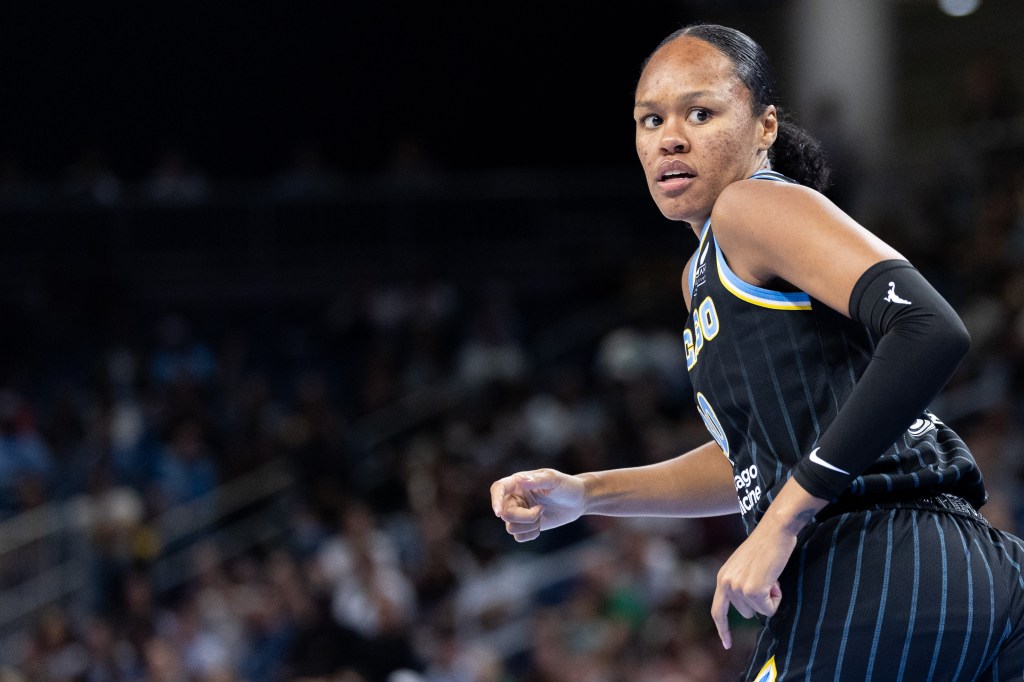
In the early weeks of the Chicago Sky’s season, Azurá Stevens was fed up.
The veteran forward was sick of sitting on the sideline. After suffering a bone bruise at the end of the Unrivaled season, she spent months away from the court, navigating a tumultuous free-agency period while also rehabbing a stubborn injury. But the lack of activity — of basketball — didn’t truly begin to wear on Stevens until she watched her teammates take the court earlier this month.
Stevens vented her frustrations to Courtney Vandersloot, her teammate of many years dating back to her first season with the Sky in 2020. This process was taking too long. Her knee hurt. Every day felt like a slog.
Vandersloot understood the feeling. The 37-year-old guard is 11 months into her own recovery from a torn ACL, dealing with her first major injury 16 years into her professional career. She gave the only advice that matters for an athlete: Keep going. The end is closer than it feels.
Those words offered little comfort as Stevens sat on the bench during the Sky’s season-opening win. They couldn’t quell the frustration and sheer boredom of her rehab routine. But when Stevens stepped onto the court last Saturday at Wintrust Arena, she looked up — at the championship banner she won with the Sky, at fans both familiar and new — and realized Vandersloot was right.
The time had passed. And finally, she was back home.
“Even though there’s a day-to-day grind and it can be really taxing, if you keep walking in and stacking days, before you know it you’re going to reach your goals,” Stevens told the Tribune. “It’s a blessing.”
None of this is new for Stevens. Her entire WNBA career has been defined by a staccato rhythm of injuries. She played only nine games in 2019 before requiring foot surgery. The next season, she logged 13 games before suffering a season-ending left knee injury. Subsequent seasons were disrupted by back, arm and knee injuries that chipped away at her availability.
Last season marked a triumphant milestone for Stevens — her first time playing (and starting) every regular-season game, averaging 28.4 minutes in 44 games for the Los Angeles Sparks. But that victory was immediately followed by an unlucky collision during the Unrivaled season.
A bone bruise is notably different from other lower-body injuries. It doesn’t reflect any fragility in a player’s knee, just the severity of impact that occurred at the point of contact. An athlete can take supplements and use strengthening exercises to relieve pressure on the aggrieved bone, but ultimately the only way to heal a bone bruise is to give it time.
So Stevens followed that advice. She rested and spent time with her family. She took a vacation to Jamaica. But no amount of relaxation could quiet the growing resentment toward her inability to play basketball, a gnawing ache that only grew worse as the Sky began playing real games.
“It’s really frustrating, I can’t lie,” Stevens said. “This one has tested my patience the most just because of the nature of the injury.
“But I think that everything has a purpose in my life. It’s hard to remember that in the day-to-day, but every time I’ve gone through an injury and looked back, it taught me so many things about myself and helped me grow as a person and a player.”
At this point in her career, Stevens has an intimate sense of how to recover from an injury. But in Chicago, the process has changed dramatically in the three years since she last played for the Sky. The team hired Jess Cohen as director of health and human performance and added eight new player performance staffers — including three athletic trainers and a massage therapist.
Stevens always felt the Sky cared deeply about injury recovery, but the team previously lacked the resources to provide players with holistic care during the rehab process. This time, that wasn’t true.
Stevens didn’t need to outsource any aspect of her recovery on her own. At times the Sky opted to use an outside physical therapist, but thanks to the team’s new downtown training location at UIC, it was easier to manage the logistics of seeking third-party care through the team. And she felt more confident in the expertise of staffers such as Cohen, who logged years in the NBA working with top-level resources and athletes.
“They’re not just winging it,” Stevens said. “It’s comforting having the new and improved staff. … I can really attest to the growth that’s happened here. It wouldn’t have been as easy a decision (to return to Chicago) if those resources weren’t here.”
Despite returning to the court last weekend, Stevens is still far from herself as she plays under a strict cap on her minutes.
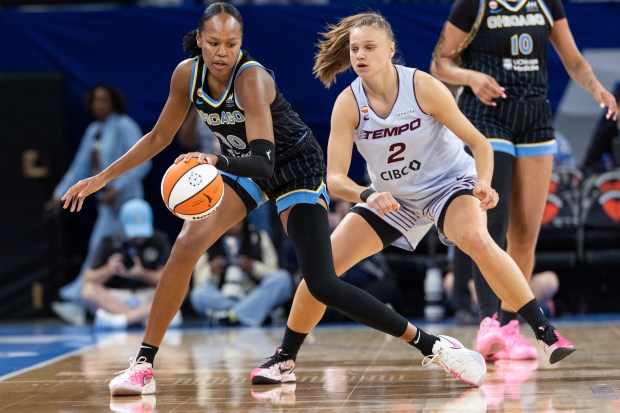 Sky forward-center Azurá Stevens works against Toronto Tempo forward Laura Juskaite during the first quarter on May 27, 2026, at Wintrust Arena. (Josh Boland/Chicago Tribune)
She’s embracing positivity during this final, frustrating portion of her recovery — for instance, focusing on how a minutes restriction can be a helpful exercise in efficiency.
“I’m not just going to be out there for 40 minutes making all these mistakes,” Stevens said. “You have to lock into the small details and get every minute right.”
But despite this optimistic outlook, the playing-time restriction is a cumbersome obstacle for both Stevens and coach Tyler Marsh.
She can’t play more than 16 minutes in a game, which translates into roughly four minutes per quarter. Marsh started Stevens on Wednesday against the Toronto Tempo, which meant the Sky had to endure a lengthy bridge period between quarters without her on the court.
“You just try to put her in a position where she can be successful in the limited minutes that she has,” Marsh said. “Don’t overdo it. Don’t overwork her. It gets a little tough in moments where you feel like you have some momentum generating and she’s getting her legs up under her, and then the next thing you know it’s time for her to come out.”
For now, both Marsh and Stevens are comforted by the fact these limitations are temporary. The Sky hope to gradually taper Stevens back into a full load of 25 to 28 minutes per game, although the team doesn’t have a set timeline for that buildup. And eventually, the Sky finally will play through their centerpiece star.
Stevens knows it’s a question of when, not if. Now all that’s left is the waiting — and the work.