
The Wagon Station Encampment is perhaps the most distilled expression of Zittel’s philosophy. Perched above a wash, 12 compact shelters reduce habitation to its essentials: a mattress, a shelf, and a few basic tools. Their curved doors open skyward, evoking both covered wagons and suburban vehicles. Guests — artists, writers, thinkers, hikers, campers — can access a communal outdoor kitchen, open-air showers, and composting toilets.
To stay in one is to experience a radical recalibration. The smallest details — light shifting across the interior, wind moving through the structure — become omnipresent.
The encampment feels part summer camp, part research station, part artwork.
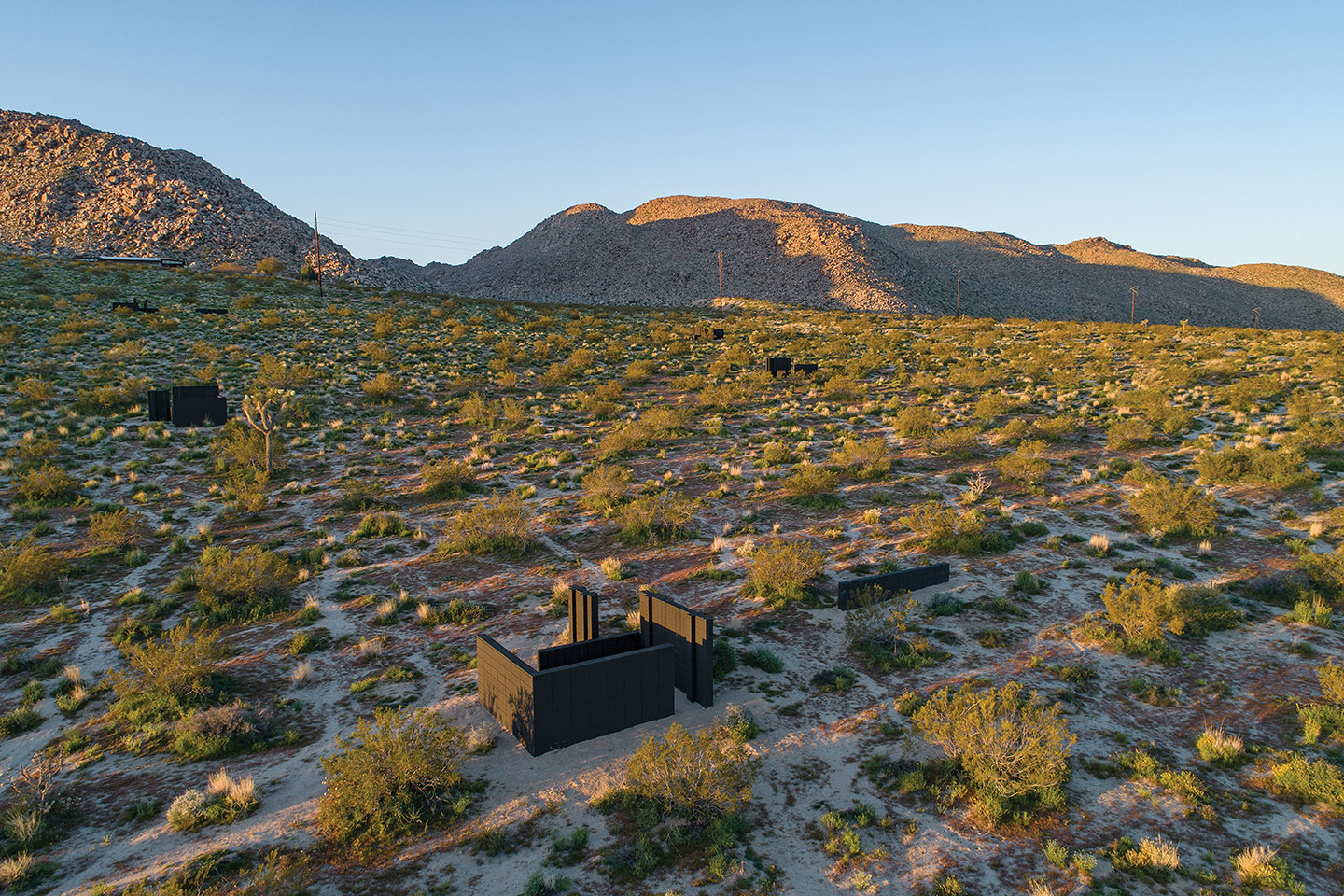
Below the compound, Zittel’s “Planar Pavilions” draw the language into the landscape — 10 black- painted cinder block structures that read as both ruins and frameworks. Artists activate them in different ways, including photographer An-My Lê, whose new work traces celestial movement across the desert sky.
Lê, based in Brooklyn and a professor at Bard College, first came to the desert nearly two decades ago to photograph military exercises at the Marine Corps Air Ground Combat Center for her landmark series 29 Palms. She returned last year as a HDTS fellow and, during her time here, created new images for her Dark Star series. Using a star-tracker to follow the movement of the night sky, she captured celestial arcs with striking precision. Earlier this year, the photographs were installed on the “Planar Pavilions,” amid the landscape that informed their creation.