
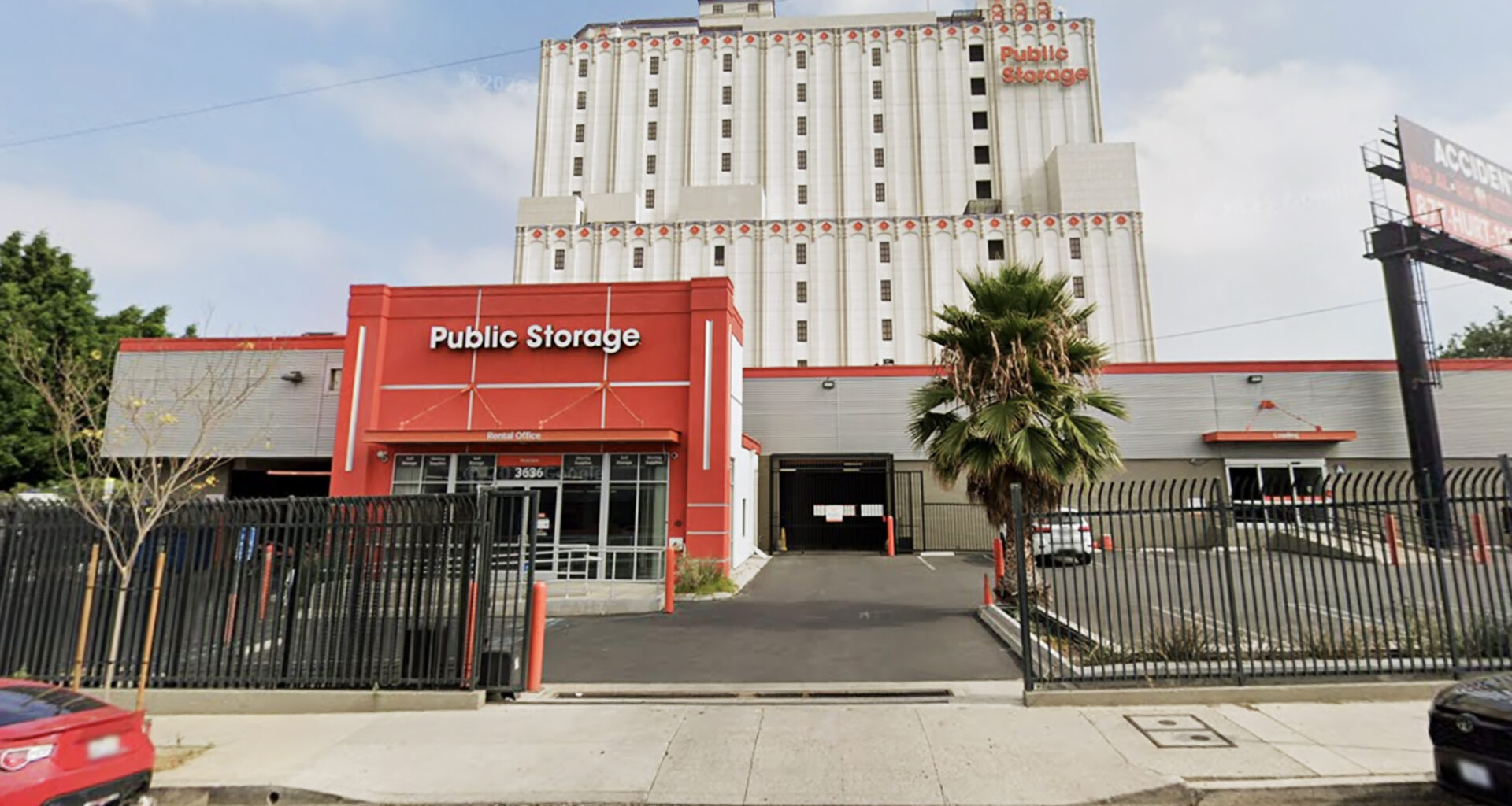
Storage facilities tend to be unremarkable buildings, spaces built for utility rather than beauty. But one towering Public Storage site in central Los Angeles was erected nearly a century ago with the express purpose of impressing passersby with its architectural bona fides. Much like the ornate former movie palace turned “evil CVS” over in East Los Angeles, this Public Storage building bears impressive art deco architectural hallmarks that were trendy in the 1920s.
This 13-story tower has always operated, more or less, as a storage facility. Yet for a spell, it bore a different distinction: as a Bacchanalian party haunt that was raided many times over during Prohibition.
When the company’s original president, James Bowen, first dreamed up the American Storage Building, he was determined to “have the finest storage warehouse in the West, if not the nation,” as the Los Angeles Times noted that same year. Bowen hired Arthur E. Harvey, an architect who designed various professional buildings and what later became the local Scientology Celebrity Centre in the Art Deco style, to design it. The American Storage Building officially opened its doors in 1928 with a huge ad in the paper, boasting that “The Most Beautiful Storage Building in the World” had finally arrived.
In addition to its storage facilities, the building also rented space to tenants, including the Bud Murray School for Stage. There, students could learn dance styles including ballet, soft shoe and “eccentric” alongside musical theater training. (Later, Hollywood star Jean Harlow became one of Murray’s students.) Soon, the building grew to include the Roof Garden Cafe, which billed itself as “Los Angeles’ Most Unique Supper Club” in newspaper ads from that era. The cafe hosted entertainers for dance competitions, orchestral performances and cabaret shows, as well as galas where movie stars rubbed elbows.
In late 1928, the penthouse became Thirteenth Heaven, a celestially themed establishment. An elevator attendant dressed as St. Peter would guide guests up to the 13th floor, where waiters dressed in angel wings and musicians wore clothes “intended to produce a spiritual illusion,” as the Los Angeles Times put it.
That Prohibition had been in effect for a near-decade did little to deter illicit fun on the American Storage Building’s top floor. The rooftop club later became the headquarters for the Los Angeles Press Club, which ran afoul of the law for apparently housing a beer-brewing operation there. When authorities raided the club in 1931, they found beer mash, hundreds of beer bottles and “a complete plant for making beer.”
In late 1931, the space rebranded once again as the Forty-One Club — a private penthouse club known as “one of the most notorious of Los Angeles night life haunts” for its sprawling bar and games of chance strewn throughout, and which attracted movie stars and other high-profile people. The Los Angeles Evening Express noted that the club was one of several underground haunts in LA that were regularly tipped off by authorities, which gave ownership enough time to hide bottles and gambling paraphernalia when cops later raided the place. That same year, the night chief of police issued a bulletin that a judge’s restraining order allowed the Forty-One Club to “operate its gaming tables wide open without police interference,” according to a report.
But in late 1931, federal authorities from San Francisco, plus a hell-bent cop from Santa Monica, finally charged ahead with a huge midnight raid on the Forty-One Club. Ahead of the sweep, the Santa Monica officer had gone undercover as a man swanning about town and nabbed a card to the exclusive Forty-One Club after showing up in classy evening wear. There, Prohibition agents found pricey booze worth $10,000 — or about $230,000 in today’s dollars — stashed in a “cleverly concealed cache hidden at the base of a hidden auxiliary elevator” inside the club. Fifteen people were arrested and charged with conspiracy to violate the Volstead Act, the club was shuttered and its furnishings were sold off.
After Prohibition was lifted in 1933, the American Storage Building’s notoriety faded with it. In the ensuing decades, the tower endured more ordinary uses, such as being office space for a telephone company, until — in a full-circle move — it eventually landed in the hands of Public Storage.
Today, the hulking building on Beverly Boulevard just north of Koreatown remains a curious sight for casual observers, with its orange diamond detailing and thoroughly out-of-place appeal. Much like Long Beach’s giant blue pyramid, it’s the sort of building, easily seen while crawling along on the freeway, that makes drivers wonder. A few years ago, ownership opted to renovate the place, but kept its exterior art deco glory intact — a nod to a time when it was perhaps the most beautiful, and certainly the most interesting, storage facility around.