
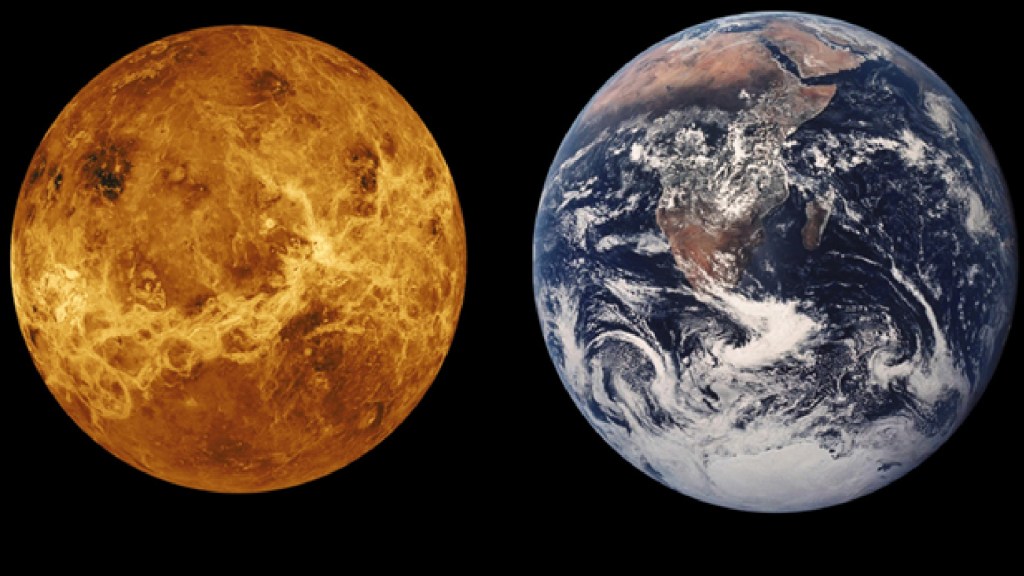
Venus is often referred to as Earth’s “sister planet” due to its comparable size and rocky composition, but its rotation sets it apart as one of the most mysterious worlds in our Solar System. While Earth and most other planets rotate counterclockwise (when viewed from above their north poles), Venus’s clockwise spin means its rotation is not just slow—it’s backwards, a phenomenon that puzzles scientists.
The Strange Spin of Venus
In a remarkable cosmic twist, Venus spins so slowly on its axis that a single day on the planet actually lasts longer than an entire year. Scientists confirm that one rotation—known as a Venusian day—takes about 243 Earth days. In contrast, Venus completes a full circuit around the Sun in just 225 Earth days.
This means sunrise to sunrise on Venus outpaces its annual orbit, a rarity in the Solar System that continues to intrigue astronomers. Even more confounding, Venus rotates in the opposite direction compared to most planets—a retrograde spin that causes the Sun to rise in the west and set in the east.
The Implications of Venus’s Slow Spin
This unusual rotation has dramatic impacts. Because of the planet’s slow spin, Venus endures long periods of blistering daylight followed by equally extended nights. Each day and night lasts for months on end, subjecting the planet’s surface to extreme heating and cooling cycles.
Temperatures on the surface can reach a scorching 470°C (880°F)—hot enough to melt lead—while the atmospheric pressure is more than 90 times that of Earth, equivalent to being deep beneath the ocean on our own planet.
Venus’s thick, carbon dioxide-rich atmosphere acts like a thermal blanket, trapping heat and making it the hottest planet in the Solar System, despite not being the closest to the Sun. The planet’s slow rotation also fuels bizarre wind patterns: high above the surface, winds whip around the planet at speeds up to 360 km/h (224 mph), racing far faster than the planet itself turns.
These super-rotating winds help distribute heat, but they also contribute to violent weather systems and immense cloud cover, making Venus a challenging world to observe and explore.
Unlocking the Secrets: What Makes Venus Tick?
Scientists are still piecing together why Venus spins so slowly and backwards. Some theories point to ancient collisions with massive celestial bodies or gravitational tugs from neighboring planets that could have flipped the planet’s rotation eons ago.
While the exact sequence of events remains uncertain, Venus’s strange day-night cycle is a window into the chaotic processes that shaped our Solar System.
Despite Venus’s hellish surface conditions, new missions are in the pipeline. NASA’s VERITAS and the European Space Agency’s EnVision are set to launch later this decade, aiming to map Venus’s surface in unprecedented detail and study its unique atmosphere.
These missions hope to unravel the history and mechanisms behind its mind-bending day-night cycle, offering clues about planetary evolution, climate change, and even the possibility of past habitability. Insights gained from Venus may shed light on how planetary climates evolve—and whether similar fates could threaten planets elsewhere, including our own.
Venus stands as a testament to the diversity and complexity of planetary systems, reminding us that our Solar System is full of surprises waiting to be discovered.