
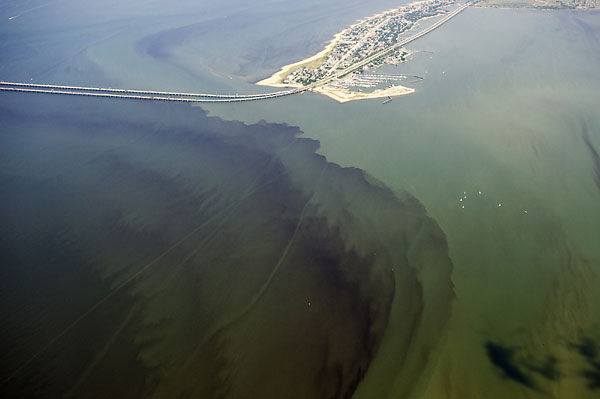
Coastal scientists expect the Chesapeake Bay will experience one of its milder dead zones in recent decades this year.
Lower than average precipitation this year meant lower river flows, and in turn, less dead zone-contributing nitrogen entered the watershed, according to the Chesapeake Bay 2026 Hypoxia Forecast released this month.
Dead zones consist of low-oxygen areas, known as hypoxia, which create difficult survival conditions for blue crabs, oysters, fish and other marine life. Hypoxia occurs when an excess of nutrients makes its way to the bay, forming large algal blooms, which eventually die and consume oxygen from the water. Warming temperatures and fluctuating rain patterns can intensify conditions.
Dead zone severity is forecast to be about 31% less than average, potentially making this year one of the least severe years since 1985. That’s according to the hypoxia forecast from William & Mary’s Batten School of Coastal and Marine Sciences and the Virginia Institute of Marine Science, the University of Maryland Center for Environmental Science and FlowWest, a science and engineering consulting firm.
With less-than-average precipitation and the entire commonwealth experiencing some level of drought conditions in April, stream and river flows to the Chesapeake Bay at the beginning of this year were 32% lower than the long-term average.
“Lower nitrogen loads entering the bay this spring are expected to translate into better oxygen conditions for fish, crabs, oysters and other bay life this summer,” said Aaron Bever, an environmental scientist with FlowWest, said in a release.
Long-term efforts to reduce nutrient runoff are working, according to W&M’s Batten School and VIMS. Marjy Friedrichs, a professor at the Batten School and VIMS, said cleaning wastewater treatment plants, as well as reducing fertilizer on bay-front properties and farms have improved the Chesapeake Bay’s habitat.
“Over the past 30, 40 years, we’ve really made tremendous progress on reducing the amount of nutrients coming into the bay,” Friedrichs said. “We knew that eventually the nutrient reductions were going to have an effect, but it takes a long time to see.”
In 2023, scientists recorded the smallest dead zone in the Chesapeake Bay since recording began in 1985. A mild dead zone means a cleaner, healthier bay, Friedrichs said, increasing the likelihood of catching a fish, and decreasing the chances of algal blooms in swimming spots.
Regardless of the favorable forecast, heavy rainfall, heat waves or extended calm periods still guide the size and duration of dead zones. They can also develop more easily with the effects of climate change, such as increases in air and water temperatures, according to VIMS.
“What we see in the bay is really a response to both climate change, as well as the nutrient management and the hotter summers, which we continue to see negatively impact the bay, and the dead zones appear earlier, last longer,” Friedrichs said. “But nutrient reductions’ impact on the bay is really overwhelming the negative side due to warming and climate change.”
Maggie Allwein, 757-672-3310, maggie.allwein@virginiamedia.com