
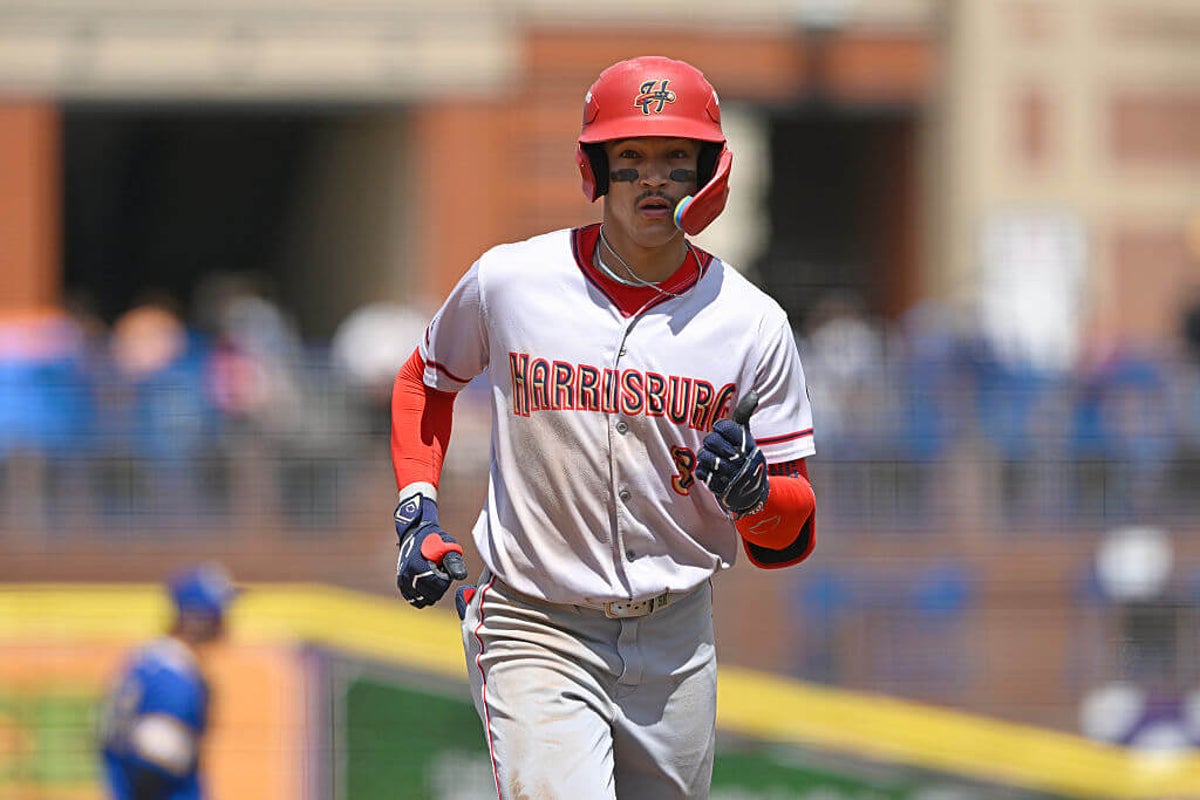
The Washington Nationals just wrapped up their best month in almost three years, so perhaps their farm system has receded to the back of your mind. It probably shouldn’t.
Their pitchers are throwing harder and missing more bats. Their hitters are lifting the ball more — a lot more — and chasing less. Team executives and coaches across levels are communicating more than ever before. While that means marathon meetings, the organization has never been more aligned. At every level, they’re now assigning the same homework, employing the same format in hitters’ meetings, and speaking the same language.
“Gosh, I’m probably talking to 25 to 30 people a day,” High-A Wilmington hitting coach Hudson Byorick said. “But … when guys come up from Fredericksburg, their plan doesn’t change. When someone goes up to Double A, it’s the same. Like, ‘This is what a player was doing, this was working for him, this is what happened when I communicated this to him on deck.’”
It is helping them thrive at both ends of the developmental arc. This week, Wilmington and Class-A Fredericksburg matched their home run totals from 2025. And the Nationals? They just completed their first month with a groundball rate under 40 percent since June 2019.
All stats are as of the start of play Sunday
Seaver King (INF)
Current level (age): Triple-A Rochester (23)
The Athletic’s rank: No. 36 on The Athletic’s updated Top 50
What he’s doing: Making better swing decisions and playing different positions
What it means: A 2026 MLB debut is possible… with some caveats
On Friday, two weeks after he was promoted to Triple A, King finally failed to reach base. It was the first time he failed to do so this season. His OPS is up 350 points from last year. There’s a lesson here about being patient when a player is bright, athletic and had just one year in Division I ball.
Swing decisions are the key driver here. King’s chase rate is down around 30 percent after it was up near 40 percent last year, which is all the more encouraging when you consider that he is swinging more frequently than he did in April.
Defensive consistency remains a work in progress. He’s still making elite plays, but the team is working with him on his footwork, which should help his arm accuracy. Several evaluators who spoke to The Athletic believed that footwork was fixable, and said they aren’t ready to rule out a big-league future at short, though the org will have him play second and third in Triple A.
The Nationals will promote him when it is the best thing for his development, not just when his numbers look good or a spot opens up on the roster. It’s about what will help King become the best player he can be, not just what helps the Nationals at an immediate moment.
Still… that could be later in 2026.
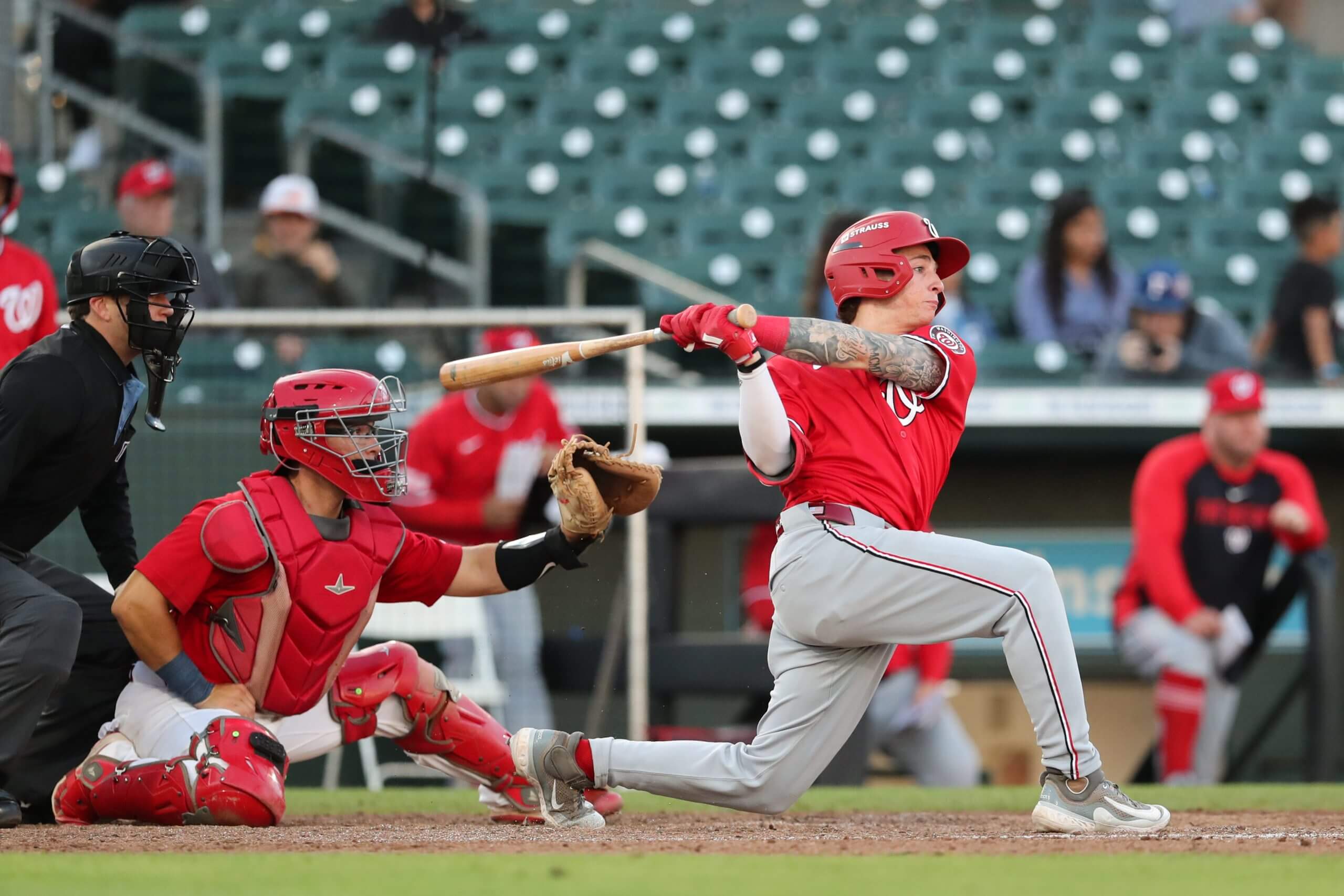
By hitting the ball in the air more, Devin Fitz-Gerald may have turned himself into a Top 100 prospect. (Jared Blais / MLB Photos via Getty Images)
Devin Fitz-Gerald (INF)
Current level (age): High-A Wilmington (20)
The Athletic’s rank: Preseason No. 12 in the Nats’ Top 20, expected to have a spot in Keith Law’s next Top 100
What he’s doing: Lifting the ball
What it means: He’s a Top 100 prospect now
Those who were bearish on Fitz-Gerald saw a small player who needed to add strength. When the Nationals evaluated Fitz-Gerald ahead of the MacKenzie Gore trade this winter, they saw a diligent worker and intelligent hitter with traits that were hard to teach. This, though?
He has an OPS over 1.000. His 12 homers are tied for the most in the system. He is pulling more baseballs in the air without sacrificing his exceptional bat-to-ball skills. He will still have to add strength in future years, but it hasn’t been any sort of issue yet. Why?
The Nationals have told him to — pardon the language — “get naked” early in counts, which means he should swing out of his clothes (or swing with intent) early in his at-bats before shortening up with two strikes. Teammate Ethan Petry played with Detroit Tigers rookie Kevin McGonigle in the Arizona Fall League, and said Fitz-Gerald’s approach, skills and consistency are strikingly similar.
Alex Clemmey (LHP)
Current level (age): Double-A Harrisburg (20)
The Athletic’s rank: Preseason No. 10 in Nats’ Top 20
What he’s doing: Rediscovering his arm slot and his athleticism
What it means: He can become the player the Nats hoped he would be when they traded for him
Clemmey’s funky delivery was one of the primary reasons the Nationals acquired him from Cleveland two years ago. Over the next 18 months, though, there was some regression as his delivery became more static. He walked a ton of batters. His velocity plateaued. Now, he’s back.
Rather than forcing Clemmey’s funky delivery into becoming a picture-perfect, repeatable endeavor, the Nationals have helped him tap back into his athleticism. Pitchers at many of their levels — Cade Cavalli and Jake Irvin in the majors — work on their “athletic throwing” before games, helping them find range so their bodies can throw hard without metronomic mechanics.
It has helped a number of their arms add velocity across the minor leagues. For Clemmey, the athletic movement has as much to do with velocity as it does with command. It’s a small sample, but he has walked six batters over his last 17 1/3 frames. He walked 26 batters over his first 23 innings this year.
Also worth noting: The Nationals have recently installed a new set of high-speed GigaPitch cameras at each of their affiliates — when I was in Wilmington they had installed one the day before — which helps them capture better looks at pitchers’ grips and release points. This could also help Clemmey and others become more consistent.
Ethan Petry (1B/OF)
Current level (age): High-A Wilmington (21)
The Athletic’s rank: Preseason No. 13 in Nats’ Top 20
What he’s doing: Leading the hitters’ meetings in Wilmington and swinging less
What it means: He’s slugging the crud out of the ball
Spring training was tough on Petry’s body, and tougher on his mind. He struggled, in part, because there were no advanced reports during camp. And so, when Opening Day rolled around and he got his first report, it was as if someone lifted all of the tension out of his 6-foot-4 frame.
“I started calming down because I started seeing percentages,” Petry said, referencing the team’s pre-game reports.
Teams rarely select a lumbering first baseman in the first couple rounds of the draft, unless there is an exceptional secondary trait. Early on, the Nationals identified Petry as one of the most intelligent players in last year’s class. In Wilmington’s hitters’ meetings, he has helped lead the way for right-handed hitters, while Fitz-Gerald does the same for left-handed hitters.
This spring, the Nationals worked with Petry to develop a more patient approach. In April, that meant he frequently struck out looking — “which I’m OK with,” Petry said, because “I can live with someone throwing a fastball on the black.” He had a .454 on-base percentage that month. Now that he’s confident in his decisions, the walks have gone down — but the power is way, way up. He has a .629 slugging percentage in May. His .962 OPS is among the org’s best.
Eli Willits (SS)
Current level (age): Single-A Fredericksburg (18)
The Athletic’s rank: No. 31 on The Athletic’s updated Top 50
What he’s doing: Hitting the ball harder
What it means: You can start to project some power
Willits has one of the highest walk rates in the minor leagues. He has the longest at-bats of anyone in the organization. He has swiped 28 bases in 42 games. But if you’re looking for something new — because, frankly, that was all on the scouting report before — it’s that he is packing a punch.
His max exit velocity is up to 110.3 mph this year, up significantly from last year. That’s no small feat from an 18-year-old who still has more strength to put on. He’s also hitting the ball in the air more often, which hasn’t come at the expense of his bat-to-ball skills.
Talk to anyone who has spent time around Willits and they’ll pretty quickly mention his drive. Heck, it’s probably fair to call it obsession. Last year’s No. 1 pick is trying to make something out of every single play. His stated goal — make the majors as a 20-year-old — feels more realistic by the day.
Here are five more players and one position group who are harder to read but notable nevertheless:
Yohandy Morales (Triple-A Rochester, 24): Morales has a 1.027 OPS, but a lot of the underlying metrics are pretty similar to last year. He has increased his attack angle a bit, and is making harder contact when he lifts the ball. But he still needs to work on his in-zone whiff, chase rate and groundball rate before the Nationals feel comfortable with a promotion. (Unranked in the Nationals’ Top 20)
Jack Moroknek (Class-A Fredericksburg, 22): When former scout Blair Henry went to Butler last year, he could not understand why there weren’t more scouts around Moroknek. He was big. He could run. His upper body was projectable, with some tweaks to make to the lower half. They identified impressive exit velocities. Now, the 2025 11th-rounder has a 1.007 OPS. (Unranked in the Nationals’ Top 20)
Isaac Lyon (Double-A Harrisburg, 22): Lyon was the lesser-known prospect acquired in the Jose A. Ferrer trade this winter, but has already been promoted twice this season. Before the trade, he could manipulate the baseball as well as anyone in the organization but averaged 90.6 on his heater. He is now sitting 92.5 mph. Given his productivity with an extreme East-to-West profile, the organization is trying to figure out whether Lyon is a starter or a reliever. (Unranked in the Nationals’ Top 20)
Robert Cranz (Double-A Harrisburg, 23): The best strikeout-to-walk ratio in the organization belongs to a former seventh rounder who has overhauled his arsenal. Last season, the fastball was elite, but the secondary pitches… well, the slider averaged 81 mph and the curveball sat 75. Now, the slider is 88 and the curveball is 81. The slider has a whiff rate near 50 percent. (Unranked in the Nationals’ Top 20).
Luis Perales (Triple-A Rochester, 23): Expect the Nationals to be patient with his promotion. A key example: His cutter is exceptional, but is getting hit hard because it’s the only pitch he can regularly command for strikes right now. He had thrown just 9 1/3 innings above High-A coming into 2026. He has a 3.05 ERA, but he just needs more time. (No. 9 in the Nationals’ Top 20)
Rochester pitchers: They are second among Triple A teams in fastball velocity (17th last year), seventh in whiff rate (23rd last year) and, in May, fifth in opponent contact quality (30th in 2025).