
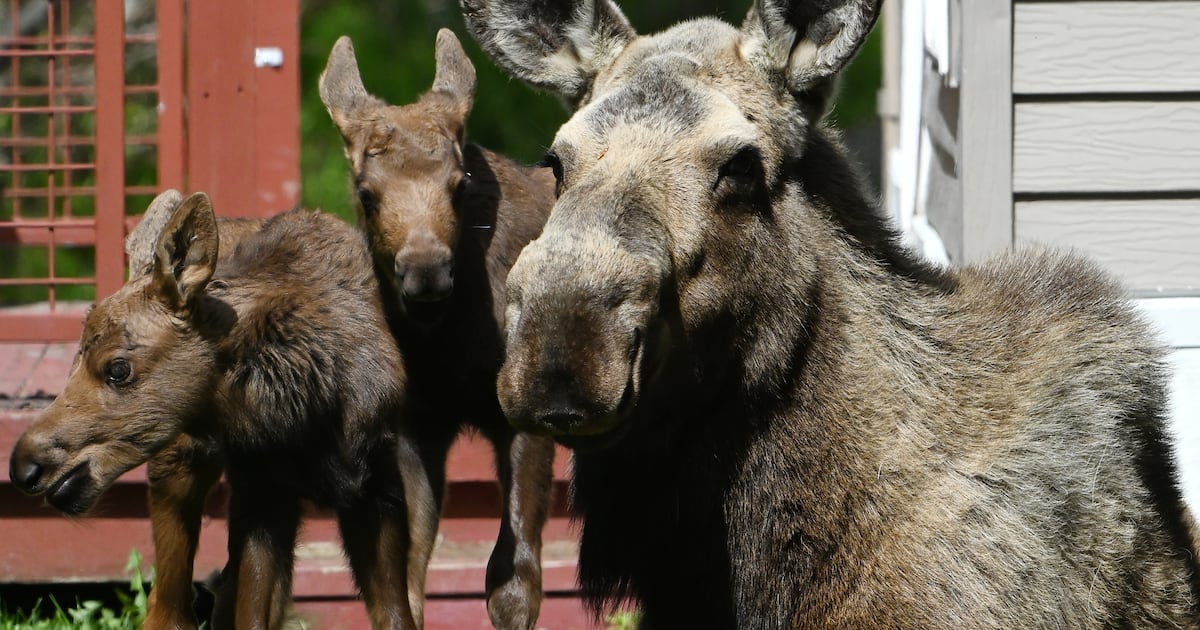
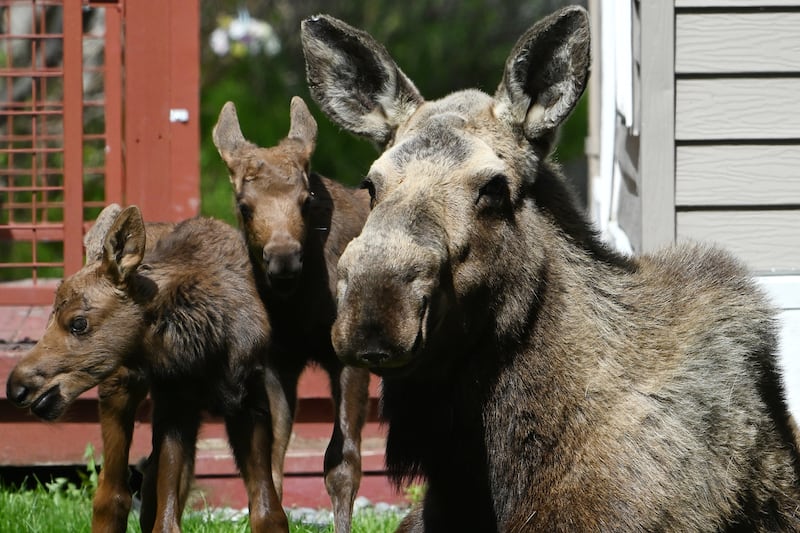
 A cow moose rests while tending to her twin calves in East Anchorage on Monday, June 1, 2026. (Bill Roth / ADN)
After several recent moose attacks in Anchorage involving people who got too close to calves, wildlife officials are recommending ways to avoid the dangerous encounters.
Since Memorial Day weekend, five people have suffered minor injuries in encounters with cow moose that occurred in the city’s green spaces, according to Alaska Department of Fish and Game biologist Cory Stantorf. No one has been injured since that weekend, he said.
“The common denominator between all these is people inadvertently getting too close to cows with newborn calves,” Stantorf said.
He wasn’t able to immediately provide a list of the locations where the encounters occurred.
After the attacks, wildlife officials issued guidance for those who spend time outside in case they encounter newborn wildlife or protective parents during the spring or early summer.
Anchorage Animal Care and Control also briefly closed the municipality’s Elmore Road shelter on Monday afternoon after a cow moose was spotted nursing her calf near the facility’s entrance and later became “(v)ery protective” of the young moose.
Animal control officials said at about 3:15 p.m. that the two moose moved on but still asked the “public to come and go with extreme caution.”
Singletrack or brushy trails with poor visibility should be avoided during this time of year to lessen the chance of wildlife run-ins, Cynthia Wardlow, Fish and Game’s regional supervisor, said in the guidance, which was released Friday.
Newborn moose calves are unable to run from predators, pets or people, which makes cows likely to defend their offspring, she said. For those who come upon a moose calf or bear cub, officials suggest backing away and leaving in the direction they came from.
Young wildlife found by themselves should be left alone, while people should carefully navigate around a moose that is blocking a trail or wait until they pass, the department said. Never approach wildlife to take pictures, officials added. Dogs should be kept on a leash.
“The best relationship with wildlife is a long-distance one,” Stantorf said.
Warning signs that a moose may attack include the animal licking its lip, pinning its ears back or raising its hackles to give it a “fluffy” appearance, he said. Sometimes, a moose will even emit a low growl when feeling threatened.
“For those first couple weeks of (a calf’s) life, Mom’s defense is to stand her ground and fight to protect those calves. Whether or not it’s a real threat or a perceived threat, her reaction is the same to that,” he said. “Right now, assume that any cow moose you come across is likely to have calves.”
One of the recent attacks occurred near an Anchorage school, Stantorf said. Officials who responded to the scene killed a cow moose because the animal was not allowing them to escape, he said. The calf was taken away “and put into placement” to be cared for, Stantorf said.
Another attack involved an unleashed dog, though he said it was unclear what role the canine played in the incident.
There are typically between six and 12 reported moose attacks every spring in the Anchorage area, he said.
When threatened by a moose, Stantorf said you should get behind a solid object, like a tree or vehicle, and stay behind it until safe.
If the moose makes physical contact, he recommended getting to the ground and rolling over to protect your head and neck until it is clear the animal has moved on, before calling for help.
Officials asked anyone who sees a young animal that appears to have been left alone for more than 48 hours to contact their nearest Alaska Department of Fish and Game office or to report it online at adfg.alaska.gov by clicking the “Report a Wildlife Encounter” button.
Those who encounter a moose they believe is acting unusually or behaving aggressively should also report that to their local Fish and Game office or online.
Emergencies should be reported by calling 911, according to wildlife officials.