
United States Personalized Medicine Market Forecast Signals a New Era of Healthcare
The healthcare industry in the United States is undergoing a transformational shift as personalized medicine becomes one of the most influential trends shaping the future of patient care. Unlike traditional treatment approaches that apply standardized therapies to broad patient populations, personalized medicine focuses on tailoring treatments based on an individual’s genetic makeup, lifestyle, environmental influences, and disease characteristics.
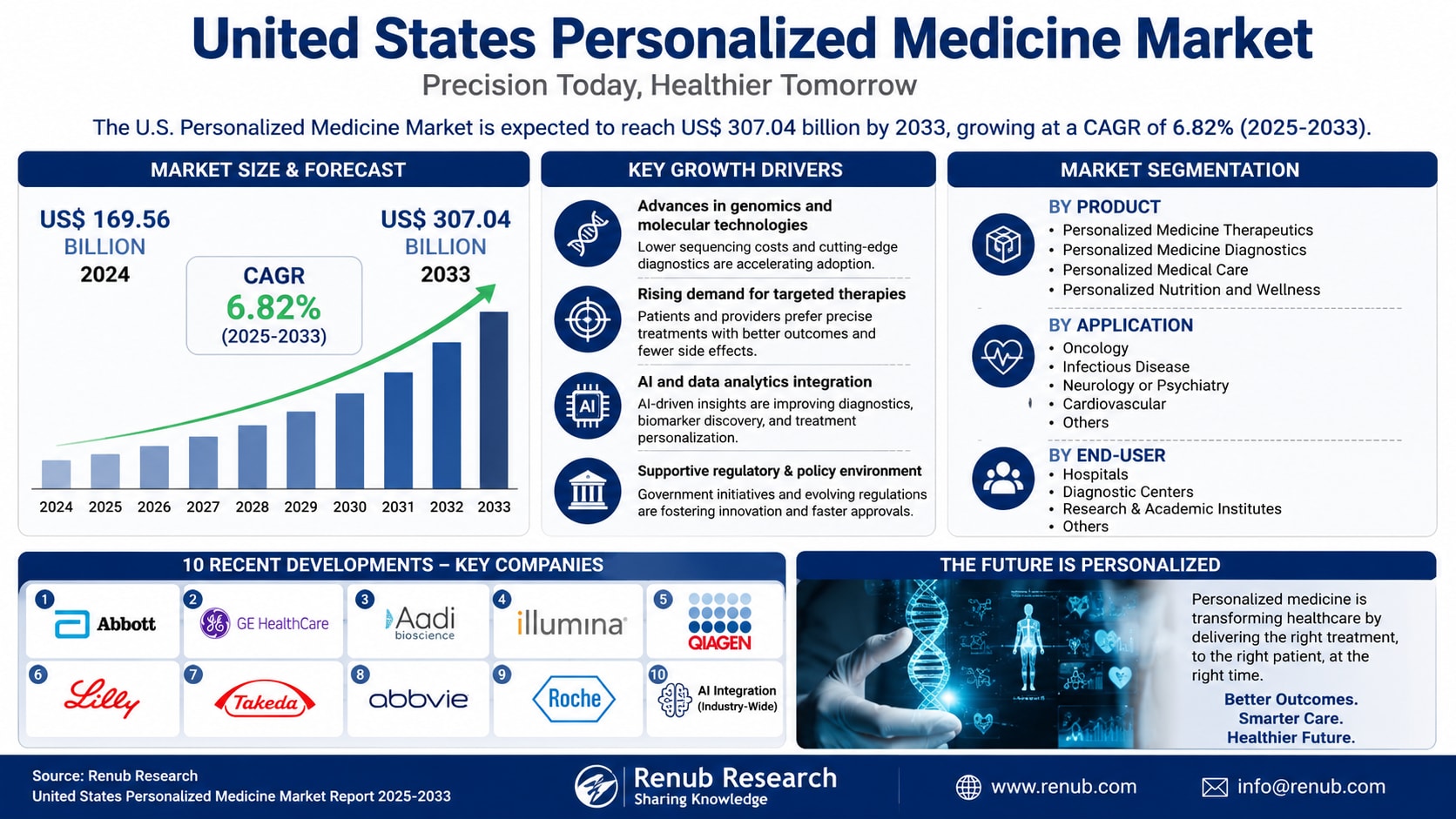
According to Renub Research, the United States Personalized Medicine Market is projected to grow from US$ 169.56 billion in 2024 to US$ 307.04 billion by 2033, expanding at a CAGR of 6.82% during 2025–2033.
Personalized Medicine Is Transforming the Traditional Healthcare Model
For decades, medical treatment largely followed a one-size-fits-all approach. Physicians prescribed therapies based on population averages, often resulting in varying levels of effectiveness among patients.
Personalized medicine changes this paradigm by leveraging genomic data, biomarkers, molecular diagnostics, and advanced analytics to create individualized treatment plans. This approach allows healthcare providers to identify the most effective therapies for specific patients while minimizing unnecessary treatments and potential side effects.
As scientific understanding of human genetics continues to evolve, personalized medicine is moving beyond niche applications and becoming a mainstream healthcare strategy across multiple therapeutic areas.
The growing emphasis on predictive, preventive, and precision healthcare is expected to remain a major catalyst for market growth throughout the forecast period.
Genomic Technology Innovations Continue to Drive Market Expansion
One of the most powerful growth drivers behind the U.S. personalized medicine market is the rapid advancement of genomic and molecular technologies.
The emergence of next-generation sequencing (NGS), advanced molecular diagnostics, and bioinformatics platforms has significantly improved scientists’ ability to understand complex genetic variations associated with disease development and treatment response.
Genome sequencing that once required years and millions of dollars can now be completed within days at a fraction of the historical cost. This accessibility has enabled hospitals, diagnostic laboratories, and research institutions to integrate genomic testing into routine clinical practice.
Healthcare providers can now identify disease-causing mutations, predict patient responses to medications, and design highly targeted treatment strategies. As genomic technologies become increasingly affordable and scalable, their adoption is expected to expand across both specialized and community healthcare settings.
Rising Demand for Targeted Therapies Is Accelerating Adoption
Patients and healthcare providers are increasingly seeking treatments that offer higher effectiveness and fewer adverse effects.
Targeted therapies represent one of the most visible applications of personalized medicine. These therapies are designed to interact with specific genetic mutations or biological pathways involved in disease progression.
Rather than exposing patients to broad-spectrum treatments that may have limited effectiveness, targeted therapies focus on precise molecular mechanisms responsible for disease.
This trend is especially evident in oncology, where genomic profiling helps physicians identify specific mutations and select therapies tailored to individual tumor characteristics. Similar advancements are occurring in autoimmune disorders, cardiovascular diseases, diabetes management, and neurological conditions.
As awareness of personalized treatment benefits grows among patients and clinicians, demand for targeted therapeutic solutions continues to rise across the United States healthcare system.
Artificial Intelligence Is Strengthening Precision Healthcare Capabilities
Artificial intelligence (AI) and machine learning are emerging as critical enablers of personalized medicine.
Healthcare organizations generate vast amounts of clinical, genetic, imaging, and patient-generated data. AI-powered platforms can analyze these complex datasets to identify patterns that would be difficult for humans to detect.
These technologies assist healthcare providers in:
Predicting disease risk
Identifying potential treatment responses
Discovering novel biomarkers
Enhancing diagnostic accuracy
Supporting clinical decision-making
AI is also accelerating drug discovery processes by helping researchers identify potential therapeutic targets and optimize clinical trial designs.
As digital health technologies continue to mature, AI-driven precision medicine solutions are expected to play an increasingly significant role in shaping the future of healthcare delivery.
Oncology Remains the Leading Application Area
Cancer treatment remains one of the most successful and widely adopted applications of personalized medicine.
Traditional cancer treatments often rely on standardized chemotherapy protocols that may produce inconsistent results among patients. Personalized oncology, however, uses genetic and molecular profiling to identify specific mutations driving tumor growth.
This information enables oncologists to select therapies that target the underlying biological mechanisms of each patient’s cancer.
Companion diagnostics have become particularly important in oncology, helping physicians determine whether patients are likely to benefit from specific treatments before therapy begins.
The growing prevalence of cancer, combined with advances in genomic profiling and targeted therapeutics, continues to make oncology the dominant segment within the personalized medicine market.
As research expands into rare cancers and treatment-resistant tumors, the role of personalized medicine in oncology is expected to strengthen even further.
Government Support Continues to Encourage Innovation
Government initiatives and regulatory support are playing an essential role in fostering personalized medicine adoption throughout the United States.
Federal agencies have implemented programs designed to accelerate precision medicine research, improve genomic data collection, and encourage collaboration between public and private organizations.
Regulatory frameworks are also evolving to accommodate companion diagnostics, targeted therapies, and innovative treatment approaches. These efforts help streamline approval processes while maintaining patient safety standards.
In addition, government-funded research initiatives have contributed to the development of large-scale genomic databases that support scientific discovery and clinical innovation.
Such supportive policies create a favorable environment for healthcare organizations, biotechnology companies, and pharmaceutical manufacturers seeking to develop next-generation precision medicine solutions.
Personalized Diagnostics Are Becoming Essential Clinical Tools
Diagnostic technologies form the foundation of personalized medicine.
Before tailored therapies can be prescribed, healthcare providers must understand the biological characteristics of individual patients and their diseases. Personalized diagnostics enable this understanding through advanced testing methods that identify genetic variations, biomarkers, and disease-specific molecular signatures.
Modern diagnostic tools assist physicians in:
Detecting diseases earlier
Improving diagnostic precision
Monitoring treatment effectiveness
Predicting patient outcomes
Supporting preventive healthcare strategies
The increasing availability of sophisticated diagnostic technologies is helping healthcare providers make more informed treatment decisions while reducing healthcare inefficiencies.
As healthcare systems prioritize value-based care models, personalized diagnostics are expected to become even more important in clinical practice.
Challenges Continue to Impact Market Growth
Despite significant progress, several challenges continue to influence the growth trajectory of the personalized medicine market.
High Development and Treatment Costs
Developing personalized therapies requires substantial investment in research, clinical trials, genomic analysis, and regulatory approvals. Many advanced treatments, including gene therapies and biologics, remain expensive for both healthcare providers and patients.
Additionally, reimbursement frameworks are still evolving, creating financial barriers to widespread adoption.
Data Privacy and Security Concerns
Personalized medicine relies heavily on patient genetic information and health records. Protecting sensitive data from cyber threats and unauthorized access remains a critical challenge.
Healthcare organizations must maintain robust cybersecurity systems while complying with increasingly stringent privacy regulations.
Workforce and Infrastructure Limitations
The successful implementation of personalized medicine requires trained specialists, including genetic counselors, bioinformaticians, molecular pathologists, and precision medicine experts.
Many healthcare facilities continue to face shortages of qualified professionals and technology infrastructure capable of supporting advanced genomic healthcare services.
Hospitals and Diagnostic Centers Are Leading End-User Adoption
Hospitals remain among the largest adopters of personalized medicine technologies due to their extensive patient populations and advanced clinical capabilities.
Major healthcare systems increasingly integrate genomic testing, companion diagnostics, and precision treatment programs into routine care pathways.
Diagnostic centers are also experiencing significant growth as demand for molecular testing and genetic analysis continues to increase.
Research and academic institutes play a crucial role as well, driving innovation through clinical trials, translational research, and collaborative partnerships with biotechnology and pharmaceutical companies.
Together, these end-user segments form the backbone of the personalized medicine ecosystem in the United States.
10 Recent Developments from Leading Personalized Medicine Companies
1. Abbott Laboratories
Abbott continues expanding its molecular diagnostics portfolio, focusing on advanced testing platforms that support precision healthcare initiatives.
2. GE Healthcare
GE Healthcare has strengthened its AI-powered imaging and diagnostic solutions to improve personalized patient management and disease detection.
3. Aadi Bioscience
Aadi Bioscience continues advancing targeted therapies designed to address rare cancers and genetically defined patient populations.
4. Illumina
Illumina has expanded next-generation sequencing capabilities, improving affordability and accessibility of genomic testing.
5. QIAGEN
QIAGEN continues enhancing companion diagnostic solutions that support precision oncology treatment decisions.
6. Eli Lilly and Company
Eli Lilly has increased investments in biomarker-driven drug development programs and precision therapeutics.
7. Takeda Pharmaceutical Company
Takeda is expanding genomic research partnerships to accelerate personalized treatment discovery.
8. AbbVie
AbbVie continues leveraging genetic insights to develop targeted therapies across immunology and oncology segments.
9. F. Hoffmann-La Roche
Roche has strengthened its integrated diagnostics and therapeutics strategy to advance precision healthcare solutions.
10. Industry-Wide AI Integration
Leading companies across the personalized medicine ecosystem are increasingly incorporating artificial intelligence and machine learning into research, diagnostics, and treatment planning processes.
Competitive Landscape
The U.S. personalized medicine market features a highly competitive environment characterized by innovation, strategic partnerships, and significant research investments.
Key market participants include:
Abbott Laboratories
GE HealthCare
Aadi Bioscience
Illumina
QIAGEN
Eli Lilly and Company
Takeda Pharmaceutical Company
AbbVie
F. Hoffmann-La Roche
These organizations continue investing heavily in genomics, diagnostics, targeted therapies, digital health technologies, and AI-enabled healthcare platforms.
Final Thoughts
The United States personalized medicine market is entering a period of sustained expansion as healthcare systems increasingly embrace precision-based treatment models. Growing demand for targeted therapies, rapid advances in genomic technologies, expanding AI capabilities, and supportive regulatory frameworks are creating strong momentum across the industry.
With the market expected to reach US$ 307.04 billion by 2033 from US$ 169.56 billion in 2024 at a CAGR of 6.82%, personalized medicine is positioned to redefine how diseases are diagnosed, treated, and prevented in the years ahead.
As innovation continues to accelerate, personalized medicine will not only improve patient outcomes but also contribute to a more efficient, predictive, and patient-centered healthcare ecosystem throughout the United States.