
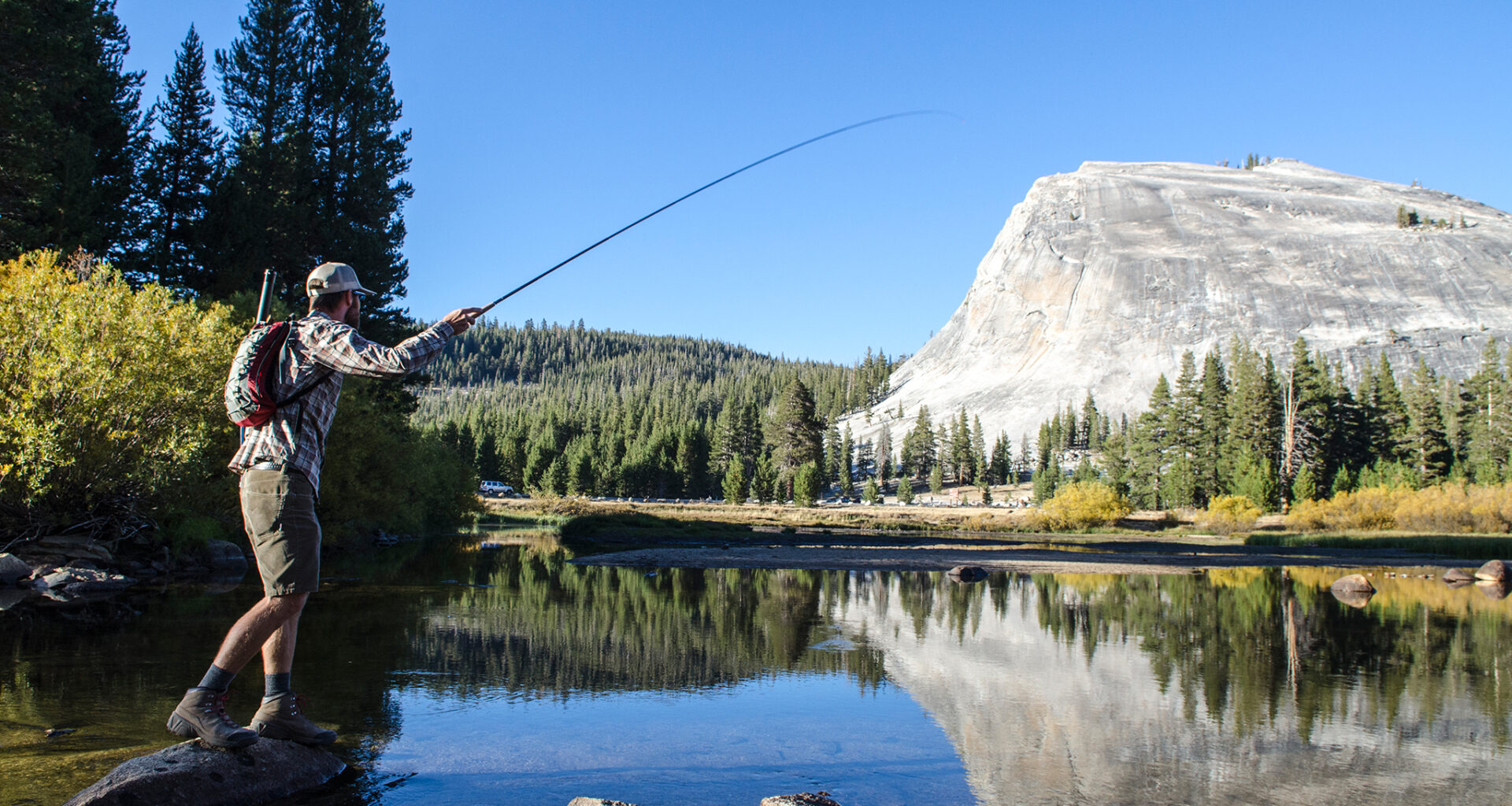
Fly fishing in Yosemite National Park.
Getty Images/Cavan Images RF
On May 26, Yosemite National Park announced sweeping changes to its fishing regulations, including year-round access and expanded opportunities for anglers to fish the Hetch Hetchy Reservoir. These new regulations are meant to bring the park into closer compliance with existing state regulations, according to park officials, but represent a significant departure from longstanding policies that halted fishing during the winter months as a respite for sensitive species.

“These updates expand recreational opportunities while maintaining our responsibility to protect Yosemite’s natural resources,” Yosemite National Park Superintendent Ray McPadden said in a news release. “Visitors can now enjoy fishing throughout the year, including in areas like Hetch Hetchy, with regulations that are easier to understand and more consistent with state guidelines.”
Article continues below this ad
Rules around fishing within Yosemite are typically set by park officials in partnership with the California Department of Fish and Wildlife. Together, the two agencies are tasked with creating opportunities for recreation while also protecting at-risk fish populations. The park’s many streams — accounting for more than 1,700 miles — and high-elevation lakes are world-class trout fishing destinations, where anglers can catch native rainbow trout alongside introduced brown, brook and golden trout.
In a statement to SFGATE, however, CDFW spokesperson Krysten Kellum said that the agency had not been consulted as part of the new regulations. “The California Department of Fish and Wildlife (CDFW) supports regulation changes that can allow for increased fishing opportunities,” she said, before adding that because the National Park Service unilaterally opened the park to fishing year-round, “CDFW has not yet reviewed the park’s new regulatory provisions to determine if they align with current state fishing regulations.” (The National Park Service did not respond to questions prior to this article’s publication.)
Devon Pearse, an ecology professor at UC Santa Cruz and lead scientist at the California nonprofit Friends of the River who has previously studied Yosemite’s trout, told SFGATE that he’s skeptical the decision was based on science, and suspects instead it was likely politically motivated. In recent weeks, President Donald Trump signed an executive order aimed at increasing access to federal lands, while the U.S. Fish and Wildlife Service proposed opening or expanding more than 1,450 hunting and sport fishing opportunities across 111 stations in 32 states, including 107 national wildlife refuges and four national fish hatcheries.
Article continues below this ad
While some fish populations in the park have increased over time, others remain sensitive, and Pearse said it’s unlikely they’ve recovered sufficiently to bear the brunt of year-round fishing pressure. The park has banned stocking since the 1990s, and so it will be on the fish to replenish themselves entirely through breeding.
“They’re trying to maintain these fish as self-sustaining populations, but if that were true, then it would make sense to limit fishing to avoid impacting things negatively,” Pearse said.
Rainbow trout swimming in the shallow side of the river in Yosemite National Park.
Heidi Patricola/Getty Images/iStockphoto
Prior to the changes, fishing was allowed year-round on public land along Yosemite’s boundaries, but the fishing season within the park stretched only from late April to mid-November. The Hetch Hetchy Reservoir has also long been largely off-limits due to its importance as a municipal water source for 2.7 million residents across the San Francisco Bay Area. While fishing wasn’t strictly prohibited, would-be anglers faced a legal paradox. Visitors were barred from traveling below the lake’s high-water mark, meaning that in low-water years, the shoreline was more or less inaccessible. Anglers can now cast off from the lake’s shoreline, however, making Hetch Hetchy the last reservoir above 200,000 acre-feet to allow fishing in California, according to the advocacy group Restore Hetch Hetchy.
Article continues below this ad
Fishers must still follow state rules, including obtaining a license and observing protections for threatened or endangered species. Anglers are still expected to use artificial lures with barbless hooks in the park, and catch and release practices for rainbow trout remain in Yosemite Valley and along the south fork of the Merced River. Bag and size limits have in some cases been modified, such that anglers can now catch an unlimited number of brown and brook trout in the valley, and must keep any fish they catch.
Several businesses offer guided fishing excursions in the park, and business owners who spoke to SFGATE had mixed reactions to the new regulations.
Elisabeth Barton, co-owner of Echo Adventure Cooperative in Groveland, said that fishing has traditionally been restricted in the offseason to protect vulnerable fish populations during spawn and to protect anglers who may not fully appreciate or understand the dangers of winter fishing.
“Fishing in extreme temperatures, whether it be very cold or very hot, can increase morbidity in fish populations,” she told SFGATE. “This is compounded by the lack of food in winter months. Without much food, a fish could expend all of its energy chasing a fly and recovering from the catch.”
Article continues below this ad
Fly fishing in Tuolumne Meadows in Yosemite National Park.
Keri Oberly/Getty Images/Cavan Images RF
Another longtime business owner, who was granted anonymity under Hearst’s ethics policy over fear of retaliation, worried that the shifting regulations will make it even more difficult to weed out bad actors. Before, the winter pause made it easier to tell when someone was breaking the law, but if fishing is allowed at any time, it will now be harder to do so.
“We rely on the rangers to enforce these rules, and the rangers have no idea about fishing,” the business owner told SFGATE, adding that in their many years as a guide, they’ve never had their permit checked. “My personal opinion is you’re going to see more people bending the rules, using live bait or taking fish they’re not supposed to.”

Stay informed, and entertained.
By signing up, you agree to our Terms Of Use and acknowledge that your information will be used as described in our Privacy Policy.
At least one person sees some benefits to the changes, however. David Gregory, the owner of Yosemite Outfitters in Mariposa, told SFGATE in an email that the return of fishing to Hetch Hetchy is something anglers and conservationists alike should be celebrating. “This is a huge step in the right direction for fishermen wanting to chase some of the largest trout in the park in a historic Valley,” he said.
Article continues below this ad
In addition, while he personally believes in seasonal closures “to give fish a season to be wild without pressure,” Gregory said that expanding access will hopefully expose a new generation of anglers to the joys of fishing. It will be on each person to educate themself appropriately, he added, such that they become a good steward of the watershed.
“I would like to encourage anglers visiting the park to be intentional. … Let conditions dictate your approach to fishing the Sierra. You don’t always need one more cast, or fish, just more time on the water,” Gregory said. “Increasing access can harm wildlife, but it also exposes the next generation of anglers and conservationists to a resource worth fighting for.”
We love national parks just as much as you do, so we have a newsletter that covers them from top to bottom. Sign up here.