
“Hearst Magazines and Yahoo may earn commission or revenue on some items through these links.”
Here’s what you’ll learn when you read this story:
First recorded in 1989, a whale has been vocalizing at 52 hertz—a much higher frequency than is typical for blue or fin whales—for decades.
Scientists have never located the exact whale responsible for the vocalizations, and theories suggest the animal might either be deaf or a hybrid of a blue and a fin whale, known as a “flue” whale.
As whales face unprecedented changes in marine environments, scientists worry that increased hybridization could imperil some species.
Officially commissioned on September 21, 1942, the Naval Air Station Whidbey Island (located two hours north of Seattle) specializes in “electronic attack,” which is the art of using radar and radio frequencies to disrupt hostile operations. One interesting tool at its disposal is an array of hydrophones—specialized microphone apparatuses designed to detect signals underwater—known as the Sound Surveillance System (SOSUS). According to The Atavist, the array proved effective during the Cold War, but as geopolitical tensions eased in the early 90s, the navy began searching for other ways to use it.
Then, on December 7, 1992, a technician named Joe George detected an extremely strange signal coming in at the incredibly high frequency of 52 hertz. His first thought (or, at least, his first declassified thought) was that it must be a whale, but there was one problem: No known whale songs had ever been recorded at that frequency—not even close. Blue whales and fin whales, for example, typically vocalize around 15 to 5 hertz, which is right at the lowest register of human hearing.
So, if this 52 hertz signal was coming from a whale, what kind of whale was it? And why was it calling out with no possibility of ever receiving an answer?
The SOSUS detection wasn’t the first time scientists heard this inexplicable call. Three years earlier, experts at Woods Hole Oceanographic Institute also heard the signal while surveying in the North Pacific. The Navy decided to declassify the recordings so that experts at Woods Hole could analyze the data and try to figure out the mystery behind the high-pitched signal. In 2004, a study published in the journal Deep-Sea Research combined 12 years of tracking data related to the 52-hertz call. The researchers summarized their findings by writing that “it is perhaps difficult to accept that if this was a whale, that there could have been only one of this kind in this large oceanic expanse, yet in spite of comprehensive, careful monitoring year-round, only one call with these characteristics has been found anywhere, and there has been only one source each season.”
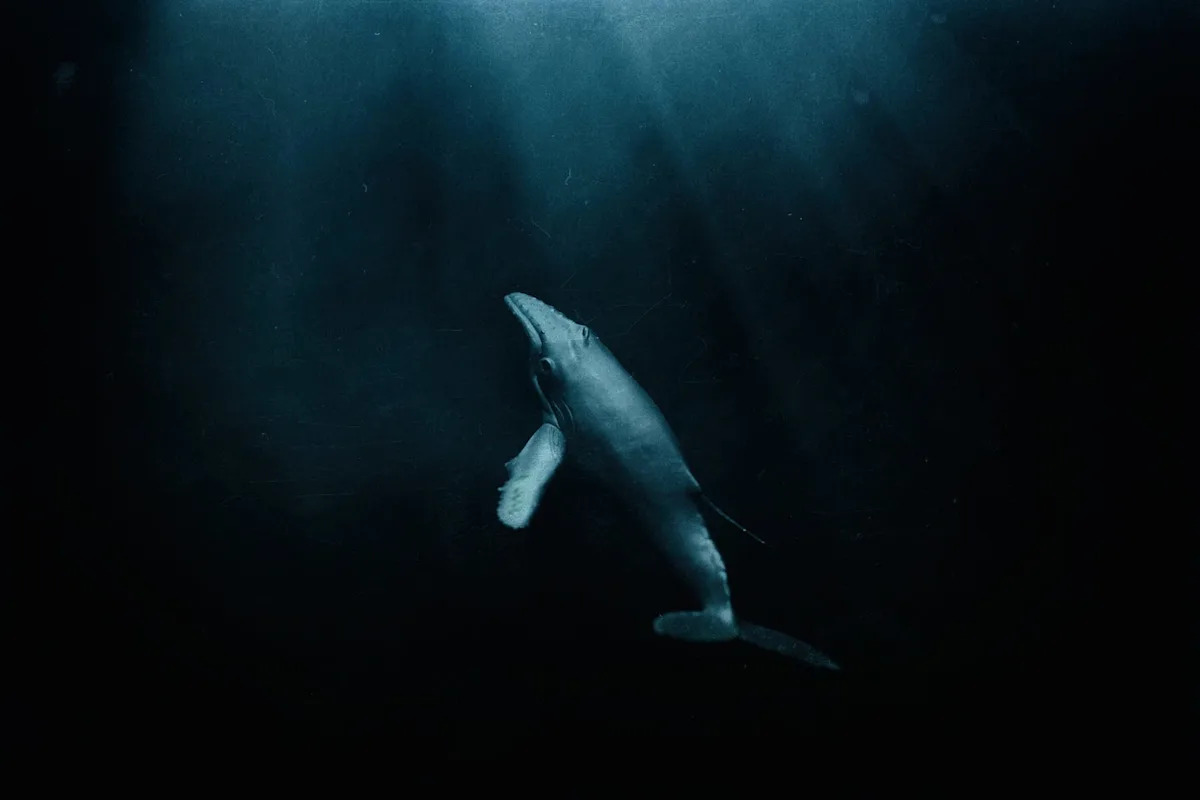
This led people to give the whale, which had become known as “52 Blue,” the nickname of the “loneliest whale.” Kickstarter campaigns even formed to try to find where the whale might be hiding, and entire documentaries have been dedicated to finding the whale. More than 20 years after that report, scientists still aren’t sure exactly what species the “loneliest whale” could be. Some experts have hypothesized that it’s a deaf blue whale, while others suggest that the whale can’t really be all that lonely, since its call retains important characteristics of blue whale songs.
“Blue whales, fin whales and humpback whales: all these whales can hear this guy, they’re not deaf,” Chrisopher Clark from Cornell University told the BBC in 2015. “He’s just odd.”
Another theory could be a clue to how climate change is impacting whale populations around the world. It’s possible that “52 Blue” is a hybrid of a blue whale and a fin whale, also known as a “flue” whale. Scientists estimate that there are roughly four times as many fin whales as blue whales, and scientists found in 2024 that there were as many as 37,000 fin whales near Iceland, compared to only 3,000 blue whales.
“Three thousand is not a very high density of animals,” Aimee Lang, a marine biologist with the National Oceanic and Atmospheric Administration (NOAA) told Grist in 2025. “So you can imagine if a female blue is looking for a mate and she can’t find a blue whale but there’s fin whales all over the place, she’ll choose one of them.”
A growing population of hybrid whales could have conservation implications. Changing ocean conditions—including warming water, acidification, and shifting prey populations—could isolate whale species into small breeding pools, threatening their survival, according to Grist.
Whales are the undisputed masters of vocalization. Blue whales can make sounds up to 188 decibels—much louder than a jet engine (150 decibels)—and these calls can be heard for thousands of miles underwater. Whale vocalizations have been theorized to serve a variety of purposes, including navigating, hunting, communicating, or signaling to an alien race not to annihilate the planet. In recent years, scientists have even decoded the hidden alphabet within whale song.
“52 Blue” has clearly been trying to communicate something for nearly 40 years. And while other whales may not understand its vocalizations, it certainly has our attention.
You Might Also Like