
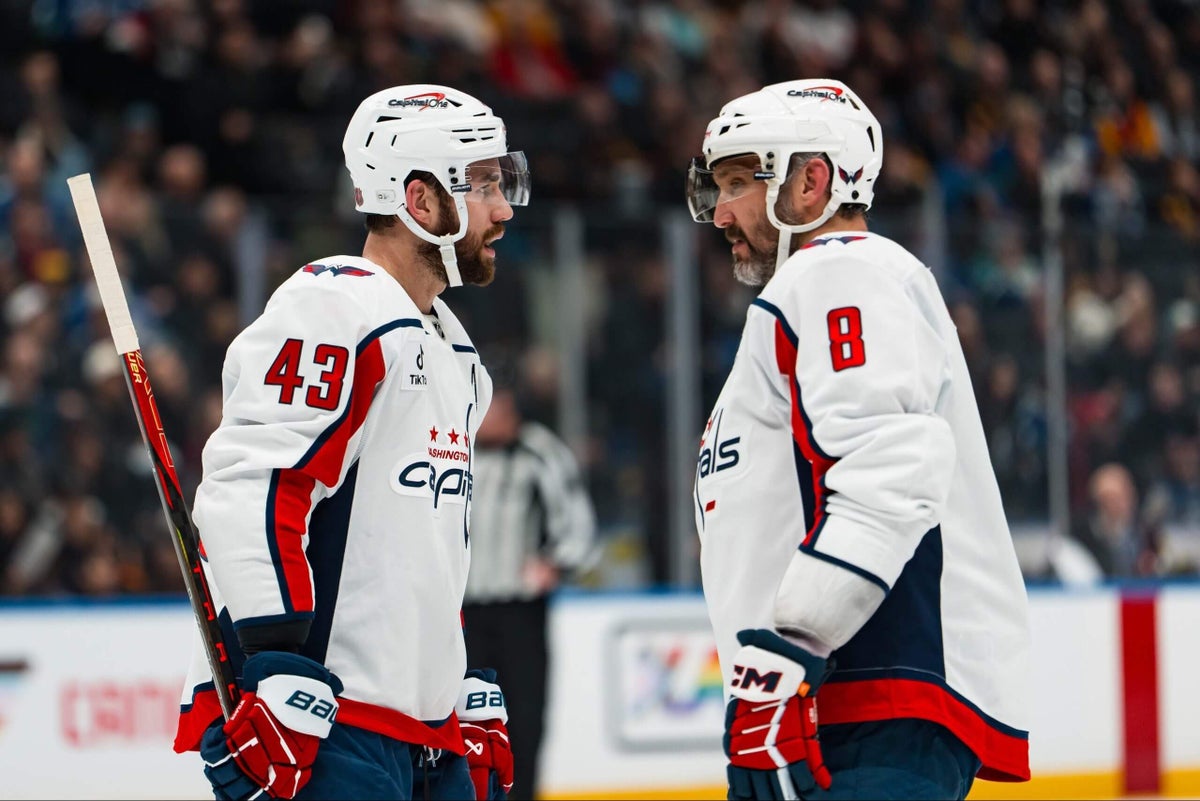
There may not be a crueler standings juxtaposition in recent memory than Washington’s this season. The Capitals finished 12th in the league with 95 points and missed the playoffs. The Golden Knights finished 13th in the league with 95 points and went to the Stanley Cup Final. Ouch.
As much as that stings, the standings can lie sometimes, and in this case, the lie is the Capitals being on the same level as the Golden Knights; they weren’t.
Washington may have been good enough to make the playoffs, but the Capitals weren’t a sleeping giant such as Vegas. The underlying numbers weren’t nearly as sparkly and the roster just wasn’t as contender-worthy from top to bottom. Going into the playoffs, Vegas checked every necessary box on the Stanley Cup checklist. The Capitals didn’t, and that remains the story going into next season.
Here’s where the Capitals stand going into the 2026-27 season. All projected values are age-adjusted based on each player’s profile of comparable peers. Here’s a primer on the Cup Checklist.

What the Capitals have
It shouldn’t come as much of a surprise that the Capitals have most of the boxes here checked. Washington has a deep team that looked playoff-caliber for most of the year despite missing the cut.
That starts with the triple glow-up of Tom Wilson, Jakob Chychrun and Logan Thompson. Over the last two years, all three have risen to highly competitive levels, enough to be considered legit high-end core pieces.
After years of being overrated as the league’s boogeyman, Wilson has blossomed in his 30s into being the league’s premier power forward. Chychrun, an incredibly toolsy player, finally put it all together into a terrific offensive package. And Thompson has some of the absolute best numbers in the league over the last two years. That’s a strong trifecta.
The layers of support behind them are also a big deal. In Matt Roy and Martin Fehérváry, the Capitals have two steady defenders for the top four, while the likely offensive emergence of Cole Hutson should fill the void left by John Carlson just fine. That Rasmus Sandin and Timothy Liljegren, two dependable two-way options in their own right, aren’t even mentioned adds further luxury to Washington’s back end. If Hutson turns out anything close to his brother, it could be the league’s strongest.
Up front, Washington has a number of strong options rounding out the top six. Aliaksei Protas has become a difference-making behemoth at five-on-five and proved his 2024-25 breakthrough was no fluke. Pierre-Luc Dubois, Dylan Strome and Justin Sourdif offer a nice mix of talent down the middle, while Ryan Leonard has a chance to really take off offensively in his second season.
What the Capitals need
Everything here is good. The problem is it’s not great — not to the level of a Cup contender. Even the Carolina Hurricanes, a team long derided for their lack of oomph and in the Cup final anyway, have a lot more to love at the very top of the lineup.
The problem with Washington is that not a single skater is projected to have a Net Rating north of plus-10, leaving the Capitals behind the eight-ball relative to every other team in the East. That’s right, all of them. (If you’re wondering who exactly qualifies on Philadelphia, the model really likes Porter Martone next season and may be a little overzealous there.)
That’s OK for filling out most of the roles needed here and having Thompson in net as one of the league’s best goalies is a major trump card on top of that. But for the two most important spots in the lineup, the holes are glaring. At Washington’s absolute best, they were holes filled by Alex Ovechkin and Nicklas Bäckström (or Evgeny Kuznetsov). Going into the 2026-27 season, the Capitals have no one.
The Capitals do have some young options that have a chance to get there. Ilya Protas and Ryan Leonard carry a ton of upside and maybe Andrew Cristall factors into the mix, too. But at this juncture, it’s still just unrealized potential. It takes a lot to actually reach the rarefied air of the two highest levels. Even if those three have a real shot, it’s not something that can be realistically counted on until they actually prove it.
That’s always been part of the question with what happens when Ovechkin retires: who takes his place at the top. Normally, the next great hope would stem from a proper rebuild — the next top-five pick with high-end pedigree. What happens when the rest of the team is too good to sink that low, which simultaneously leaves them not good enough to climb any higher?
The big question
What does a post-Ovechkin world look like for the top of Washington’s lineup?
No one but Ovechkin knows what happens next, but the hole at the top of the lineup he filled for two decades had been vacant long before any decision loomed on whether he retires or not. The average franchise forward on a Cup team carries a Net Rating of plus-17.7, while the bare minimum for a passing grade sits at plus-13.4. The last time Ovechkin surpassed “passable” was 2021-22.
Still, even when Ovechkin’s game lost the luster necessary for contention as The Guy, his offense was still prolific enough to warrant star forward status. Going into the 2026 offseason, the Capitals have neither of the two top players necessary to legitimately contend.
To Washington’s credit, the Capitals have done everything right in what has been one of the league’s most impressive retools. They’ve hit big on reclamation projects such as Dubois, Strome and Chychrun. They found a legit star goalie in Thompson. They found a hidden gem in Sourdif. They’ve got the absolute most out of Wilson at an unlikely age. And they’ve found some draft gems outside the top five.
All of that is commendable, but so far, all the Capitals have done is hit some doubles and triples to stay in the hunt. To contend, they need a grand slam in order to fill the two most difficult spots in the lineup.
That likely comes down to a best-case scenario outcome from one or more of their top prospects. Ryan Leonard, picked eighth in 2023, had a fantastic rookie season and has all the makings of a top-six forward. Ilya Protas, brother of Aliaksei, has unicorn potential given his size and skill after scoring 66 points in 69 games in the AHL as a rookie. Andrew Cristall, who put up some illustrious numbers in junior, was along for that ride, scoring 60 points in 72 games.
In that vein, the future looks fairly bright, brighter than can be reasonably expected for a team that has stayed as competitive as Washington has. But good might not be good enough; Washington needs that trio to be great.
Leonard potentially has the upside necessary and was ranked 17th in Corey Pronman’s list of top U23 players in January. In Scott Wheeler’s most recent prospect rankings, he viewed Protas and Cristall as top-six types. The talent is there, but realizing it at the level necessary to qualify as 1A and 1B on a Cup team is a different story. We’re talking a top 10 to 20 percent outcome where one of those guys becomes a top 25ish forward. And if they don’t get there, filling that hole through other avenues is even trickier.
Washington has a whole lot to like, but this right here is the difference between getting into the playoffs and going deep in the playoffs. The Capitals need an unexpected breakthrough well beyond reasonable expectations for their trio of young guns.
Possible? Of course. But it might be wise to have a Plan B.
The 95-point Capitals are not the same as the 95-point Golden Knights. The deep, but lacking stars Capitals are not the same as the Hurricanes with similar issues either. While the Stanley Cup Final may feel like proof that the Capitals are not quite as far off as missing the playoffs would suggest, the truth is that two very large holes at the top of the lineup are currently prohibitive to their status as contenders.
That can change with some of Washington’s intriguing young talent … if everything goes right.
But if it doesn’t, the Capitals will find themselves in a bit of a bind: maybe good enough, but not great enough, can sometimes feel like a team just spinning its wheels.