

The waters off the Jersey Shore have a Caribbean vibe these days looking unusually blue and green. You can thank spring weather for the turquoise swirls and super tiny ocean plants.
NASA satellites began spotting the colorful patches off the coasts of New Jersey, Delaware, Maryland, and Virginia in April.
It’s been “a productive year with a lot of seasonal upwelling and phytoplankton blooms,” said Rutgers University oceanographer Oscar Schofield.
Here’s what that means.
Repainting the water
Phytoplankton are microscopic algae, plant-like organisms that drift with ocean currents. They may be tiny, but when conditions are right, they multiply quickly and change the color of the water.

A woman coaxes a man to come deeper into the water as they swim in Asbury Park. Our Shore Towns: Asbury Park: From sunrise till past sunset.
“The average plant size in the ocean is about 50 microns,” said Schofield, who is chair of Rutgers University’s Department of Marine and Coastal Sciences.
“They can show up in a week, and then they could be gone in a week,” he said.
Wind fertilizing the ocean
Southwest winds can push surface water near the Shore out to sea. Colder, deeper water then rises to replace it, bringing nutrients that help phytoplankton grow.
“If we have protracted periods of lots of southwest wind, it’s almost like it’s helping fertilize the ocean and promotes these big blooms of algae,” he said.
Cold & blue vs. warm & green
The seafloor at the Shore is uneven, and that affects how water moves.
“You can go to one beach and the water is super cold,” Schofield said. “And then you can go 10 miles up the road and the water is super warm.”
That means the bluest water won’t be at every beach. The areas around Tuckerton and just south of Asbury Park are deeper and nutrient-rich. That can create conditions for phytoplankton blooms. These are places you’re more likely to see this blue water. Check conditions online before you go because things change quickly when the wind shifts, said Schofield.
Good fishing means more blooms
The same water conditions that help phytoplankton grow also support more marine life.
“Often the beaches that you see are really good for fishing tend to be those regions where you get a lot of these algal blooms,” Schofield said.
Is it safe to swim?
Yes, this is a natural process that happens often, he said. It’s not pollution and it’s not dangerous.
Harmful algae exists elsewhere, like the red tides that happen in places such as Florida, Schofield said. But they’re not typical here.
“I would have no hesitation going for a swim,” he said.
How long will it last?
New Jersey often sees several of these bloom events during warmer months, Schofield said. A typical bloom may last about seven to 10 days, but this spring’s winds have kept the nutrients around longer.
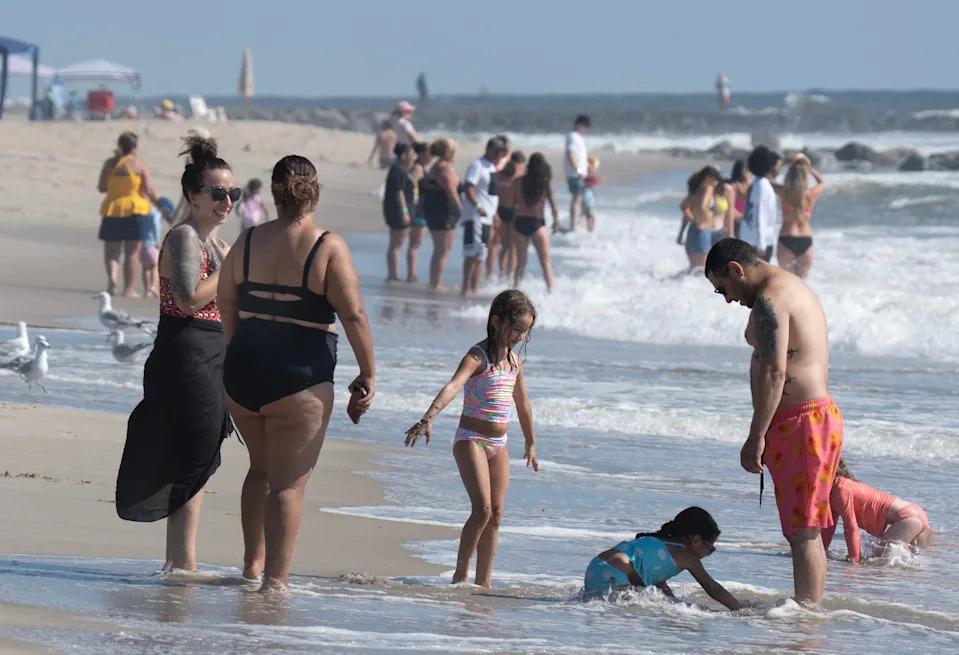
Children play in the water at the Asbury Park beach. Our Shore Towns: Asbury Park: From sunrise till past sunset.
This article originally appeared on NorthJersey.com: Algae blooms making Jersey Shore ocean look blue, but it may not last