
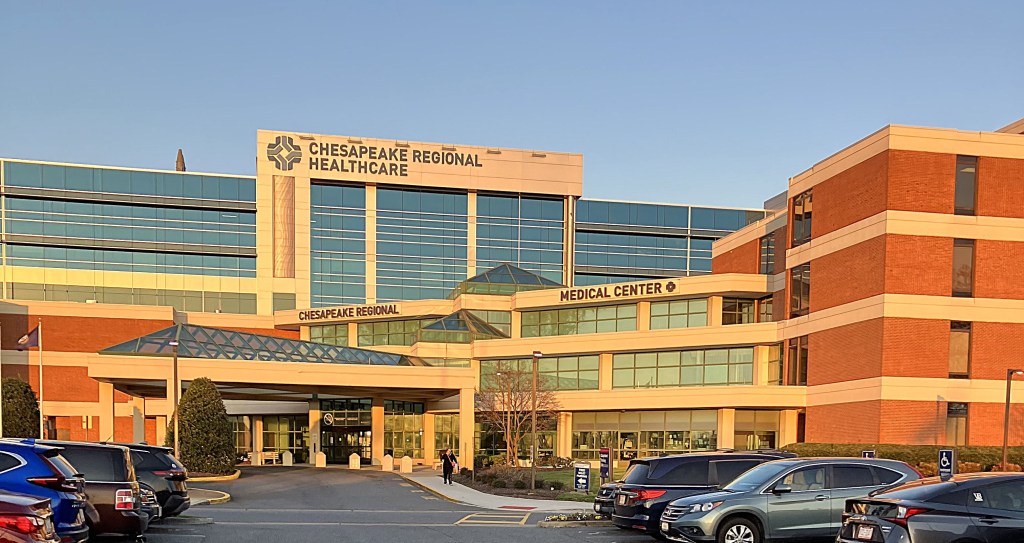
CHESAPEAKE — Following the recent departure of Chesapeake Regional Healthcare President and CEO Reese Jackson, members of the hospital authority board are declining to share additional details about the circumstances.
The health care system announced Monday that Jackson’s tenure ended Saturday. He had held the position since 2016. No reason was shared at the time of the announcement.
The hospital is governed by the Chesapeake Hospital Authority, an 11-member body that met in special-called meetings Friday and Tuesday. Several board members at Tuesday’s meeting declined to comment on Jackson’s departure.
At Tuesday’s meeting, the board members unanimously approved an “agreement” following an executive closed session that spanned more than an hour. But the board declined to discuss the agreement and cited Freedom of Information Act exemptions when asked for a copy of the approved document. When members came out of the closed meeting, they did not specify for the record what the approved agreement was, and chair Dee Gilmore declined to tell a reporter what the agreement regarded.
The Virginian-Pilot reached out to both board clerk Daviana Wright and hospital spokesperson Tricia Hardy for a copy of the adopted agreement Wednesday. Around 5 p.m. Wednesday, Hardy responded saying the document was being withheld entirely as it “contained personnel information concerning an identifiable individual,” citing Virginia Code that relates to exclusions from the state Freedom of Information Act. Hardy also cited another provision, which states that records “recorded in or compiled exclusively for use in closed meetings” can be exempt from public disclosure.
But the agreement adopted Tuesday was voted on during the open, public portion of the meeting, right before adjournment. Virginia code states that no record “otherwise open to inspection under this chapter shall be deemed exempt by virtue of the fact that it has been reviewed or discussed in a closed meeting.” Additionally, Virginia law states that records can be disclosed with appropriate redactions.
Members of the Chesapeake Hospital Authority Board are exclusively appointed by Chesapeake City Council, including two members who are licensed medical workers, according to Virginia state code. Members serve for four years across no more than two consecutive terms and receive $250 per in-person meeting.
The authority is also governed by a specific Virginia code that grants the board additional exemptions for conducting public business in closed sessions beyond what’s allowed under Virginia’s Freedom of Information Act. Tuesday’s meeting had three topics listed on the agenda: June planning meeting, personnel matter, and committee discussion. The board cited three reasons for going into closed session. The first was to “discuss general operational matters and planning that will affect the competitive position” of the authority, outlined in the authority’s section of Virginia code, according to a copy of the motion used to enter into closed session.
The second reason was to “discuss the assignment, appointment, and performance of specific public officers, appointees, or employees” of the authority. The third was for consultation with “legal counsel employed or retained by” the authority regarding “specific legal matters” that require legal advice.
Board members at Tuesday’s meeting also attempted to adjourn the executive session while still meeting in closed session. Virginia law requires a body to officially reconvene the open session to certify the end of the closed session with a roll call vote. Any vote for action taken following a closed session must be conducted in the open meeting. After a reporter objected Tuesday, the board reconvened the open meeting and formally conducted a roll call vote intended to certify that only lawfully exempted matters were discussed in the closed session.
The board also met for a special-called meeting on Friday, a day before Jackson’s departure. A copy of that agenda obtained by The Pilot shows the board met for “legal consultation” and “board discussion” in an executive session scheduled for 4 to 8 p.m. When asked about any votes made or documents approved at that meeting, Hardy told The Pilot “such documents do not exist.”
Megan Rhyne, executive director of the Virginia Coalition for Open Government, said the policy of FOIA is that “the affairs of government are not intended to be conducted in an atmosphere of secrecy.” Rhyne said the lack of specificity or disclosure on what or who is being discussed in closed session is concerning.
“If it’s hard for a member of the media — much less a citizen, an individual citizen who doesn’t have your savvy — to get basic information about what the government is doing, what it is they are taking their votes on, that would be very concerning to me,” Rhyne said. “And certainly not in keeping with the policy of FOIA.”
Jackson’s departure comes as the Chesapeake Regional Medical Center faces both a class-action lawsuit filed by hundreds of patients and a federal health care fraud investigation. Jackson was named as a defendant in a lawsuit in which nearly 900 women claim Chesapeake Regional and its executives failed to stop former gynecologist and obstetrician Javaid Perwaiz from performing medically unnecessary surgeries on them. Perwaiz is serving a 59-year federal prison sentence after a jury found him guilty in 2021 of defrauding private and public insurance programs of over $20.3 million by performing unnecessary procedures, including irreversible sterilizations, on female patients.
In January 2025, a federal grand jury indicted Chesapeake Regional on charges of health care fraud and conspiracy to defraud the federal government related to Perwaiz.
The case is pending an appeal filed by the Chesapeake Hospital Authority asking for dismissal of the case on the grounds of sovereign immunity. Chesapeake Regional has denied wrongdoing.
Natalie Anderson, 757-732-1133, natalie.anderson@virginiamedia.com