
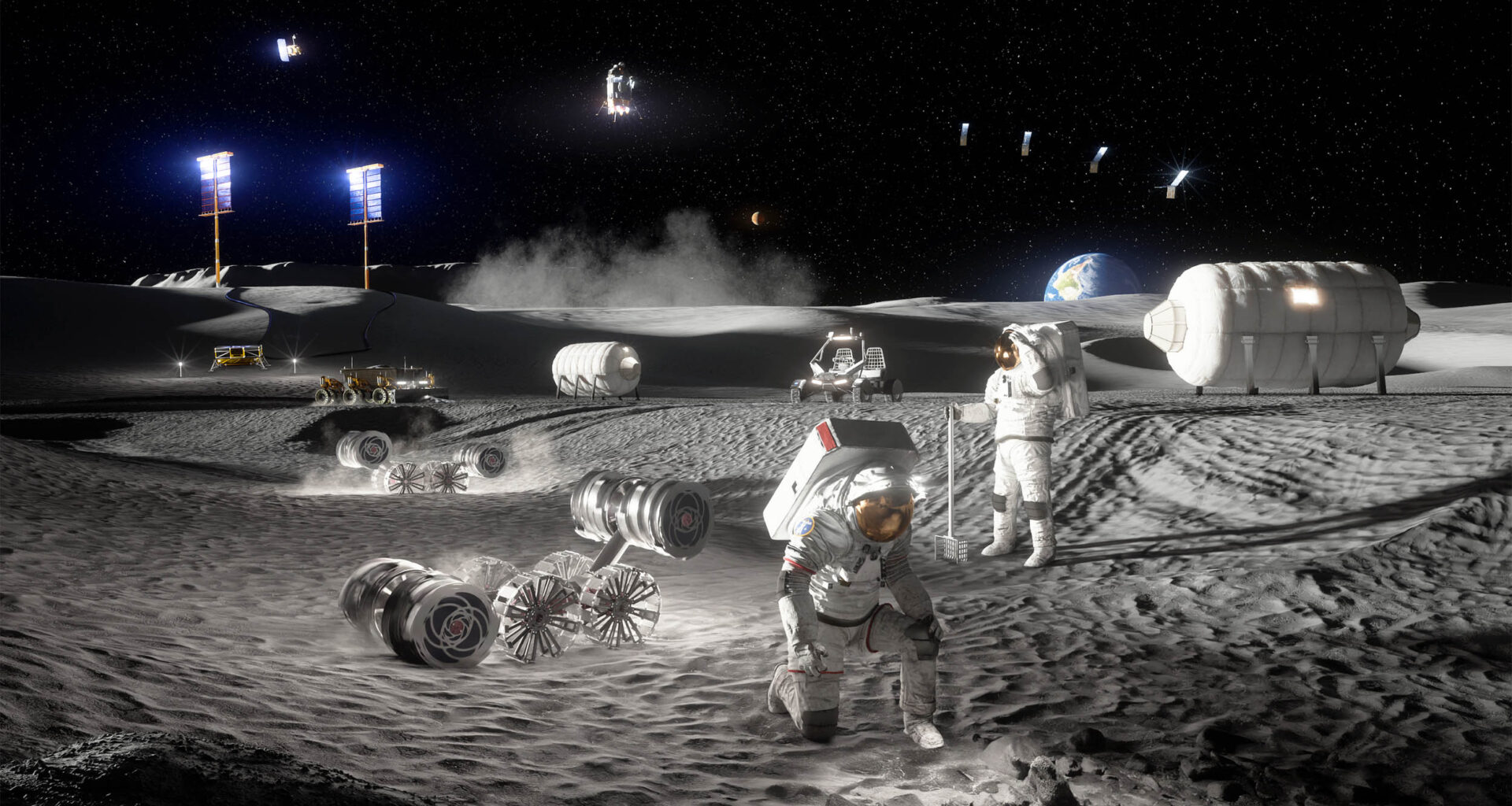
A permanent Moon base has been described in NASA planning documents for years – rover concepts, habitat designs, and power systems mapped out in detail. Turning those documents into contracts is a different matter.
NASA signed several of them this week. Two rover deals totaling more than $400 million. A lander agreement worth up to $468 million. And three cargo missions scheduled before the year is out.
NASA’s lunar base takes shape

At a late-May event at the agency’s Washington headquarters, NASA laid out its plan for the Moon Base, its first permanent foothold on another world. The announcement traded vague ambition for hardware contracts and launch schedules.
Carlos García-Galán, the program executive for Moon Base at the National Aeronautics and Space Administration (NASA), brings 27 years of human spaceflight experience to the role.
Three phases will structure the build, running from now through 2032 and beyond and leading toward routine crew rotations.
The first phase, running through 2029, focuses on scouting and testing. NASA wants as many as 25 missions in that window, most of them robotic, hauling roughly four tons of gear to the surface to learn what survives and what fails.
New rovers head to the Moon
Two American companies have won the job of building the first lunar vehicles. NASA awarded Astrolab $219 million and Lunar Outpost $220 million to deliver the first lunar rovers astronauts will steer across the Moon’s surface.
Astrolab’s vehicle weighs about 2,000 pounds and reaches speeds of up to 6 mph on flat terrain. It can carry astronauts and supplies and operate unmanned between crewed visits. The design builds on an existing rover platform.
Lunar Outpost’s Pegasus is lighter and faster, reaching speeds of more than 9 mph and designed to operate for up to a year.
Astronauts can drive it directly or hand control to a remote operator on Earth when no crew is present. Autonomous driving is also an option, using technology derived from Apollo-era hardware.
Both teams have 18 months to finalize their designs, conduct crewed evaluations, and qualify their machines for flight. Deploying both rovers early will give NASA valuable terrain data before any astronaut steps off a lander, supporting the agency’s goal of achieving crewed surface mobility by 2028.
Lunar deliveries come first
Getting those rovers to the South Pole falls to a separate set of landers. NASA handed Blue Origin $188 million, with an option worth another $280 million, to haul the hardware to the surface before any boots arrive.
Three early flights have already been identified. The first, targeted for fall 2026 at the earliest, will use a Blue Origin lander to touch down near Shackleton Crater and measure how rocket exhaust disturbs the lunar surface.
That lander recently completed environmental testing at NASA’s Johnson Space Center. A second mission will carry more than 1,100 pounds of cargo aboard a different vehicle.
The third mission will investigate the mysterious bright streaks on the Moon’s surface known as lunar swirls using instruments from European and Korean partners. These three missions are only the beginning.
More than a dozen additional missions will be announced this year, each designed to generate operational data before astronauts land. NASA is treating each flight as a building block, with results from one mission shaping the next.
Hopping across lunar craters
One of the more unusual elements of the program involves flight. A NASA mission called MoonFall will send four small drones to make short hops across terrain too steep or rugged for any rover to reach.
NASA’s Jet Propulsion Laboratory in Southern California developed and tested the drone hardware.
The agency selected Firefly Aerospace to build the spacecraft that will carry the drones to the Moon. Launch is targeted for 2028.
Each drone will land independently and capture high-resolution images over a single lunar day. After the final flight, a survive-the-night payload will continue operating for months, maintaining a U.S. presence at the pole long after the hopping ends.
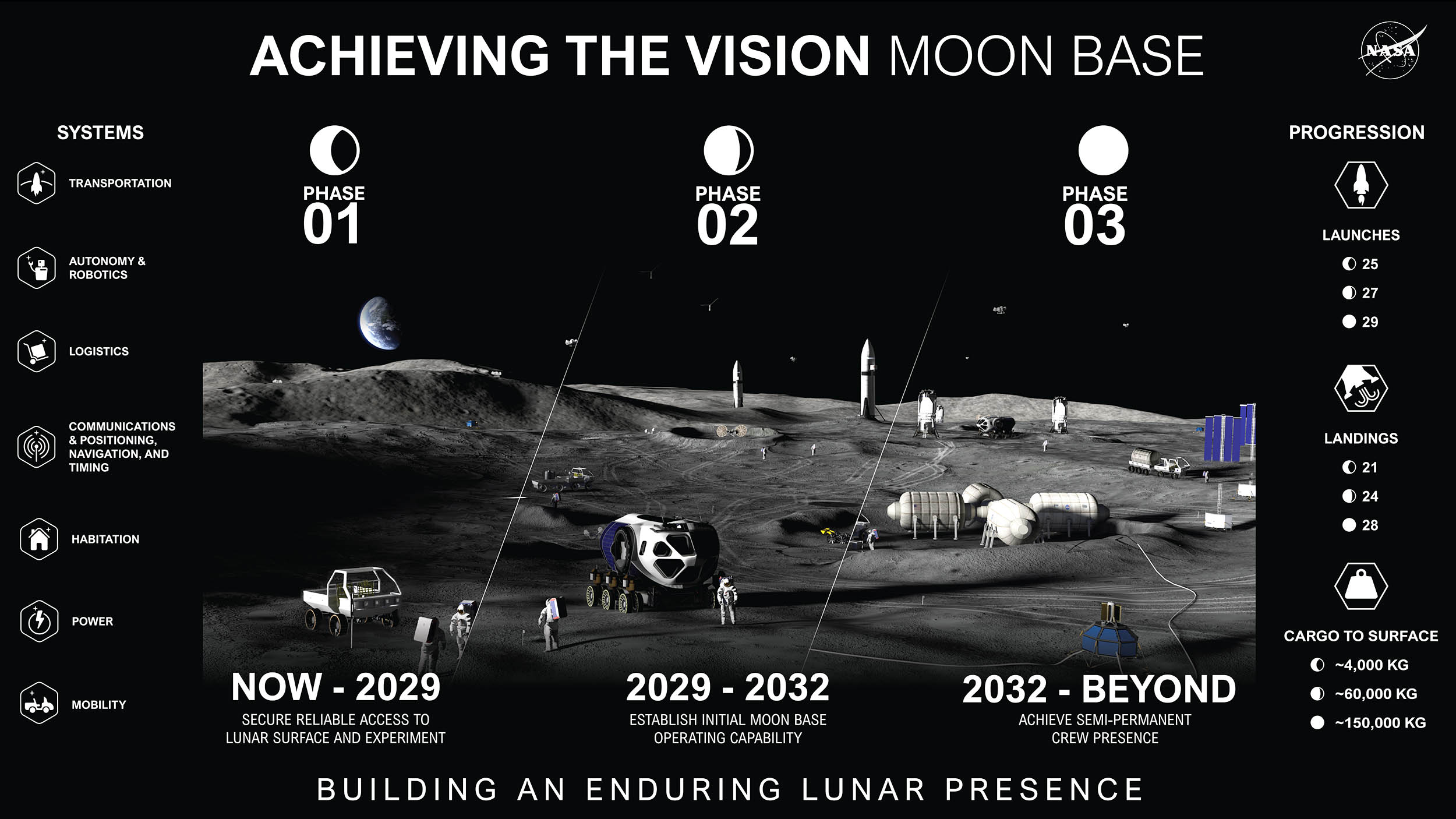 Infographic illustrating a phased approach to Moon Base development near the lunar South Pole, showing the progression from early exploration and infrastructure deployment to sustained human presence on the Moon. Credit: NASA/Edmy S. Cruz Reyes. Click image to enlarge.A prime spot for exploration
The South Pole isn’t a random choice. Parts of the region receive long stretches of sunlight, supporting more consistent solar power and steadier temperatures for equipment that must operate for years.
A few steps away, the story flips. Deep craters there have sat in permanent shadow for billions of years, cold enough that scientists believe water ice has persisted inside them.
Temperatures range from above 130°F (54°C) in sunlit areas to roughly -334°F (-203°C) inside those craters.
That ice is the prize. Locked within it may be a record of how water and other materials moved through the solar system.
It could also prove valuable for future exploration. Scientists may someday convert the ice into drinking water, breathable oxygen, or rocket fuel produced on-site rather than transported from Earth.
The Moon base gets real
Until this announcement, the Moon Base was an idea with a name. Now it has signed contracts, budget commitments, named spacecraft, and launch schedules – the difference between a roadmap and an active program.
If the early missions succeed, Artemis astronauts could explore more of the lunar surface than any Apollo crew.
Some of the oldest terrain in the solar system would become accessible to scientists. Engineers could finally test whether crews can live using resources provided by the Moon itself.
That knowledge will inform every long-range plan for sending people to Mars. The machines that will carry future crews are no longer drawings – they are funded projects with deadlines.
—–
Like what you read? Subscribe to our newsletter for engaging articles, exclusive content, and the latest updates.
Check us out on EarthSnap, a free app brought to you by Eric Ralls and Earth.com.
—–