
The Cap Times is an independent newsroom serving Madison and Wisconsin. Sign up for the Food & Culture newsletter for exclusive weekly insight.
Becky Burbach took up crocheting as a pandemic hobby. She began posting her scarves and stuffed animals on Instagram, which is where the founder of a Madison public art nonprofit sent her a message.
“She reached out and asked if we could have a meeting, because she was looking to hire somebody,” said Burbach, who lives in McFarland. Burbach had never done public art before.
“I was really excited that she discovered me,” she said. “At the time, the payout sounded really great.”
In 2022, Madison Public Art Project founder Jillian Talarczyk hired Burbach to create a 30-foot-long by 10-foot-tall crocheted wildflower mural, ultimately called “Wildflowers of Wisconsin,” for McKee Farms Park in Fitchburg.
Burbach designed a mural. Then she spent months going to libraries, nursing homes and park shelters around the Madison area, hosting classes and workshops “to bring in the community” to the project.
Yet by the time “Wildflowers” debuted in fall 2024, Burbach’s name was nowhere on the project. Talarczyk hired a Milwaukee artist to redesign and complete the mural.
Because Burbach had signed a contract agreeing to payment at the completion of the piece, she was paid nothing for months of work. Asked about this, Talarczyk told the Cap Times, “MPAP (the Madison Public Art Project) was planning payment for the brief time she spent on the project. MPAP has never defaulted in payment to our artists.”
“The challenges and stress that comes along with the classes and pattern creation/deadlines has been overwhelming, and I know that going into this upcoming show season I won’t have time to keep up with both,” Burbach wrote in a September 2023 email to Talarczyk, which Burbach shared with the Cap Times.
“This project has taken a toll on my mental health,” she added. “I’m happy to hand over any patterns I’ve created … and am sorry that it has come to this.”

The “Wildflowers of Wisconsin” crochet mural was on display at McKee Farms Park in Fitchburg.
COURTESY OF KIERSTEN DARLING
Given the number of artists around Madison, opportunities to make public art of the kind Madison Public Art Project funds — murals that climb the walls of buildings, multi-year installations made with community input — have been relatively rare.
“There are a lot of artists and not many possibilities,” said muralist Richie Morales. When speaking up could get an artist painted as difficult, it can seem better to accept limited opportunities, even if it means swallowing frustrations.
Janson Rapisarda, who makes work as Jan the Voyager, works on a mural at Bakers Place.
COURTESY OF JAN THE VOYAGER
Yet something is shifting. As the city of Madison prepares to invest more than ever in public art (meaning more money from other sources), a group of artists has identified specific, consistent challenges with Madison Public Art Project.
The Cap Times spoke with nine artists who’ve worked with the Madison Public Art Project. Most expressed varying levels of frustration with the nonprofit, citing issues with micromanagement, condescending communication, poorly written contracts, lack of credit for their work and payment complications.
Talarczyk responded to some of these allegations and refuted some. She wrote in an email: “I enjoy working in public art because it’s art for everyone, not just for those who can afford it.”
Burbach is clear that she backed away from her agreement with Talarczyk by her own choice. But by not talking about what happened, she felt like she’d missed an opportunity to protect someone else.
“We need to unite together. We need to speak out,” Burbach said. “We need to prevent this from happening to other artists in our community. … I don’t care about getting any money. I just care about other people not getting harmed in the future by signing a contract.”
Asked whether artists have given her feedback about her process, Talarczyk reprinted a list of survey responses that were 100% positive. They tell one kind of story.
Among themselves, artists are telling another.
Jillian Talarczyk is the president and creative director at Madison Public Art Project.
JOHN HART/STATE JOURNAL
Patronizing professional artists
Madison Public Art Project is an independent nonprofit. It has nothing to do with the city of Madison, which regularly funds public art projects.
Talarczyk, a Madison native who splits her time between Dane County and New York City, announced the creation of the nonprofit in October 2020. Her goal at the time, expressed in an early TV interview, was to “strengthen communities with engaging art by supporting emerging and established artists.”
Talarczyk connects clients both public (the city of Monona) and private (Noel Development, Neutral) with independent artists. Sometimes she sends out a request for quotes and invites artists to apply. Other times, she approaches artists directly.
“Mostly projects are funded by grants and donations which vary by project,” Talarczyk wrote in an email, citing three (“Driftless Winds,” “Heritage Hollow” and “Bloom In Flight”) that were funded by developers.
Six years in, Madison Public Art Project’s reputation among local artists is complicated.
Brooke Wentland paints a fire hydrant along Monona Drive as part of a public art project called “Vibrant Hydrant” commissioned by Madison Public Art Project in 2022.
AMBER ARNOLD / WISCONSIN STATE JOURNAL
Some take exception to how much credit Talarczyk takes for their work. They cited incessant texts with a patronizing tone, micromanagement and artificial walls between clients and artists that caused more problems than they solved.
In a piece for Tone Madison, T.L. Luke, a visual artist and illustrator, called out Madison Public Art Project’s 2022 “Vibrant Hydrant” pitch as “a bad deal” full of “red flags.”
“To my young and emerging artists, undervaluing your labor signals to (organizations) that they can continue to offer bad deals to artists,” Luke wrote. “They need you more than you need them.”
The timeliness of payment has been at issue for some artists. But even when the funding is good, the experience hasn’t necessarily been positive.
Julie Vornholt made the mural “Bloom in Flight” last fall at 4607 Monona Drive.
COURTESY OF JULIE VORNHOLT
Julie Vornholt, the Madison-based creator of “Bloom in Flight” (2025) on a residential building in Monona, described her overall experience over several months as generally fine. The pay was more than she’d ever been paid for a mural, and “my art’s on a building.”
Still, she wouldn’t jump to work with Madison Public Art Project again. There were add-ons, like a coloring book and painted vases, that she didn’t feel like she had a choice about.
“(Talarczyk) said ‘we’re doing them’ while I was getting on the lift to paint,” Vornholt said, “then gave me the vases right after I had hand surgery.
“(I) told her it’d be months before I could use my hand but she insisted and gave them to me anyway,” Vornholt added. “I should have stood my ground more but was caught off guard on both occasions.”
Who gets credit?
The first mural to introduce Madison Public Art Project to Madison came via Liubov Szwako, known as Triangulador. His boldly colorful geometric work first caught local attention via discarded mattresses. He’s since gone on to do design work for corporate projects, as well as murals across the city.
In summer 2020, Triangulador had secured a wall on a self-serve laundromat at 701 E. Johnson St. with a group of artists from OhYa Studio. They were ready to paint when he approached Talarczyk for help with funding. After some back and forth, Talarczyk agreed to invest $4,000 — $1,000 for each artist — for the “Flamingo Swirls” mural.
Liubov Szwako, who makes work as Triangulador, and artists from OhYa Studio collaborated on “Flamingo Swirls.” The mural is shown here in December 2020.
JOHN HART / WISCONSIN STATE JOURNAL
When the mural was finished, Triangulador was dismayed by how Talarczyk presented it as a “community mural” rather than an artist-led piece. He said he felt erased in her social media posts and downplayed in media about the project. The process was fast and the money was paid upfront, but the whole experience left a bad taste in his mouth.
When the Public Art Project posted a major opportunity a few years later to make some murals at Bakers Place on the near east side, Szwako was wary.
“With the Neutral building, I saw the RFQ (request for quotes) for the art, and when I saw who was running it I was like, ‘(expletive) no,’” Szwako said. “That’s such a cool building, and I would love to have my work on there, but I did not want to deal with her.
Liubov Szwako makes art as Triangulador, shown here in 2021.
RUTHIE HAUGE
“I’ve had beautiful, amazing clients and I’ve had rough ones,” he added. “If you get her as the first and only experience (with public art), I can see how that can be very discouraging.”
Madison Public Art Project is just Talarczyk, with no other employees. It’s a small operation — 990-N tax forms from the last three years show the nonprofit grossed less than $50,000 each year.
The nonprofit is funded primarily by grants and corporate sponsors. Sponsors have included the MG&E Foundation, the American Family Insurance Institute for Corporate and Social Impact and the Pleasant T. Rowland Foundation. (The Cap Times’ charitable arm, the Evjue Foundation, has also been a donor.)
Janson Rapisarda, or Jan the Voyager, works on the “Driftless Winds” mural at Bakers Place in Madison. It took him months to get paid for his work.
COURTESY OF JAN THE VOYAGER
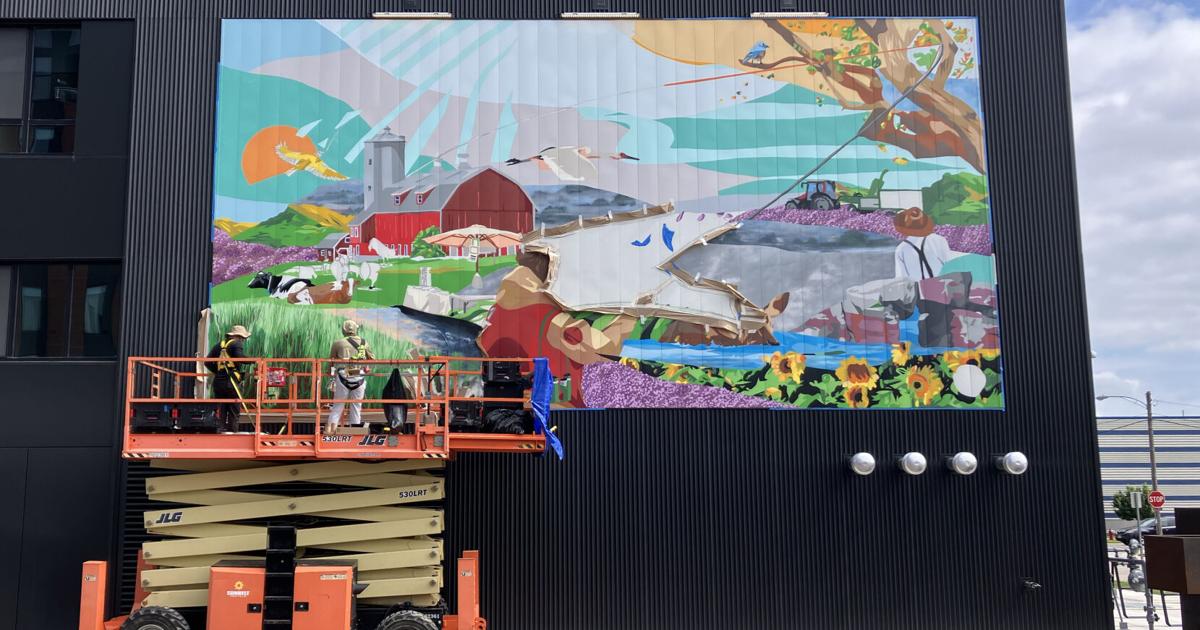
Janson Rapisarda was contracted for two murals at Bakers Place, a mass timber high-rise opened by Madison developer Neutral in spring 2025 off East Washington Avenue. Rapisarda worked on the murals between July and September of last year.
This was a solo project for Rapisarda, a Milwaukee-based artist who makes work as Jan the Voyager. Long before he turned to local media after months of going unpaid for his work — a total cost of $54,562 after compounding late charges, according to a history of emails shared with the Cap Times — he noticed a series of what he now considers tiny red flags.
First, what had looked at first like a public art project became a corporate commission, and Rapisarda said he had to do more revisions than he was contracted for. He noticed when the client, Neutral owner Nate Helbach, wouldn’t prioritize meetings to approve mock-ups. (Helbach did not respond to a request for comment by press time.)
That was frustrating but “it happens a lot,” Rapisarda said. He estimated he made around 15 mock-ups.
“The proposal he submitted looks absolutely nothing like the final work for either mural,” said Katie Batten, Rapisarda’s wife and fellow artist. Talarczyk eventually advocated on his behalf, Rapisarda said, and raised the rate.
Another red flag was non-payment of small things early on. Once, Madison Public Art Project rented an expensive scissor lift, which made Rapisarda feel obligated to continue to work despite the fact that Neutral hadn’t yet paid for the rental. These missed payments were detailed in emails among representatives from Neutral, the nonprofit and Rapisarda, which were shared with the Cap Times.
Batten took over as contact point after early calls and texts started to feel overwhelming. The texts were about “normal” things, Rapisarda said, like sending a videographer out to document the painting process, but the reminders felt relentless.
“I’d be taking my gloves off while I’m painting to text her, to deal with it, and then the film guy wouldn’t show up on time,” Rapisarda said.
Asked about this, Talarczyk wrote, “Public art is not a 9-5 kind of job. Sometimes the project requires working weekends, nights or holidays. … Some artists prefer calls while others prefer text or email.”
Janson Rapisarda, who makes work as Jan the Voyager, worked on two murals at Bakers Place in Madison. This one is called “Heritage Hollow.”
COURTESY OF JAN THE VOYAGER
What happened after the mural was complete has been well-documented — for months, Neutral didn’t pay. In a Milwaukee Journal-Sentinel story from September 2025 about a construction pause on another high-rise, the company gave a statement saying, in part, “recent tariffs and broader inflation have materially increased key input hard costs.”
Rapisarda sent dozens of emails. Neutral, he said, approved and then “unapproved” late fees, pushing payment deadlines again and again. (Emails shared with the Cap Times support this.)
In December, Rapisarda and Batten wrote to Karin Wolf, Madison’s city arts administrator, for help.
“At this point, I am unsure if I will ever receive payment,” Rapisarda wrote in an email the Cap Times obtained via a records request. “Neutral is citing issues with rising costs and tariffs, but their struggles should not fall onto the backs of Wisconsin artists.”
Wolf reached out to Madison Public Art Project with strong words, noting that the city and others engaged in public art making “have worked hard to establish Madison as a place where artists are valued and treated fairly.
“When payment issues like this arise, it undermines the trust we’ve built and can discourage talented artists from working here in the future.”
Talarczyk wrote to the Cap Times that the Madison Public Art Project “donated over $10,000 of legal support to ensure the artist was finally paid, and an additional $16,450 of unbilled hours to support the murals’ art scope.”
Rapisarda finally got paid when the building sold in April. Talarczyk said her nonprofit has now been paid, too — $12,537. “We are implementing additional legal measures to further ensure that artists are paid and paid on time,” she said.
Rapisarda has moved on, though he said talking about the experience still upsets him. He and Batten spoke from Massachusetts while working on a mural project there. The pair “don’t want to keep throwing Jillian under the bus,” they wrote in a follow-up email.
Their advice to artists now: “If you’re seeing red flags, like if you’re not seeing payment come through on time, take it seriously,” Rapisarda said. “And if you start to see them stack up, don’t be afraid to stop work.”
Audifax designed a mural under the Beltline Highway at the Monona Drive exit ramp in Monona. “Riding Waves” was commissioned by the Madison Public Art Project.
AMBER ARNOLD / WISCONSIN STATE JOURNAL
‘Scarcity creates difficult choices’
The state of Wisconsin has long been notoriously stingy with funding for the arts — near or at the bottom, year over year (currently the state ranks 48th, according to the National Assembly of State Arts Agencies).
Madison itself, despite programs like DAMA (Developing Artists, Murals & Alliances) and CODAworx, also has had limited funding for public art.
According to Wolf, the city’s budget for public art fluctuates, and most of its projects take several years. Prior to 2024, she estimated, the city spent about $110,000 a year on public art, and the last couple of years it has “probably been closer to $200,000 annually.”
“Now that we are full on implementing Percent for Art, I’m guessing the average spend will be much higher going forward,” Wolf said, referencing a city ordinance that dedicates 1% of major projects ($5 million or more) to public art.
At a recent Madison Arts Commission meeting, “we had a million dollars in public art projects on our agenda: Bartillon, State Street Campus Garage, South Point Operations Facility, Triangle, South Park,” Wolf said. “The list goes on.”
Artists working in Madison mostly want to do their work. Vornholt, the “Bloom in Flight” muralist, said “we’re painting because this is our art. It’s kind of — for me. This is my heart and soul.”
“If you’re labeled difficult to work with, there are so many talented artists around,” Vornholt added. “They’ll find somebody else. A lot of what we do is not just our art … we’re basically the spokesperson for our business.”
Alicia Rheal and Amy Zaremba install a new mural on the Regent Street side of a Bayview Foundation apartment building in 2023. Zaremba is working on a new mural now with Madison Public Art Project.
RUTHIE HAUGE
Amy Zaremba, another local artist, agreed. She is working with Talarczyk on a mural project right now called City Connections. Designed for Union Cab Cooperative’s building at 2458 Pennsylvania Ave., it was funded by sponsors and is set to go up at the end of the summer.
“Scarcity creates difficult choices,” Zaremba wrote in an email. “Public art has well-documented benefits for communities, yet public investment often doesn’t reflect that value.
“As a result, when opportunities arise … it can be hard to turn them down, even when there are concerns.”
Some artists who’ve worked with Madison Public Art Project, including the prolific local muralist Audifax, declined to talk about their experience. Talarczyk has required some artists to sign non-disclosure agreements, ostensibly so no one will steal the idea. “Sometimes (an NDA is) required to protect the project,” Talarczyk wrote.
Will Turnbull co-created “Canopy Understories,” on display in 2022 and 2023 at the Longenecker Horticultural Gardens inside the UW Arboretum. Turnbull said he and his studio partner signed non-disclosure agreements that prevent them from commenting on the process.
“I believe that clarity, transparency, openness and outside oversight are integral parts of the public art commissioning and fabrication process,” Turnbull wrote in a text response to a request for comment.
Kiersten Darling, a crochet artist based in Milwaukee, worked on a mural with Madison Public Art Project.
COURTESY OF KIERSTEN DARLING
Kiersten Darling, the Milwaukee textile artist who took over after Burbach left the “Wildflowers of Wisconsin” crochet mural, said if she ever worked with Talarczyk again she’d make some different choices.
For example, she would have insisted that Talarczyk hire someone to do social media, because that turned out to be beyond her capacity, and it may have been a better way to communicate to workshop attendees what level of crochet skill they were looking for. Still, Darling was happy with the pay rate.
“She was really mindful of wanting artists to be paid a fair wage, which doesn’t happen very often, especially in the fiber arts community,” Darling said. “Fiber arts takes so much work … Jillian respects artists and understands that, you know, you need to eat.
“I do know for a fact that when (fiber artists) partner with some of the big (brands) … they get paid pennies, and they’re just really taken advantage of,” Darling said. “They’re hoping the exposure will be enough.”
The volunteers for this project, she said, did the work for the love of crochet and community art, which she appreciated. “I was really surprised with how much time people donated to this project to make the flowers.”
Richie Morales works on paintings inside of his former Arts + Literature Laboratory studio in Madison.
RUTHIE HAUGE
Richie Morales, the Madison-based creator of the “Siempre Aprendiendo” (“Always Learning”) mural at 2200 Pennsylvania Ave. next to an open field across from Demetral Park, had only good things to say about the Madison Public Art Project.
“It was (an) amazing experience,” said Morales, whose mural full of hummingbirds and flowers went up in May 2025. “They gave me a lot of opportunity to create whatever I would like to create.”
Some projects are “very specific what they need and what they want,” Morales said. Here, he made about five mock-ups and was happy with the result. The contract covered extra work he did, like bookmarks, and included payment for a crew to transport and install his art.
“For me, it was good,” Morales said.
OhYa Studio artists (from left, Brian Kehoe, Ray Mawst and Emily Balsley) work on the “Flamingo Swirls” mural in 2020. Liubov Szwako, who makes work as Triangulador, connected the project with Madison Public Art Project.
AMBER ARNOLD / WISCONSIN STATE JOURNAL
Best practices for public art
Wolf has been the arts administrator for the city of Madison for close to two decades. When artists have approached her with complaints about Madison Public Art Project, she tries to be helpful while staying professionally neutral about Talarczyk and her work.
“I’m generally pretty excited that there are multiple entities, whether it’s her organization, which is a nonprofit, or community groups, or even colleagues at the city who get excited and want to incorporate more public art into our landscape,” Wolf said. “I think that’s a very positive direction.
“But I do believe that arts administration is a field — like many fields — where expertise is important. It shouldn’t be assumed that anyone can do this. … There are best practices.”
Many artists said a variation of what Darling, the “Wildflowers of Wisconsin” artist, said: Yes to more public art, with adjustments based on how those artists work.
“I want her (Talarczyk) to be able to keep doing what she’s doing, because there isn’t a lot of funding for public art,” Darling said, “and it would be really cool to have much more public art out there in the world. But I think it is a very specific type of person that would get along with her well.”
Burbach deleted her Instagram after breaking ties with the nonprofit and has not done any public art since. “I don’t want to be vindictive,” Burbach said. “I learned my lesson.”
Meanwhile, Zaremba is in the middle of her mural with Madison Public Art Project. She’s gotten a little public feedback on the mural’s theme and is determined to stay optimistic.
“I hoped that, following earlier challenges, the program would evolve in a more positive direction and provide stronger opportunities for artists,” Zaremba said.
“Many opportunities, whether independent or city-supported, come with tradeoffs,” Zaremba added. “As artists, particularly public artists, we have to weigh those carefully and decide whether the potential impact is worth the uncertainty.”