
A massive sandstone block at the heart of Stonehenge has puzzled archaeologists for decades. Known as the Altar Stone, the six-ton megalith stands apart from the monument’s other stones because of its unusual origin. Researchers now believe the stone came from northeast Scotland, around 700 kilometers from Stonehenge, raising fresh questions about how prehistoric people moved such a heavy object across Britain.
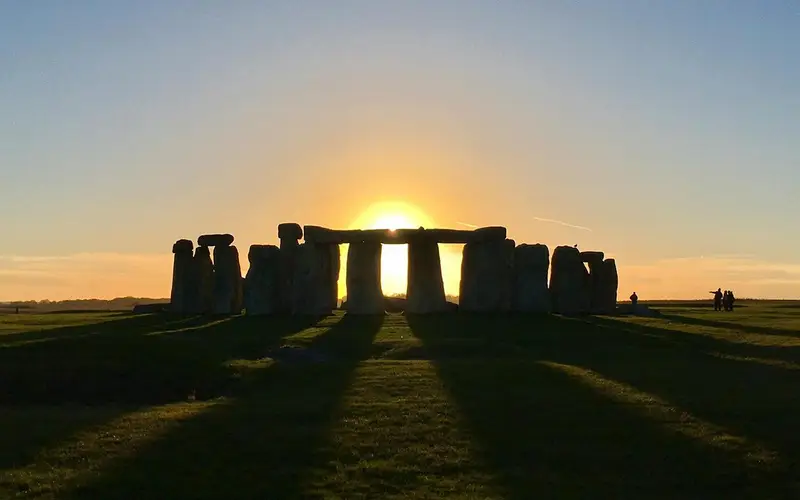 Stonehenge, one of the UK’s first world heritage sites. Credit: B A Fields/Pexels
A new study led by researchers at Curtin University examined both the geological source of the stone and the routes by which it could have reached Salisbury Plain. The team combined mineral analysis with computer models of ancient ice sheets to test a long-running idea that glaciers carried the stone south during the last Ice Age.
The results point in a different direction.
Scientists analyzed zircon minerals preserved within the sandstone. These minerals act like geological fingerprints, helping researchers match the Altar Stone to potential source areas. Sandstone deposits in Caithness, on the Scottish mainland, produced the closest match. Other areas within the Orcadian Basin shared some similarities, though none matched as closely.
The team then investigated whether glaciers could have transported material from Caithness to southern England. Their models showed ice movement from the region mostly traveled northeast. A narrower pathway carried material southeast toward Dogger Bank, a landmass that once connected Britain to continental Europe before rising seas submerged it.
If the Altar Stone reached Dogger Bank through glacial movement, people would still have needed to transport the stone roughly 400 kilometers to Stonehenge. Without any glacial assistance, the journey would have stretched close to 700 kilometers.
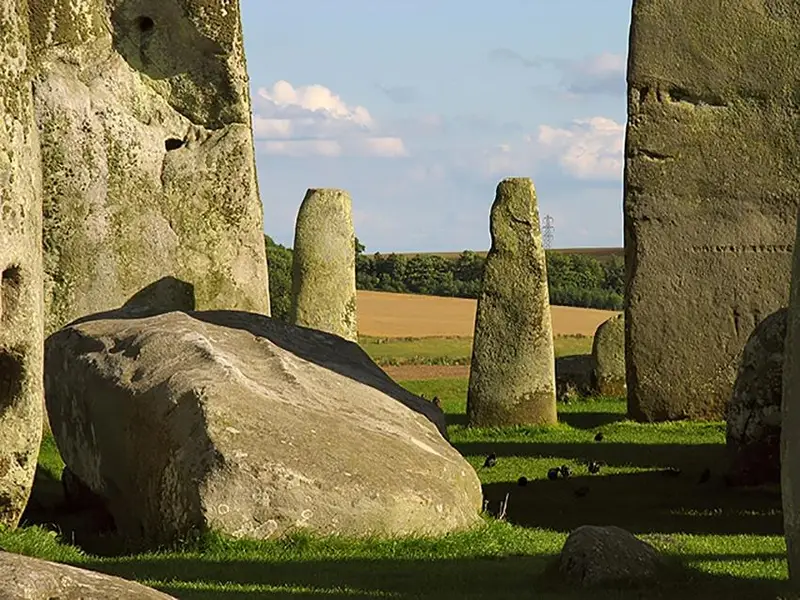 The Altar Stone at Stonehenge located on Salisbury Plain. Credit: Pam Brophy / Past the Stones: Stonehenge / CC BY-SA 2.0
Researchers found another problem with the glacial theory. Dogger Bank disappeared beneath the sea thousands of years before the Altar Stone likely arrived at Stonehenge. This timing makes a purely natural route difficult to explain.
The findings suggest glaciers played, at most, a limited role in the stone’s history. Human communities still carried responsibility for moving the megalith over a substantial distance.
Researchers propose a staged journey across different landscapes. People may have hauled the stone over land and used rivers or coastal waters when suitable routes were available. Transporting a six-ton block across hundreds of kilometers would have required planning, cooperation, and knowledge of the terrain.
The study adds to growing evidence that Neolithic communities managed large projects involving people from different regions. Stonehenge itself stands as one example of such coordination. The Altar Stone’s long journey now appears to reflect a similar level of effort and organization.
Future work will focus on identifying the stone’s exact source in northeast Scotland and reconstructing the route prehistoric communities used to bring one of Stonehenge’s most enigmatic stones to its final destination.
More information: Clarke, A. J. I., Veness, R. L. J., Kirkland, C. L., Clark, C. D., Gandy, N., Emery, A., … Ádám, I. (2026). From highlands to henge: Refining the provenance and transport pathways of stonehenge’s Altar Stone. Journal of Quaternary Science, (jqs.70080). doi:10.1002/jqs.70080