
The Windup Newsletter ⚾ | This is The Athletic’s MLB newsletter. Sign up here to receive The Windup directly in your inbox.
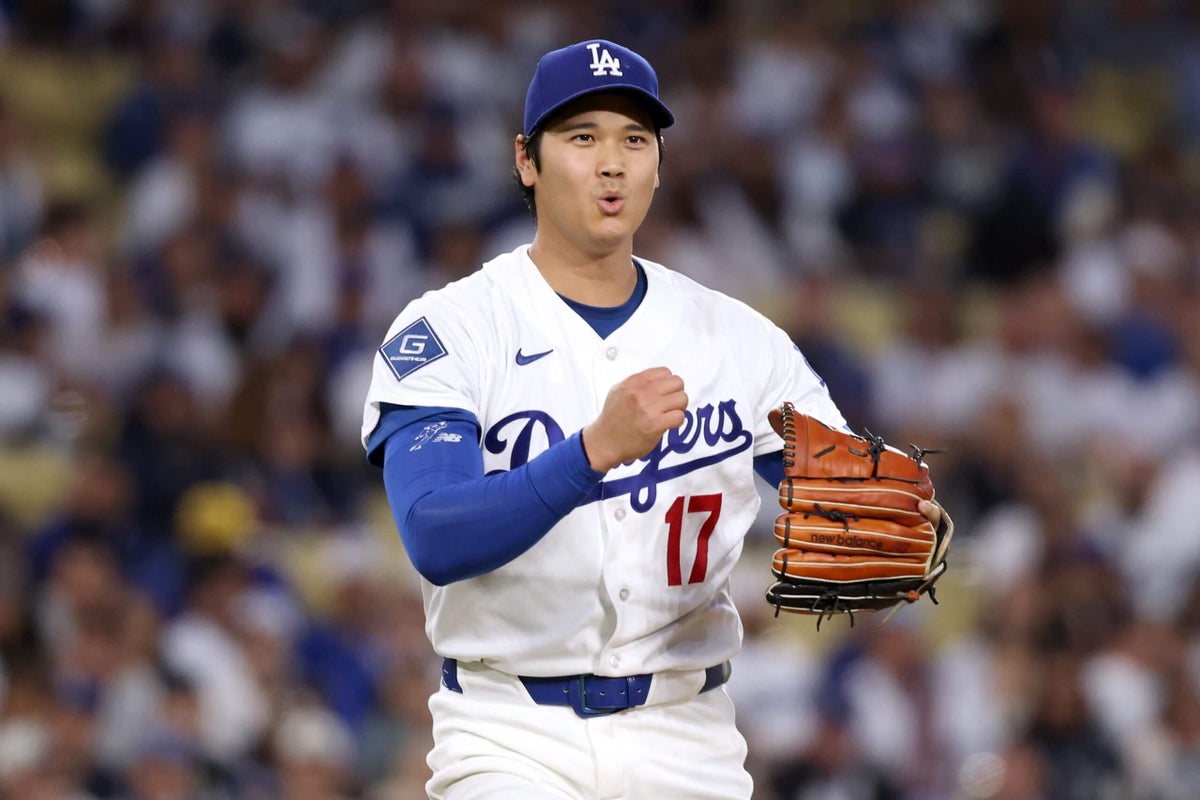
If you see magic for enough days in a row, sometimes you forget it’s magic. So, let’s pause and acknowledge what we’re seeing from Shohei Ohtani.
Plus: We’ve got Ken Rosenthal on the Padres’ deadline plans, a deep dive into why some teams get injured more and [deep sigh] I found another rabbit hole. I’m Levi Weaver — welcome to The Windup!
WHAT?! Ohtani is just not normal
When watching Ohtani, human nature can almost trick me into forgetting just how distinct a player I’m seeing.
Take last night, for example: Ohtani reached base five times (3-for-4 with two walks) while pitching six innings, allowing no runs on two hits and one walk and striking out six in a 7-0 win. Further, his ERA after 10 starts is now 0.74. According to MLB’s Sarah Langs, that’s the third-best such mark in MLB history, trailing just 2021 Jacob deGrom (0.56) and 1966 Juan Marichal (0.66).
Don’t forget: This is also the first player in MLB history to post a 50 HR/50 stolen bases season. The guy who has led the sport in runs scored and total bases in each of the last two years.
Even if you’re getting used to it, it’s just so incredibly not normal.
More Ohtani: Elise Devlin tells us about the system Ohtani has employed since high school to achieve his goals.
Middle Relief: Can Padres be buyers after being bought?
Today, we have an excerpt from Ken’s latest notes column.
If Fernando Tatis Jr., Manny Machado and Jackson Merrill fail to hit to their accustomed levels, Padres president of baseball operations A.J. Preller might consider it futile to adopt his usual frenzied approach at the trade deadline.
But seriously, does anyone expect that out of the executive who gives the entire sport whiplash virtually every year?
If anything, Preller could become even more dangerous once the Padres’ $3.9 billion sale to José E. Feliciano and his wife, Kwanza Jones, is finalized. At the past three deadlines, Preller operated with limited payroll flexibility. Some teams hear that Feliciano and Jones, while not yet approved, plan to grant him greater financial leeway.
The Padres’ farm system, depleted from all of Preller’s wheeling and dealing, is the worst in baseball, according to The Athletic’s Keith Law. But people seem to say that every year, and every year Preller comes up with prospects to trade.
The bigger questions, perhaps, are whether the Padres will merit reinforcement at the deadline, and what their biggest needs might be.
Somehow, the Padres are tied with the Cardinals for the first wild-card spot in the National League. With Tatis, Machado and Merrill all sporting OPSes below .700. With the offense through Tuesday ranked ahead only of the Royals in runs per game. With right-hander Yu Darvish spending all season on the restricted list while recovering from major elbow surgery, and with Nick Pivetta and Joe Musgrove still not close to returning from injuries.
Tatis has been hot of late, but complementary players such as Gavin Sheets, Miguel Andujar and Ty France have been among the Padres’ biggest offensive contributors. If Machado and Merrill return to form, the team’s lineup should be in relatively decent shape.
Then again, another outfielder could help. Ramón Laureano struggled before going on the injured list with a hip issue. Nick Castellanos was designated for assignment Wednesday after batting .191 with a .560 OPS in 122 plate appearances.
The bigger void, though, almost certainly will be in the rotation, which the Padres have been piecing together behind righties Michael King and Randy Vásquez all season.
Ouch: A deep dive on injuries
I’ve often wondered why some organizations seem to lose more players to injury, while others … well, injuries happen everywhere. Nobody is immune.
But some teams are hurt more than others, right?
Today, we get a deep dive from Eno Sarris and Britt Ghiroli, and yes: The Yankees, Mets and Orioles consistently lose more player time to injury than other teams. But the reason is not as simple as an incompetent training staff.
There are many factors, it turns out: financial flexibility, the willingness to take on injury risk and even a team’s tendency to embrace (or eschew) advancements in tech, data and analytics that will benefit a player’s performance.
Youth sports are also a factor, as kids are exposed to advanced training early. More than 50 percent of Tommy John surgeries are now done on players under the age of 20.
For a sport that has been in an injury crisis for the better part of a decade, the story is a fascinating look at the various factors that could be contributing to it. I recommend the read.
Another Rabbit Hole: What’s the most common uniform number?
This started on Tuesday night, watching Dustin May (No. 3) pitch to Joc Pederson (No. 3), both wearing a No. 4 patch (Lou Gehrig Day). I recalled that Pederson had worn No. 4 last year and that May used to wear 85, which is oddly retired in St. Louis for a former owner.
So of course my brain’s next question was: “I wonder which uniform number has been worn by the most players?” Maybe Ted Lasso was wrong.
Anyway, I had to know.
Step one: Is this Google-able? Sorta. Ultimately, it did give me the right answer. But the link was more than 10 years (and 22,000 MLB games) old. I had to fact-check it myself.
Step two: Build a spreadsheet. You can see the final product here, and if you’re curious about the methodology, there’s a second tab with notes. It took two days, so while I worked, I had more questions — about retired numbers!
Step three: fun facts!
The most commonly retired number — not counting Jackie Robinson’s 42 — is 10.
Of the numbers between 1 and 50, only two have never been retired by any team: 38 and 48.
The Marlins are the only team with no retired numbers. They once had No. 5 retired for their first team president, but un-retired it for Logan Morrison (which is very funny to me).
Speaking of which: Four numbers have been retired without a player ever wearing them. Two are managers — Don Zimmer (66, Rays) and Casey Stengel (37, Mets) — one is August Busch Jr.’s No. 85 in St. Louis, and the other is No. 33 in Pittsburgh, retired for Honus Wagner, since that’s the number he used as a coach (when he played, there were no uniform numbers).
And then there’s the opposite of that: The most commonly issued number in Phillies history is No. 34, which has been issued to 63 different players. It’s also now retired, for Roy Halladay.
The most-issued team-number combo of all time is: “Yankees, No. 38,” which has been worn by 75 players, from Marius Russo in 1939 to Devin Williams last year.
Most cases of a player being the only player in team history to wear a number are in those lineman-esque 70s-through-90s numbers. But the lowest (non-zero) number to have been worn by one person in team history was … Lou Gehrig’s No. 4 with the Yankees.
Speaking of the Yankees, they not only have the most retired numbers, but they’ve also used more of the 1-100 options than any other team. The only number they haven’t issued is No. 87.
And of course, the answer to the original question: The most commonly issued number in baseball history is … drumroll, please …
🥁🥁🥁🥁🥁🥁🥁🥁🥁🥁🥁🥁🥁🥁🥁🥁
… 22, worn by 1,103 players (No. 12 is close at 1,098).
Bonus: The number that has been issued to the fewest players? 1/8, which was issued only to Eddie Gaedel of the St. Louis Browns in 1951 (meaning it beat 86, 89 and 91 by 49 years). But the least-frequent whole number is now 95, which has been worn by just five players in MLB history, from Takahito Nomura (2002 Brewers) to Josh Ekness this year with the Marlins.
Handshakes and High Fives
Cristopher Sánchez finally allowed a run after 50 2/3 scoreless innings. It’s the longest by any left-handed pitcher, and the fifth-longest in MLB history.
Aaron Judge underwent more tests on his right rib (bone bruise). The results? He needs even more imaging.
Commissioner Rob Manfred called the league’s current luxury tax system a “failure.” But his tune has changed in recent years.
The Pirates had an 8-3 lead in the seventh inning in Houston. They lost 11-9. These highlights are made better by the person screaming as each pitch is thrown.
The Padres are 2-8 in their last 10 games, and the Nick Castellanos experiment is over.
The “Three Best Leaders …” series continues with LaTroy Hawkins, who spent 21 years in the big leagues.
It won’t make the Red Sox not regret trading Kyle Harrison, but Caleb Durbin appears to be having a breakthrough with a new private hitting instructor.
Most-clicked in our last Windup: We have a repeat winner: The league’s first 3-6-3-6 double play since 1972.
📫 Love The Windup? Check out The Athletic’s other newsletters.