
Mirrors have long been used by scientists to test how animals think. When a monkey finds hidden food by looking at a reflection, something beyond basic instinct is understood to be at work.
A connection is being made between what is seen in the glass and what exists somewhere else in the room. Until now, this ability had only been recorded in animals with backbones.
That understanding has been changed by a study published by researchers at Dartmouth College.
Octopuses trained to use mirrors
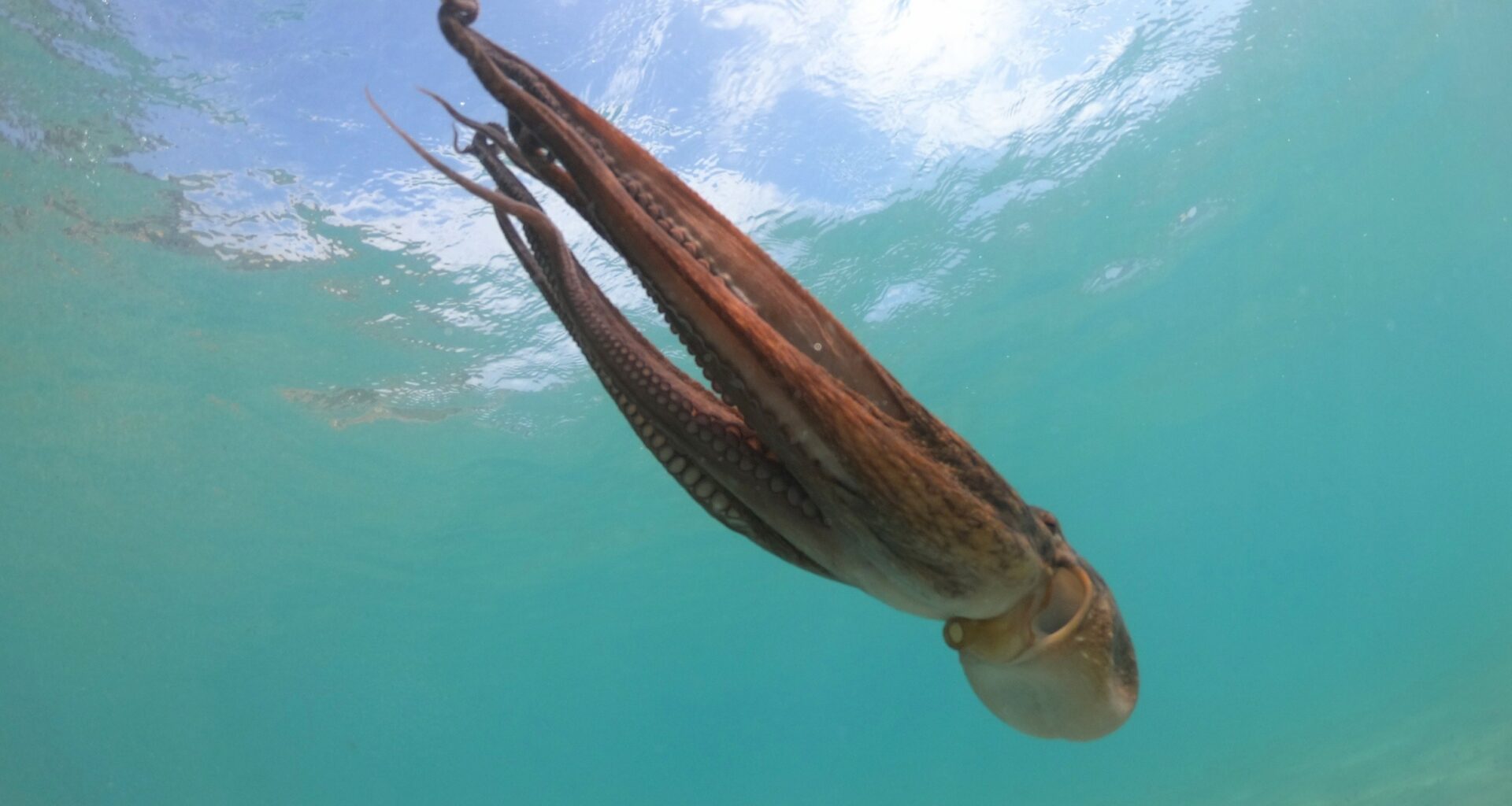
Three California two-spot octopuses were trained to use a mirror to find a hidden reward.
The correct side of the tank was chosen roughly 73 percent of the time. It was demonstrated, for the first time, that an invertebrate is capable of using a mirror as a spatial tool.
“Our findings are the first to demonstrate that invertebrates can use mirrors to understand their environment to find prey,” says lead author Mary Kieseler, now a postdoc at Switzerland’s University of Fribourg.
“It’s a skill that previously has only been documented in vertebrates, such as in some mammals and some birds.”
Mirrors reveal spatial reasoning
The use of mirrors in animal cognition research is not new. Monkeys, dogs, pigs, crows, and parrots have all been tested with mirrors.
In each case, a reflection had to be interpreted to locate something not directly visible. More than sharp vision is required for this. A mental link must be made between a reflected image and a real location in space.
Every animal in which this ability had been recorded shared one characteristic: a backbone. No invertebrate had ever been shown capable of it. The Dartmouth study set out to change that.
Unusual animals show intelligence
Octopuses are separated from vertebrates by more than 520 million years of evolution. Their brains are structured very differently from those of mammals, and a large portion of their neurons are spread across their eight arms.
By most traditional measures, they would not be expected to perform a task requiring spatial reasoning from a reflected image.
And yet, puzzles are solved by octopuses, individual humans are recognised by them, and tools are used by them in the wild.
Earlier studies also showed that mirror images are reacted to by octopuses as though another animal were present. Whether any understanding of what a mirror actually is had been developed by these animals remained unknown.
Octopuses learn mirror clues
The experiment was carried out in phases. First, a mirror was placed in the tank and the octopuses were allowed to explore it freely.
Then training began. A live crab in a glass jar was hidden behind a barrier, visible only through its mirror reflection.
At first, the reflection was approached directly by each animal, as though the crab were inside the mirror itself. Between ten and twelve practice trials were needed before each octopus learned to go straight to the jar.
“We don’t enter the world knowing how to use a mirror but learn how to use a mirror,” says senior author Peter Tse, a professor of psychological and brain sciences at Dartmouth.
Like people learning to use a rearview mirror while driving, octopuses can learn that a mirror helps them find things around them.
Virtual prey in a mirror
For the main testing phase, a virtual crab was used instead of a live one, so that only visual cues could be relied upon by the octopuses.
A white crab silhouette was projected onto a screen at the back of the tank, either on the left or the right side.
Each octopus was placed in a small chamber whose walls blocked any direct view of the screen. The crab’s location could only be known through its mirror reflection.
To receive a real crab reward, the correct side had to be reached after a 180-degree turn away from the mirror.
All three octopuses learned to do this, with the correct side being chosen in roughly 73 percent of trials.
Octopuses may have mental maps
In 59 percent of correct trials, the chamber walls were climbed over by the octopuses rather than the longer route being taken around the outside.
This required movement away from the visible reflection and a barrier to be scaled before the target location could be seen.
A simple learned association between a reflection and a reward would not predict this. It suggests instead that the crab’s position was being held in mind as a location in three-dimensional space.
“Hunters are very effective when they have a mental map of their territory,” said Tse. “Our work suggests that octopuses might also have internal maps, an internal representation of space.”
Instincts were overridden
To complete the task correctly, a deeply ingrained predatory instinct also had to be suppressed each time.
“Octopuses are like cats: they will sneak up on their prey and pounce, and they want to do so as fast as possible, so that they don’t become preyed upon,” said Tse.
When prey is seen, the natural response is to move toward it immediately. For this experiment, that response had to be set aside and a different direction taken.
That this was learned and repeated consistently across trials is seen by the team as evidence of deliberate self-regulation, not reflex.
The findings need more evidence
It is acknowledged by the authors that the study has limitations. Only three octopuses completed the full experiment, as others either declined in health before finishing or were used in earlier pilot work.
A sample of three is small, and further research with larger groups will be needed.
It is also noted that two explanations for the behaviour could not be cleanly separated by this study. One is that a simple association was learned between a reflection and a reward location.
The other is that a genuine internal spatial map was being used. Both remain consistent with parts of the data, and additional experiments will be required to tell them apart.
Similar intelligence evolved separately
“Octopuses are among the most evolutionarily distant animals from humans, as our last common ancestor was a worm that lived 350 to 500 million years ago,” said Kieseler.
“Given that such a remote organism has independently evolved the means to use a mirror as a tool to process spatial cognition suggests that the underlying cognitive processes might be subject to convergent evolution, where different species evolve similar neural solutions to the same challenge.”
Mirror-based spatial navigation has now been observed in mammals, birds, and cephalopods, three groups that share almost no common cognitive ancestry.
That the same ability appears to have been reached independently through entirely different evolutionary paths suggests it may represent a universal solution to navigating complex environments.
The study is published in the journal Current Biology.
—–
Like what you read? Subscribe to our newsletter for engaging articles, exclusive content, and the latest updates.
Check us out on EarthSnap, a free app brought to you by Eric Ralls and Earth.com.
—–