
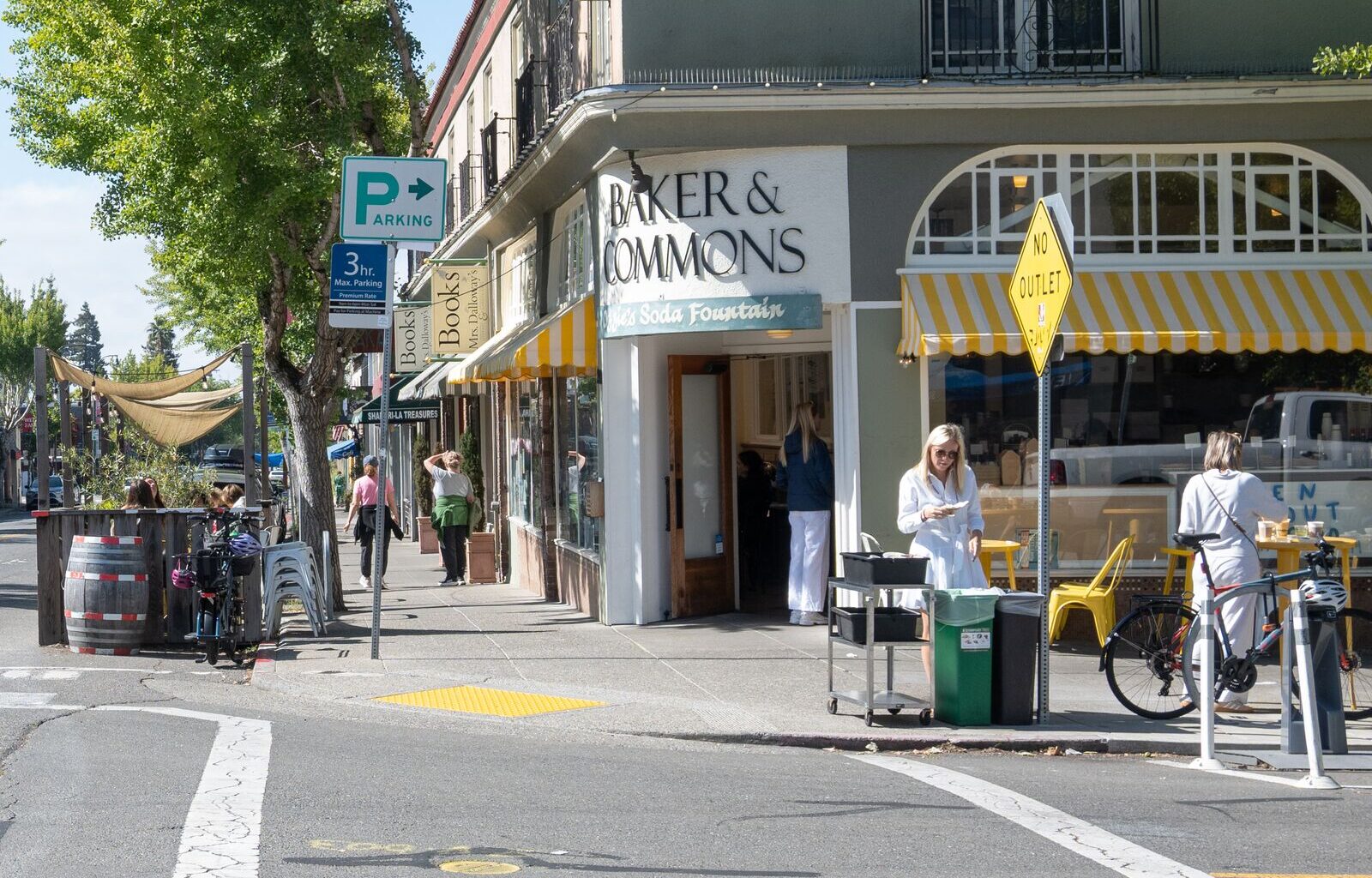
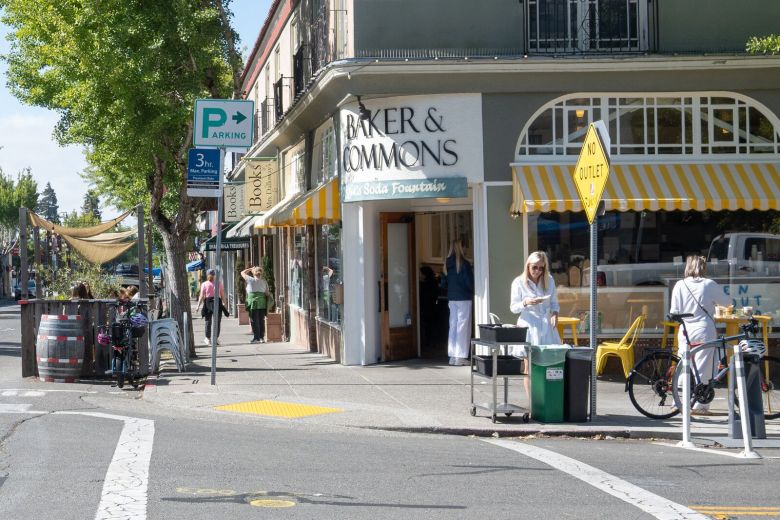
 Preservationists sought to declare the Elmwood neighborhood’s commercial strip a “historic district.” Critics said the campaign sought to block housing in the neighborhood. Credit: Hope Muñoz/Berkeleyside
Berkeley’s Landmarks Preservation Commission narrowly turned down a proposal to declare the Elmwood neighborhood’s commercial strip a “historic district” Thursday, dealing a defeat to residents and merchants who sought the status in hopes of limiting changes in the area city officials have targeted for new housing.
Hundreds of people, including 17 owners of commercial properties in the neighborhood, signed petitions in support of the designation, which would have made it more difficult to demolish and redevelop buildings in the district. That’s the outcome many critics fear will happen if Berkeley adopts a set of proposed zoning changes that would raise height limits on College Avenue in the Elmwood District, along with portions of Shattuck and Solano avenues in North Berkeley, to encourage apartment buildings in those areas. The City Council is expected to vote on the zoning proposal this summer.
“It is a functioning, vibrant, commercial and residential area,” resident Amy Clyde said of the Elmwood during the public comment period at Thursday’s meeting. “People are trying to create public spaces like this all of the time, all over the country — why would we not want to keep this just the way it is?”
Housing advocates blasted the historic district application as an attempt to undermine the zoning changes and create barriers to building homes in a historically wealthy and exclusive neighborhood. While the rezoning is a separate process, speakers Thursday night often invoked the potential for new development in the Elmwood as a reason to support or oppose the designation.
“The fact that people are talking about upzoning and housing gives away the game that this entire proposal is a sham to block housing,” said Elmwood resident Alana Kinrich.
Kinrich is married to newly appointed landmarks Commissioner Theo Gordon, a housing advocate and critic of the historic district application who was appointed to fill a vacant seat on the body ahead of Thursday’s meeting by Councilmember Terry Taplin. The addition of Gordon and another new commissioner, Barry Fike, swung the 5-4 vote that rejected the historic district application; Fike, a former president of the Berkeley Federation of Teachers, was tapped by Mayor Adena Ishii.
The application for the historic district sought to extend protections to 34 Elmwood properties stretching from a nail salon and strip mall just north of Russell Street to the neighborhood’s post office at Webster Street. Preservationist Anthony Bruce described the area, where most structures were built between 1907 and 1928, as “one of Berkeley’s most remarkable and best-preserved neighborhood shopping districts” in the application.
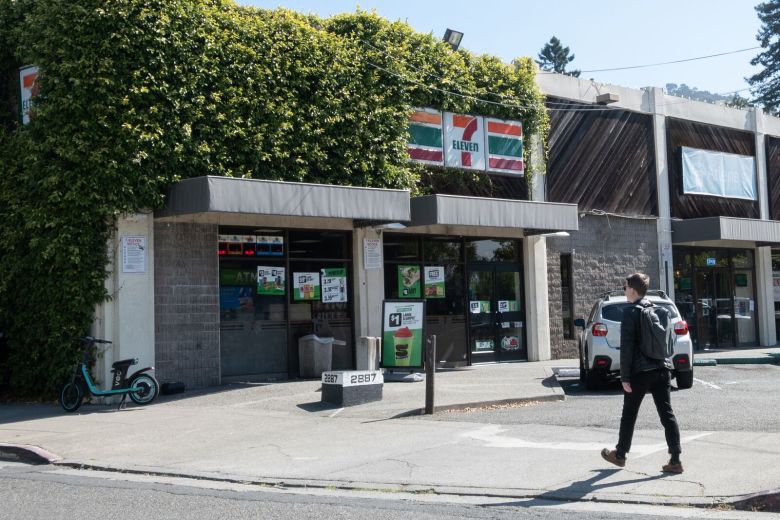 Proponents of the historic district designation sought to extend protections to a strip mall anchored by a 7-Eleven that planners say could be redeveloped. The complex was built as a grocery store in the 1930s, then heavily renovated in the 1970s. Credit: Hope Muñoz/Berkeleyside
City planning staff wrote in a report that 28 properties in the neighborhood could qualify for the historic district designation, saying the strip has significance because it was the first area designated for commercial activity in Berkeley’s 1916 zoning ordinance.
The narrower list of properties would leave out the post office, which was built in the mid-1970s; the strip mall, a former grocery store that was heavily renovated around the same time; and the parking lot behind the neighborhood’s Wells Fargo branch, among others. Planners say those three sites are some of the only places in the Elmwood where a developer might realistically build housing under the rezoning plan.
Commissioners who opposed the designation said it would be inappropriate for Berkeley to honor how the Elmwood was shaped by the 1916 zoning code. That ordinance made the residential blocks next to the shopping district the first neighborhood in the country zoned exclusively for single-family homes, a category that cities nationwide would use to impose racial segregation by economic means.
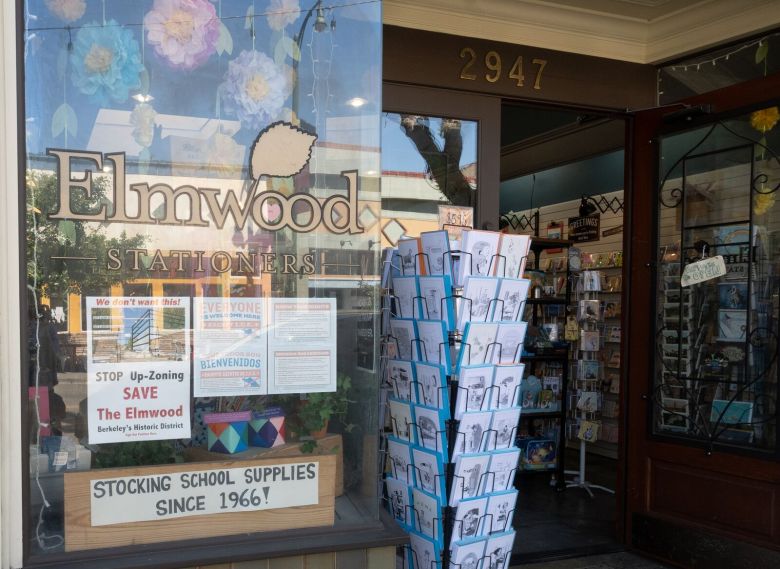 Several businesses in the Elmwood District have posted signs opposing a plan to raise height limits in an effort to spur housing construction in the neighborhood. Credit: Hope Muñoz/Berkeleyside
And while supporters pointed out that the designation would not bar new development in the neighborhood outright, critics said it would make the process for building anything there much more complex. Projects within the district would be subject to a discretionary review by the Landmarks Commission and potentially the City Council, which could take up to a year and a half.
“It is a very expensive and long process,” Gordon said. “That uncertainty makes it even harder [to build housing], and leads to abandoned projects.”
Commissioners also questioned whether the district as a whole was worth designating as historic, or if their body should instead bestow landmark status on specific properties. The Wells Fargo branch, which opened in 1925 as the Mercantile Trust Company Building, and a former hardware store next door to it are already city landmarks.
“Landmarking the entire district is too broad,” said Commissioner Paul Schwartz, who at a meeting last month said he was inclined to support the designation but had changed his thinking by Thursday. “If there are structures that are worthy of landmarking, they should come forward one by one.”
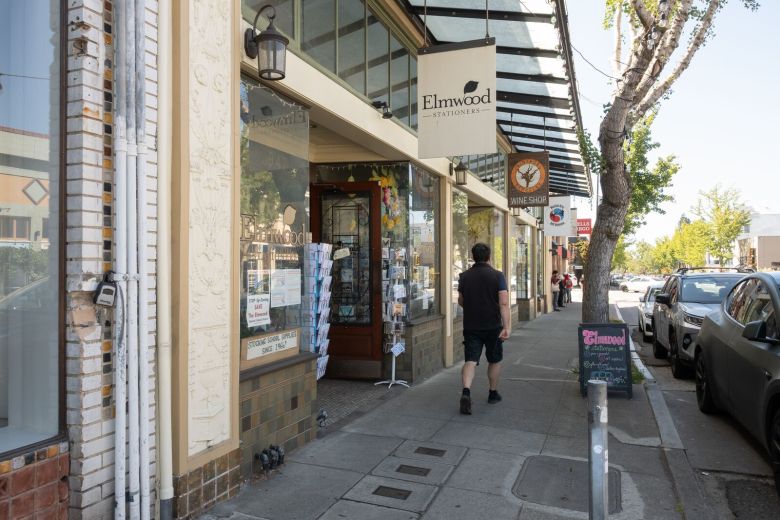 Most of the Elmwood District’s commercial strip was built between 1907 and 1928. Credit: Hope Muñoz/Berkeleyside
Commissioner Susan Orbuch argued that while some buildings had more architectural or historical merit than others, they combine to create a neighborhood that is worth recognizing.
“I don’t believe all of the buildings on College Avenue are landmark-worthy,” Orbuch said, but “they still contribute to what makes that a street that has vibrancy, character [and] historic merit.”
Supporters of the designation also sought to disentangle the commercial district’s ties to the 1916 zoning ordinance from the residential segregation and red-lining that shaped the Elmwood for much of the 20th century. Commissioner Steve Finacom said the early zoning code was focused on how to separate commercial activity from residential areas, and noted some of the neighborhood’s businesses were run by people of color. Segregation in Elmwood’s residential blocks was enforced by racist language in the deeds to many homes, Finacom said, and “was not a zoning issue.”
Orbuch, Finacom and commissioners Kathleen Crandall and Michael Montilla voted in favor of the historic district designation. Gordon, Schwartz and Fike joined commissioners Ellie Greene and Molly Turner in voting against it. After the motion to approve the designation failed, Orbuch asked that the commissioners consider landmarking specific Elmwood properties at the body’s next meeting in July.
Correction: An earlier version of this article incorrectly described the recommendation planning staff made to the Landmarks Preservation Commission. Staff advised the commission that 28 properties in the Elmwood neighborhood would meet the criteria for a historic district, however they did not specifically recommend that the body approve the district application.
“*” indicates required fields