
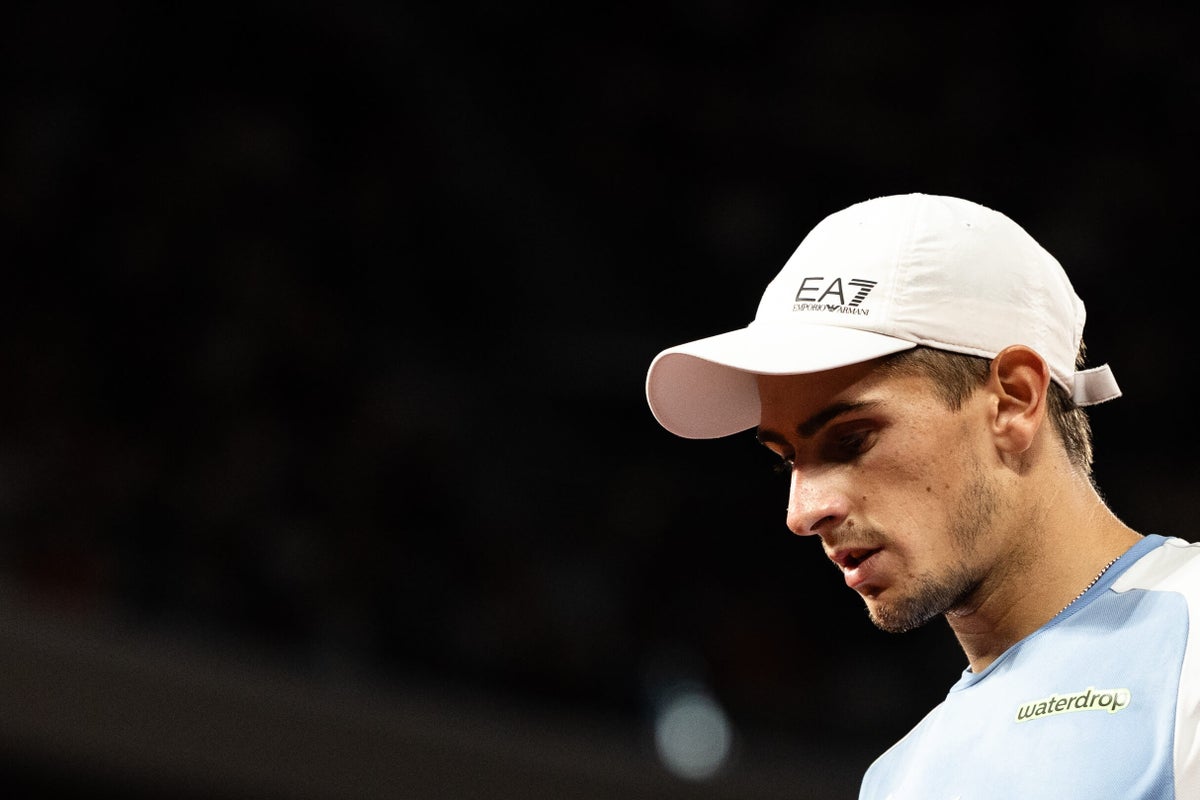
PARIS — Italy’s Matteo Arnaldi withdrew from his French Open semifinal Friday against compatriot and No. 10 seed, Flavio Cobolli, around 20 minutes before the two players were due on Court Philippe-Chatrier.
According to tournament organizers, Arnaldi, the 25-year-old world No. 104 who had a storybook run to the final four, came down with a virus ahead of the match and could not play.
Tennis does not allow someone who has been eliminated from the main draw of a tournament to take the place of someone who has beaten them. Fans will be reimbursed for their tickets, tournament organizers said.
“When he came to me almost one hour ago, I almost cried,” Cobolli said in a joint news conference after the announcement. “It’s something you don’t expect at all. I was completely sad for him.”
Arnaldi said he started feeling ill Thursday evening. After dinner, he went back to his hotel but woke up sick and vomiting around 1 a.m.
“I had a fever too during the day. I can’t move, I can’t eat, I can’t drink. There was no way I would be able to play. I feel sorry for all the fans,” he said.
Arnaldi’s withdrawal is the first at a Grand Slam semifinal since 2022, when Rafael Nadal pulled out of the Wimbledon semifinal against Nick Kyrgios, sending the Australian to the first and only Grand Slam final of his career to date. He lost to Novak Djokovic in four sets.
Cobolli will face No. 2 seed Alexander Zverev Sunday, after the 29-year-old German defeated Jakub Menšík of the Czech Republic earlier Friday.
It was the latest bizarre turn for a tournament that has been full of them: Carlos Alcaraz could not defend his title because of a wrist injury. Jannik Sinner was overcome by ill health, heat and cramps in his second-round match, losing to Juan Manuel Cerúndolo in five sets after being one game from a three-set win.
Novak Djokovic lost to João Fonseca the next day after being up two-sets-to-love, doing so for only the second time in 303 such matches.
The women’s world No. 114, Maja Chwalińska, is in the women’s final. The women’s world No. 1, Aryna Sabalenka, was within two points of closing out a quarterfinal win against No. 22 seed Diana Shnaider, then lost 10 games in a row and went out.
Four-time champion and world No. 2 Iga Świątek lost in the fourth round. Coco Gauff, the defending champion, lost in the third round.
Arnaldi’s withdrawal, combined with Zverev’s win over Menšík, sets up a final showdown that few would have predicted when the tournament started.
Zverev was already a three-time Grand Slam finalist, the world No. 3, and by far the best of the field outside of Sinner, Alcaraz and Djokovic, at least in terms of Djokovic’s Grand Slam record.
He is a terrific clay-court player who can take advantage of the additional time that clay provides and the height the ball reaches after it bounces. During the past six months, he has committed himself to playing with more intent, rather than hanging in the back of the court and trying to grind opponents into submission.
Zverev has been the most bankable player in the men’s draw, though Cobolli has been a close second, dropping just two sets in five matches. Friday would have been Cobolli’s first Grand Slam semifinal. Thus, Sunday will be his first Grand Slam final.
For Zverev, it’s been six years since he played someone besides Jannik Sinner or Carlos Alcaraz in a Grand Slam final. At the 2020 U.S. Open, which was Zverev’s first major final, he faced Dominic Thiem of Austria. He led two sets to love, and was up a service break and served for the match in the fifth set. He lost in a tiebreak.
Thiem, the No. 2 seed, was the favorite in that match, but not by much. Zverev was 23 and had beaten each of the Big Three already, and won the ATP Tour Finals.
He will be a big favorite heading into this final, and if Zverev serves on Sunday as he did Friday, Cobolli, the No. 10 seed, could be in for a long afternoon. It will be four full days since he last played a match, which was his quarterfinal win over Felix Auger-Aliassime in the late afternoon and early evening Wednesday.
He didn’t need the rest, but now he has it.
“Sometimes it helps, sometimes it’s not,” he said in the news conference with Arnaldi. “You lose the rhythm, but I think also during warming up, I played really well. Now I got practice again.”
The only risk is being stale.
“Maybe it helped, maybe not. I’ll tell you after the final,” he said.
Arnaldi, who survived consecutive five-set comeback wins in the third and fourth rounds, will only be able to watch. “To have to withdraw from the first Slam semifinal is not something that you wish to anybody. … That was the right decision for me to take,” he said.
In a very dramatic Roland Garros, there may be more drama to come.