
Follow The Athletic’s French Open coverage
Welcome to the French Open briefing, where The Athletic will explain the stories behind the stories on each day of the tournament.
On Day 13, two men’s singles semifinals were slated, but only one was played.
How did a semifinal reveal the tennis gap between ceiling and floor?
If tennis matches were won by the player who hit the highest level, then Jakub Menšík might have been crowned the victor against Alexander Zverev Friday.
Having gone off court for medical treatment early in the third set, when trailing by two sets to love, Menšík, the 20-year-old No. 26 seed from the Czech Republic, suddenly entered a purple patch. He hit two brilliant forehand drop shots, the second a winner, to break Germany’s Zverev for the first time in the match and lead 4-2.
A couple of games later, Menšík used serve-and-volley tactics on three straight points to get to 5-3, 40-0. That gave him three set points. He took the first with another sensational drop shot, this time on the backhand side.
But what happened in the match before and after was defined by how much higher Zverev’s floor was compared to his opponent’s. When Menšík had dips, especially in the second set, No. 2 seed Zverev, 29, didn’t, instead maintaining a solid level that his opponent couldn’t match over the course of a 7-5, 6-2, 3-6, 6-3 win that sent him into his fourth Grand Slam final.
And after Menšík had hit that high to win the third set, it was followed by a dip that felt almost inevitable. Zverev broke his serve to lead 2-0 at the start of the fourth, just as Menšík had finally generated some momentum. Menšík tried another drop shot to start the game, but this time Zverev was onto it, flicking away a backhand passing shot winner in response.
Menšík then tried to pull the trigger early with a backhand but sent it into the net, before making a mess of a volley off a powerful Zverev return. Menšík went for too much with another backhand down break point and that was the game, and ultimately the match.
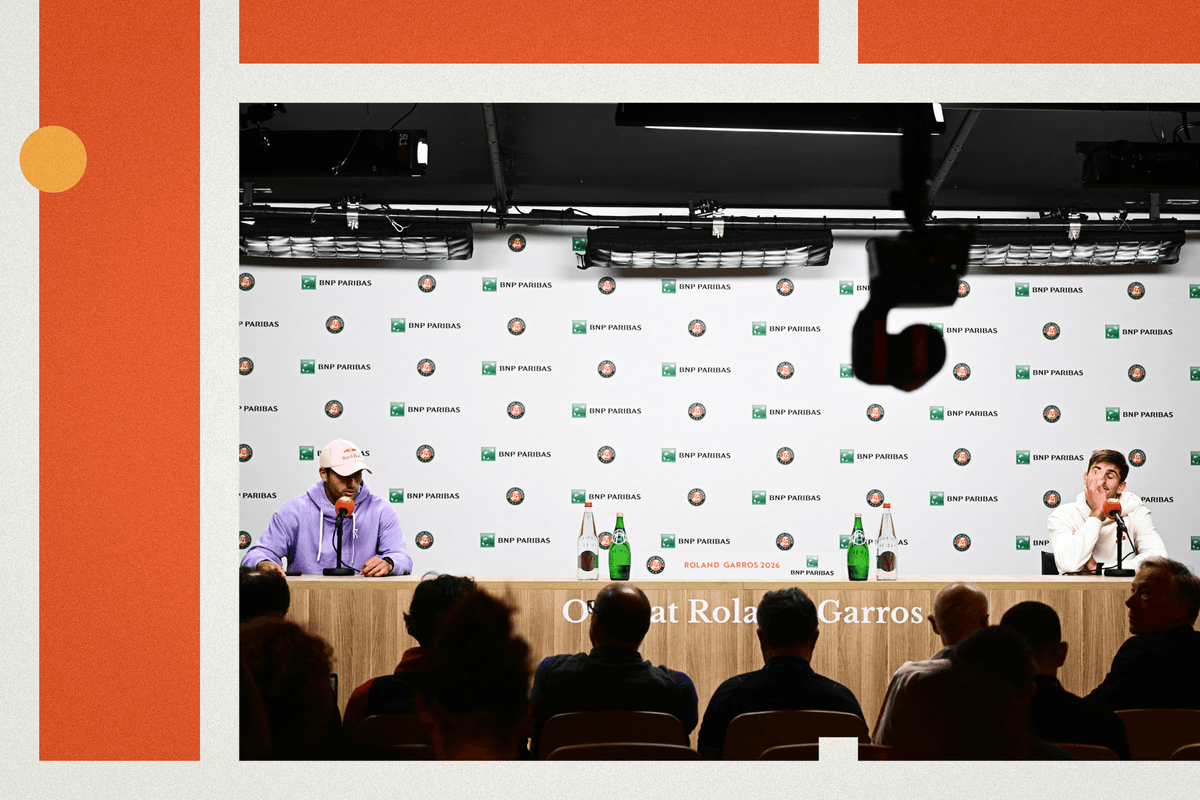
“Sascha is third in the world for a reason,” Menšík said in a post-match news conference. “He’s the guy who doesn’t allow you to be longer time in your side of the momentum. So even if I had some great games and had some opportunities, still, with his huge serves and basically, strong game from the baseline, it was super difficult for me to attack him, and of course, as well, to find the momentum and take the momentum on my side.”
No sooner had Menšík fought his way back into the contest than it was out of his hands again. Zverev’s level had barely fluctuated in the meantime — he hadn’t played a bad game to be broken, nor had he played an especially good one to break.
“I still felt like I was mostly in control (at the end of the third set) and that if I get back to having chances and if I use them once or twice, I will get back into the match and be the winner in the end,” Zverev said in a news conference.
“That’s all I told myself. A five-set match is long.”
— Charlie Eccleshare
How did Matteo Arnaldi’s withdrawal stun Roland Garros?
A cheerful tennis star having a knock in front of smiling fans. A host standing at the side to conduct the entertainment. And a fan running onto the court (after being invited to do so) to win a point with a no-look drop shot against a pro.
This kind of scene has become a familiar one at three of the four Grand Slams the past few years, as the Australian, French, and U.S. Opens add entertainment to the week that immediately precedes the main fortnight of each tournament. Wimbledon does not yet engage in such trifles.
But Friday evening in Paris, before the sun had set on Roland Garros, that was how men’s finalist Flavio Cobolli, the Italian No. 10 seed, found himself spending his time.
Cobolli, 24, was in hit-and-giggle mode after sobering news. Around an hour earlier, his compatriot, 25-year-old world No. 104 Matteo Arnaldi, had withdrawn from their semifinal with a virus. It sent Cobolli into a maiden Grand Slam final, but in a way that no player truly wants — as much rest as they might get as a result. It also left 15,000-or-so ticketholders on the biggest court at the French Open with nothing to watch.
So with Cobolli in need of some hitting time, fans in need of some fun and Court Philippe-Chatrier in need of a party to host, the Italian went out for a short session. Once he’d done some forehands and backhands, he knocked some balls into the crowd as souvenirs, before inviting a fan for a knock, and that was that. A nice, yet surreal end to yet another day at this tournament that delivered far from what was expected.
Cobolli invited a fan to hit with him on Philippe-Chatrier 🫶#RolandGarros pic.twitter.com/ENA1Fazd9h
— Roland-Garros (@rolandgarros) June 5, 2026
— James Hansen
Other notable results on Day 13:
In a tantalizing doubles matchup, No. 1 women’s seeds Kateřina Siniaková and Taylor Townsend routed No. 4 seeds Gabriela Dabrowski and Luisa Stefani 6-0, 6-1.
Women’s wheelchair tennis GOATs Diede de Groot (Netherlands) and Yui Kamiji (Japan) — who have 34 major singles titles between them — played their 69th meeting. De Groot emerged victorious, 6-4, 6-2, to set up a final against Ksénia Chasteau of France.
In the wheelchair boys’ singles, 13-year-old Matthew Knoesen of the UK faced 16-year-old Alex Lantermann of Belgium — and won, 7-6(4), 6-4.
Shot of the day
Eight-time Grand Slam champion Andre Agassi was every tennis fan when the news of Arnaldi’s withdrawal came through:

Drop Shots
🧘 Jakub Menšík may have lost his semifinal, but he went on a compelling journey to get there.
🐶 How tennis stars and their dogs spent their days at Roland Garros.
🌱 From falling tree pollen to the very grass they play on, some tennis stars have to cope with … Hay fever.
Up next: Women’s final
🎾Maja Chwalińska (Q) vs. Mirra Andreeva (8)
9 a.m. ET on TNT, HBO Max
Chwalińska is the underdog, Andreeva the favorite. Nineteen-year-old Andreeva’s game will, in theory, be too much for her 24-year-old opponent: the Russian’s serve is one of the most potent on the WTA Tour and she has the creativity to keep up with the Pole’s buffet of changes in ball speed, spin, height and direction.
But in matchups like this, pressure dynamics are everything. Andreeva is unlikely to reach another major final with such a low-ranked opponent in her way. She is going for a first Grand Slam title and playing with expectation. She has a history of finding it hard to accelerate and fully attack in those kinds of situations. It’s going to be compelling.
French Open women’s draw 2026French Open men’s draw 2026
Tell us what you noticed on the 13th day…