
The
IPO of Elon Musk’s SpaceX, ticker symbol likely SPCX, has investors
hoping that investment returns reach the stars.
It
is crackin’ up to be the largest IPO of all time, and the media is
going to be flooded with interviews and marketing in the weeks to
come before it likely starts trading on Friday, June 12th.
Reuters
reports that the SpaceX IPO price will be $135 a
share, and Bloomberg
reports that the company has “already received
orders for more than the shares available.” But that’s not
necessarily where it will open. Supply and demand will move the price
the moment trading begins.
The
Average Joe retail investor will have unprecedented access to the
shares. Morningstar, a leading investment research firm, highlights
that while “[m]ost IPOs allocate between 5% and 10% of shares to
individual investors”, SpaceX has “decided to reserve up to 30%
of its IPO shares” for them. Of course, the institutions are there
too. The
Wall Street Journal points out that indexes like the
Nasdaq will pick up shares sooner than normal, but the S&P 500
will take much longer because it is not bending its rules to fast
track its inclusion.
SpaceX
is not only democratizing IPOs, but it also has galactic goals. Its
mission pushes even farther, reaching spiritual and religious
heights: “Our mission is to build the systems and technologies
necessary to make life multiplanetary, to understand the true nature
of the universe, and to extend the light of consciousness to the
stars.” (1)
Wowzers.
While
the narrator of Star Trek spoke of space as the final frontier, this
company tells their investors that space “represents the largest
economic frontier in human history.” (2) They believe that
they have “identified the largest actionable total addressable
market (“TAM”) in human history”, clocking in at $28.5
trillion. (3)
Due
to the limitations of Earth, they “must build infrastructure and
industries in space, expanding
human capabilities to improve life on Earth and to establish life
beyond.” (4) Mr. Musk is serious about this, as his
compensation increases when the company establishes “a permanent
human colony on Mars with at least one million inhabitants.” (5)
SpaceX
isn’t just starships. It’s artificial intelligence (Grok,
designed as a “truth-seeking AI model”) (6), internet
services (Starlink), and social media (X, the renamed Twitter, now
owned by xAI — which itself became a SpaceX subsidiary earlier this
year). The company frames all these businesses and more under the
infrastructure of space, connectivity and AI.
Even
if some balk at the highfalutin mission and market, the bullish
argument for the company may launch if it achieves some of its aims.
When
you own this company, you may own the future in the stars and a wave
of new possibilities for humanity, but you also carry the potential
for frightful content. For example, some of the AI — which itself
is both a gift of technological breakthrough and has some grim
implications for our humanity — has “Spicy” outputs “that
present heightened risks, including reputational harm, the generation
of potentially explicit content and misinformation or deceptive
outputs, potential nonconsensual or exploitative imagery,
intellectual property infringement, or content that could be viewed
as exploitative, harmful, harassing, abusive or discriminatory.” (7)
I
don’t tell people whether to buy, sell or hold stocks over the
Internet, but here is some research when considering SpaceX
specifically and IPOs in general.
According
to Jay Ritter’s work at Warrington College of Business, since the
1980s, IPOs tend to pop big on day one and moderate over the first
year. While IPOs spike an average of 18.9% on day one, the average
one-year return is only 5.6%.
More
recently, the numbers are worse over the first year. Since 2011 the
one-day pop is 23%, and the one-year return is -1.7%. Probably the
biggest concern for the short to medium term investor is that even
after three years, IPOs have underperformed the overall market by
more than 20%.
Translation:
most of the time, one would have had a better 3-year performance
buying a boring broad stock market index fund on the first day
the IPO traded than buying the flashy IPO itself.
If
you want all the details, here is Ritter’s chart (8):

But
this is not the average sized IPO, one might say. This is set to be
the biggest ever.
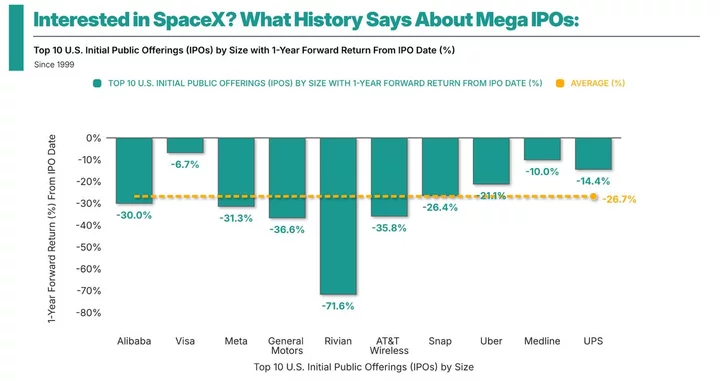
What
does history show about how some of the biggest IPOs have performed
over the first year? It’s not good.
The
top 10 US IPOs by size have averaged a decline of 26.8% over
the first year. The best performing one, Visa, was still down
6.7% in its initial year.
This
does not mean that this will occur for SpaceX, but it does put a
cautionary tale on the hype.
Don’t
get me wrong. Some of those stocks have turned out quite well over
the longer term: Meta (Facebook) and Visa in particular. It’s
another reminder of something I’ve written about before: timeframe
is a critical part of any investment decision.

That
said, investors should gear up for big swings in price for Musk’s
space company. One writer picked up by Morningstar noted that: “The
critical amplifier is float — at about 3.3%, where Tesla sees
10.0%-15.0% swings on milestone slips, we expect SpaceX to experience
20.0%-30.0% moves on equivalent catalysts.” (9) Are you the
kind of investor who can handle potentially massive volatility?
Is
the possible valuation of the company at $1.75 trillion worth it?
According to Braden Dennis & Ryan Henderson, if you strip away
all costs and taxes and focus just on its core profitability, it will
trade at more than 300 times EBITDA, which is significantly greater
than similarly sized companies like Meta (Facebook), Taiwan
Semiconductor, and Amazon. (10) And guess what? As of June
5th, 2026, betting markets like Polymarket think the
valuation may be even higher than that by the time it stops trading
on IPO day. (11)

One
of the biggest concerns for an early investor on IPO day (not an
early investor pre-IPO; they are happier than clams and will be quite
pleased to endorse it in the media), is that the day they start
buying is not the entirety of shares that will be on the market
within the year. There is a risk of dilution. A few writers point to
this problem:
Assuming that the $86.25bn gets successfully allocated [an
extraordinary amount of stock for underwriters to place at the
beginning], the market absorption is still not done. A wall of supply
is coming from those insiders that bought SpaceX at a fraction of the
price.
The S-1 makes clear that Musk (approximately 42% economic interest -
with 85% of voting power via super-voting Class B shares) is subject
to a normal lock-up but a lot of SpaceX insider stock joins the free
float remarkably quickly.
“Early Release Eligible Shares” have not been quantified in the
draft S-1 but the lock-up schedule and triggers are set out below and
I have seen estimates that 80-90% of the non-Founder shares will be
freely tradeable by November. (12)
What
might SpaceX do to Musk’s other company — Tesla? Interestingly, there
have been whisperings
about a potential merger between the two. If the IPO
doesn’t go well, might they merge? Does it make sense to put both
companies under one roof either way? After all, SpaceX has already
purchased hundreds of millions of dollars of Tesla products like
Megapack and Cybertruck. (13) Or might they thrive
independently and benefit one another?
Here’s
what matters. I don’t do market predictions. And with the cautions
above, remember that fundamentals don’t always drive price,
especially with a celebrity CEO like Elon, who people tend to love or
hate.
NYU
finance professor Aswath Damodaran, who values the company about a
half trillion dollars below its expected price, says, “No matter
what your views are about the SpaceX IPO, positive or negative, there
is no denying that this company is a loaded bet on the AI and
Elon Musk, and while that may concern some, there are others who will
look at Musk’s track record with Tesla and feel the odds are in their
favor.” (14)
The
question you should be asking is probably not what this company will
do or not do on the first day or first year of trading, but how this
company or any other investment fits into your overall financial
plan.
We
do not believe investors should be asking what will help you get rich
quick, but what will help you live and leave a legacy.
We
may indeed reach the stars through corporations like SpaceX. The
stock may give stellar returns to its shareholders. But make sure you
don’t reach so high that you see stars from taking a risk
you can’t afford to take.
###
Brandon Stockman has been a Wealth Advisor licensed with the Series 7 and 66 since the Great Financial Crisis of 2008. He has the privilege of helping manage accounts throughout the United States and works in the Fortuna office of Johnson Wealth Management. You can sign up for his weekly newsletter on investing and financial education or subscribe to his YouTube channel. Securities and advisory services offered through Prospera Financial Services, Inc. | Member FINRA, SIPC. This should not be considered tax, legal, or investment advice. Past performance is no guarantee of future results.
###
Sources:
1.
SpaceX’s S-1 SEC Document, page 1. Accessed
online.
2.
SpaceX’s S-1 SEC Document, page 2. Accessed
online.
3.
SpaceX’s S-1 SEC Document, page 11. Accessed
online.
4.
SpaceX’s S-1 SEC Document, page 75. Accessed
online.
5.
SpaceX’s S-1 SEC Document, page 235. Accessed
online.
6.
SpaceX’s S-1 SEC Document, page 4. Accessed
online.
7.
SpaceX’s S-1 SEC Document, page 30. Accessed
online.
8.
The chart and the data in the above few paragraphs is from “Initial
Public Offering Updated Statistics” (May 18, 2026), page 78.
Accessed
online.
9.
“Does SpaceX’s Sky-High Valuation Make Sense?” (March 9, 2026).
Accessed
online.
10.
“SpaceX: Here’s What You Get For $1.75 Trillion” (May 24, 2026).
Accessed
online.
11.
“SpaceX IPO Closing Market Cap” (May 28, 2026). Accessed
online.
12.
“The Physics of SpaceX” (May 24, 2026). Accessed
online.
13.
SpaceX’s S-1 SEC Document, page F-56. Accessed
online.
14.
“Revisiting the SpaceX Valuation: A Post-Prospectus Update!”,
June 4, 2026. Accessed
online.