
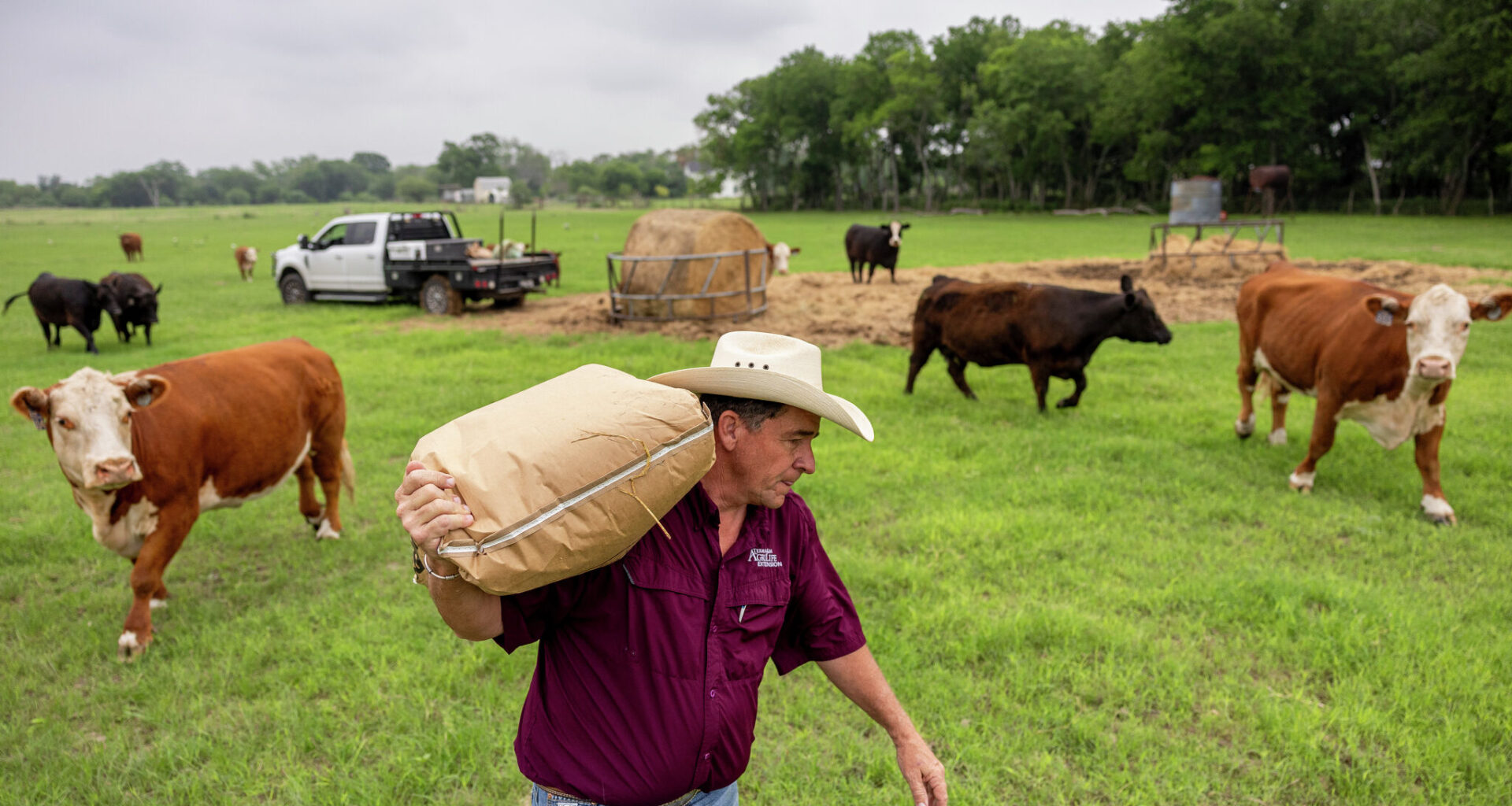
For the past five years, Texas ranchers have been struggling against drought.

Now, those with cattle to sell are finding a bright spot — but it’s one causing pain for consumers and politicians. It’s not a clear win for ranchers, either.
Despite dried-up pastures and shrunken-down herds, ranchers like Lew Thompson, who runs nearly 3,000 head near Pearsall, are reaping what he called “prolific sales.”
Article continues below this ad
“Usually when the drought is on, you just keep getting kicked in the teeth on the price,” Thompson said. “We have a very unusual situation.”
READ MORE:Are groceries in San Antonio getting more expensive? See for yourself.
This time around, ranchers are cashing in cattle for all-time high prices as inventory in the United States has plummeted to 75-year lows.
Article continues below this ad
The result is retail prices that have surged more than 18% from a year ago, pushing the average price of a pound of ground beef in American cities to $6.90 in April, the highest on record. A year earlier, it was $5.80, also a record. As recently as early 2021, the price was less than $4.
Prices are projected to keep rising, too, with the U.S. Department of Agriculture forecasting another 10.1% increase by the end of the year.
Ranchers aren’t reaping all the price increases in profit, though. Their margins are being squeezed by difficulties spurred by the lingering drought and record-high costs for feed, fuel, fertilizer, equipment and supplies as Trump administration tariffs, war and persistent inflation take their toll.
Thompson, for example, said his costs are up about 25% in recent years, wiping out the 12% average increase in cattle sale prices seen across the U.S. in the past year.
Article continues below this ad
Cattle wait for the sales prior to the weekly cattle auction at Karnes City Auction on Wednesday, May 13, 2026.
Katina Zentz/San Antonio Express-News
Beef prices rise as cattle herds shrink
The steadily rising prices are rattling consumers and, increasingly, elected officials who are beginning to understand the political impact of declining affordability in the U.S.
This spring, a group of congressional Democrats introduced a bill designed to break up the heavily consolidated U.S. meat industry, which they blamed for a lack of competition and high prices. Later, the U.S. Justice Department said it was investigating potential antitrust violations in the cattle and beef industry. Then, Texas Attorney General Ken Paxton said his office was launching its own investigation.
Article continues below this ad
“Texans deserve fairly priced beef and our state’s cattle ranchers deserve to be paid fairly for their hard work,” Paxton said in a statement. “If major meatpackers manipulated the market to underpay ranchers while forcing families to pay higher prices at the grocery store, we will hold them accountable.”
The major meatpackers — the U.S. beef market is dominated by four companies — have remained silent on the antitrust allegations.
The Meat Institute, an industry group, responded to the federal investigation by saying the industry is already heavily regulated and transparent. It asserted that beef packers also have been losing money and that the processors “welcome a fact-based discussion about beef affordability and how best to meet the needs of American consumers.”
Economists, though, suggest the rising prices are simply a reality of declining U.S. supply amid the drought, higher land prices, urbanization, aging ranchers and escalating prices for everything from feed and fences to calves and cows.
Article continues below this ad
As of early January, according to USDA data, there were about 86 million cattle and calves in the United States. Texas, the state with by far the largest herd, had about 12 million. Both figures represent historic lows: The latest U.S. herd size is the smallest since the early 1950s, and the Texas herd is among its smallest in decades.
Buyers and sellers watch the weekly cattle auction at Karnes City Auction on Wednesday, May 13, 2026.
Katina Zentz/San Antonio Express-News
“It really comes down to the U.S. cattle herd shrinking,” said Emily Kerr, a senior business economist at the Dallas Fed. “When you have fewer cattle, fewer cattle going into slaughter, I mean that just really squeezes the supply side of beef production.”
Most of the beef the U.S. consumes comes off feedlots with cattle from producers large and small. Large cattle ranches may produce thousands of head a year while smaller producers may bring from five to 20 for finishing.
Article continues below this ad
The loss of those smaller producers is adding up, said Brad Reiley, manager of Seguin-based Producers Co-op. And when enough of the smaller producers disappear, it strains supply.
“It’s the straw that broke the camel’s back,” he said of drought-stricken ranchers throwing in the towel. “You get enough of these little ones and then boom, all of a sudden, it’s like — where are the numbers that we need to feed the U.S.?”
Sutton Albert sits on a fence while watching over the livestock prior to the weekly cattle auction at Karnes City Auction on Wednesday, May 13, 2026.
Katina Zentz/San Antonio Express-News
Alfred Grollimund looks down at his dog Cotton during the weekly cattle auction at Karnes City Auction on Wednesday May 13, 2026.
Katina Zentz/San Antonio Express-News
Lee Meyer raises a hand during the weekly cattle auction at Karnes City Auction on Wednesday, May 13, 2026.
Katina Zentz/San Antonio Express-News
Drought squeezes ranchers despite record cattle prices
Bryan Davis is the south region area chief in the Disaster Assessment & Recovery Unit of Texas A&M AgriLife Extension Service. As a fourth-generation rancher with his own herd, he said he appreciates the higher cattle prices.
Article continues below this ad
“But at the same time, our input costs are greater than they’ve ever been — for feed, for gas, for the energy that it takes to grow a crop and then also to get it harvested,” said Davis, who estimated his costs in some cases have quadrupled.
RELATED: Iran war drives up fertilizer and fuel costs for already-struggling Texas farmers
Before the drought, Davis could get two or three cuttings a year from his hay fields to be used as feed. In the past two years, he’s gotten just one, requiring him to spend more to feed his cattle.
Since pastures and hay fields began drying up earlier this decade, Texans have been forfeiting production, selling off their herds and, in some cases, even their land. But ranchers like Davis, whose family has been perfecting its herd’s genetic base for 30 years, are being forced to pay record prices for forage to keep animals alive.
Article continues below this ad
“We had the most rain last week since last October.” Bryan Davis, a fourth-generation rancher, said while he herds his cattle to feed them on Wednesday, April 29, 2026, in Marion, Texas. A drought over the last few years has impacted local reachers like Davis, who have been already struggling to stay afloat.
Andrew J. Whitaker/San Antonio Express-News
Bryan Davis tears his hay bale to feed his cattle on Wednesday, April 29, 2026, in Marion, Texas.
Andrew J. Whitaker/San Antonio Express-News
Davis said his wife’s family has been on the land on the far Northeast Side of San Antonio since the late 1940s. That was prior to the devastating 1950s drought, a benchmark the current drought is increasingly being compared to.
Paul Bertetti, senior director of the Edwards Aquifer Authority, said this is “at least the second worst” drought the water management agency has recorded since its creation in the mid 1990s. While the current drought is still a few years shy of the eight-year span of the 1950s drought, water levels at the start of April were the lowest they’ve ever been at this time of year — including during the 1950s.
Article continues below this ad
“A lot of the old farmers and ranchers talk about that drought still to this day in the coffee shops,” Davis said. “The drought of the ‘50s and how many people sold out and lost their land.”
Ranchers take a break in the cafe during the weekly cattle auction at Karnes City Auction on Wednesday, May 13, 2026.
Katina Zentz/San Antonio Express-News
Like that one, the current drought has been a reality for years, though its exact start date is debatable. The Edwards Aquifer Authority characterizes drought by low water levels that require pumping restrictions. Using that definition, it started in 2022 — the same year many ranchers began selling off herds they could no longer feed or water.
FROM 2022: Busy cattle auctions warn of drought’s tightening grip on Texas agriculture
Article continues below this ad
But Bertetti said the current water deficit began in 2019.
Since that year, there has been a 65-inch deficit in rainfall, he said, amounting to more than two typical years of rain. Farther west, past Bandera County and Uvalde, water has been scarce since the early 2010s.
Bryan Davis shows off a dessert termite tunnel, which is a drought sign ranchers look for in the ground, on Wednesday, April 29, 2026, in Marion, Texas.
Andrew J. Whitaker/San Antonio Express-News
‘Needs to be more’
Whenever it began, the drought that’s been drying out South and Central Texas since early this decade has also begun to parch the usually hopeful nature of self-proclaimed optimist Reiley, himself a small producer.
Article continues below this ad
“I’m starting to really see the hurt and pain that a lot of people are dealing with,” he said.
For small producers like him and the ranchers he works with on a daily basis at Producers Co-op, the drought drives an uncertainty that is tough to navigate.
“What these people are doing on a daily basis is no different than going to a Las Vegas casino,” Reiley said. “They’re throwing hard-earned money, or money from the bank, putting it out there on the line, with no guaranteed payback.”
Motorists drive by Producers Co-Op Feed Mill in Seguin on Tuesday, May 12, 2026.
Katina Zentz/San Antonio Express-News
Dean Mills, forklift operator and truck driver, walks by bags of feed at Producers Co-Op Feed Mill in Seguin on Tuesday, May 12, 2026.
Katina Zentz/San Antonio Express-News
Zach Cowan, feed mill manager, left, speaks with Brad Reiley, general manager, at the Producers Co-Op Feed Mill in Seguin on Tuesday, May 12, 2026.
Katina Zentz/San Antonio Express-News
RELATED: Has recent heavy rainfall raised South Texas lake levels? Here’s the new update.
Article continues below this ad
Weather is among the factors they’re betting on.
Robert Mace, executive director of the Meadows Center for Water and Environment at Texas State University, said the severity of the current drought does rival that of the 1950s but he noted a key difference. Because of climate change, a typical Texas day now is warmer than the hottest years of the drought during the 1950s or during the 1930s Dust Bowl. That results in soil moisture burning off faster than it did back then, leaving less water rolling off the landscape into rivers and reservoirs.
Even downpours like the 6-inch dump of rain in South Texas in late April is not enough to recover from the drought conditions.
“You really need a change in the weather pattern to pull ranchers and farmers out of drought,” Mace said. “It needs to be more than one giant freak storm.”
Article continues below this ad
While heavy rain and flooding can top off reservoirs, he said, the impact can be short-lived. Deadly flooding in the Hill Country last July did exactly that, filling up reservoirs upstream of Austin. But the flooding was followed by the same high temperatures and lack of rainfall, reverting back to the conditions farmers and ranchers have been struggling with — dwindling herds lacking grass to graze.
READ MORE: Yes, it rained. But did that ease San Antonio’s long-running drought?
“That can cause lingering impacts to those ranchers, because it takes a while to build a herd back up,” Mace said. “That has impacts for what you and I pay for a hamburger. It has impacts on the beef market, quite frankly, even across the globe.”
Mace said that there’s about a 70% chance South Texas will enter El Niño conditions this year, resulting in a cooler and wetter climate. But those effects won’t hit until fall or winter.
Article continues below this ad
“If we can hold out to the fall, the odds are in our favor that we’ll see a wetter than normal season over Christmas,” he said.
But it will require several weeks of consistent rainfall supported by overcast days to overcome the soil moisture deficit.
Bertetti said it will take two or three years to know if Texas is out of the current drought, though.
Mario Salizar, left, Bryan Garcia both from New Berlin look at the Cibolo Creek after recent heavy rainfall on Wednesday, April 29, 2026, in Marion, Texas.
Andrew J. Whitaker/San Antonio Express-News
RELATED: How a rancher and a nonprofit teamed up to protect 6,600 acres of Texas prairie
Article continues below this ad
Until then, ranchers are being strategic to stay afloat. Thompson has drawn his cattle in tighter, leaving 21,000 acres of pasture vacant in Frio County. By pulling his herd into smaller pastures rather than grazing, he’s able to better care for them and manage their feed supply. Davis sells directly to customers, cutting out some of the middle-man costs.
For the past 20 years, he said AgriLife Extension has been doing rainwater harvesting and talking to landowners about the benefits. It’s a practice that is becoming more prevalent in San Antonio, Davis said, and a practice that he inherited from his grandmother.
“She learned in the drought of the ‘50s,” Davis said. “Every drop matters.”
Article continues below this ad
Bryan Davis drives his truck to his cattle to feed them on Wednesday, April 29, 2026, in Marion, Texas.
Andrew J. Whitaker/San Antonio Express-News
Trevor Bach contributed to this report.