
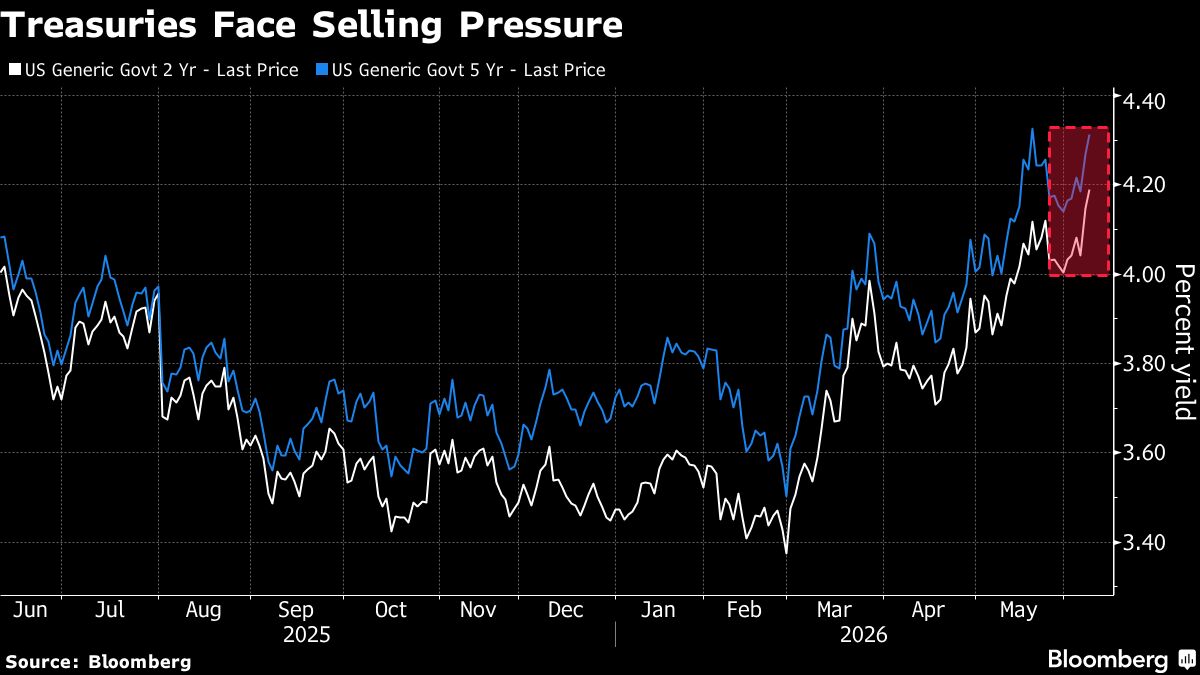
(Bloomberg) — Treasuries fell as investors ramped up bets that the Federal Reserve will need to raise interest rates, while tensions in the Middle East added to inflation concerns.
Most Read from Bloomberg
Yields rose as much as two basis points across the curve, with the biggest moves in the five-year sector which is one of the tenors more sensitive to changes in Fed policy expectations.
Investors are still assessing the strong US jobs report on Friday, which topped all forecasts and reaffirmed the view that the Fed, under Chairman Kevin Warsh, will need to raise borrowing costs to contain inflation that is running above target.
Meanwhile, President Donald Trump said Israel and Iran are “looking to do” an immediate ceasefire after earlier urging both to swiftly halt their attacks on each other. Oil prices rose, potentially adding to inflationary pressures in the world’s largest economy.
Traders have returned to pricing in a quarter-point Fed hike by December and around a 20% chance of a second increase. Last Thursday, markets were betting that March 2027 would be the earliest timing for a quarter-point hike.
“Resilience in the labor market makes it easier for a central bank to defend tighter policy warranted by higher inflation,” said Abbas Keshvani, director of Asia macro strategy at RBC Capital Markets in Singapore.
Yields on two and five-year Treasuries have risen more than 80 basis points since this year’s lows in March to 4.16% and 4.29% respectively. Those on benchmark 10-year debt have risen more than 60 basis points to 4.55%.
Goldman Sachs Group Inc. economists say they no longer expect the Fed to cut interest rates this year due to a stronger-than-expected labor market. BNP Paribas analysts now forecast three quarter-point rate hikes starting in December, having previously expected the US central bank to keep interest rates steady in a 3.5% to 3.75% range this year. JPMorgan Chase & Co. sees 10-year yields ending the year higher at 4.70%.
Traders are also wagering that inflation figures this week will show the biggest surge in consumer prices in several years, adding to the case for higher rates.
What Bloomberg Strategists Say…
Benchmark US 10-year yields at 4.57% are likely to climb further this week unless Wednesday’s US CPI data comes in surprisingly weak.
— Garfield Reynolds, Markets Live Strategist
President Donald Trump, in an interview with NBC’s Meet the Press, sought to push back against market expectations for higher interest rates, saying there is “no reason” for the Fed to hike. Raising the benchmark rate “is the wrong thing to do,” Trump said. “We should actually lower interest rates.”
Warsh faces his first Federal Open Market Committee meeting on June 16-17. There are expectations that officials will drop the so-called easing bias from their policy statement.
“ Recent positive job gains, a low unemployment rate, and elevated inflation significantly increase the likelihood that the Fed will raise interest rates this year,” Jason Schenker, president and chief economist at Prestige Economics LLC, wrote in a note.
Bonds elsewhere also weakened. German and UK 10-year yields rose one basis point to 3.05% and three basis points to 4.93% respectively. Japan’s 10-year equivalent jumped six basis points to 2.73%.
–With assistance from James Hirai.
(Updates throughout)
Most Read from Bloomberg Businessweek
©2026 Bloomberg L.P.