
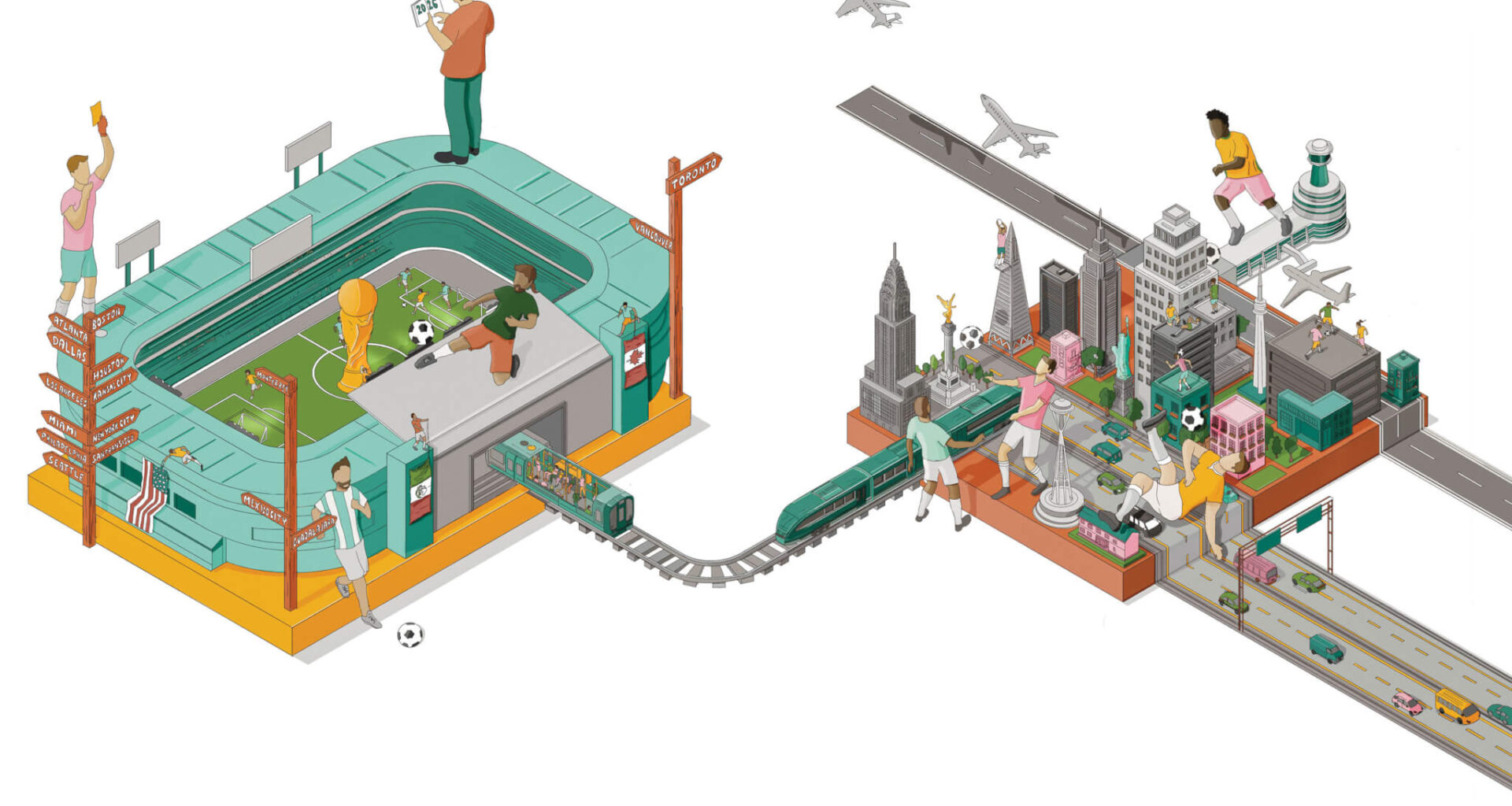
Forty-eight teams. One-hundred-four matches. Sixteen cities across three countries. The 23rd FIFA World Cup is the largest tournament the sport has ever staged. It will open on June 11 in Mexico City and close on July 19 in New Jersey. For 39 days, the World Cup will take over stadiums across North America. Under FIFA’s naming rules, every stadium with a corporate sponsor will shed its name and be rebranded with a neutral geographic placeholder. Beyond the race to update North America’s sports infrastructure, much of which was not purpose-built for soccer, host cities are also taking the opportunity to complete civic infrastructure projects.
As the clock ticks down to the large crowds promised by the tournament, these improvements range from expanding transportation capacity to increasing walkability and connectivity. In Houston, more than 90 new trees will go up on its Main Street, a portion of the city’s Green Corridor initiative that will connect FIFA Fan Festivals to the stadium with an emphasis on providing shade to event attendees to mitigate extreme temperatures. In Mexico City, a comprehensive multimodal transportation update includes an expansion of light rail and the construction of two new electromobility corridors—additions meant to outlast the tournament. The word “legacy” echoes across the 16 venues. Each city’s projects are a confession of how much it cares about public space—or doesn’t. In some cases, accelerated development means questions of access and affordability are being pushed to the side: Twenty-two thousand new surveillance cameras are being installed in Monterrey. And in New Jersey, NJ Transit has announced that the 9-mile commuter train ride to MetLife Stadium will be priced at $150 for a round trip. Meanwhile, Mexican host cities are running their tournaments on water taken from the neighborhoods around the stadiums.
Some host cities have brandished the tournament as an excuse for more development, while others have used the deadline to stitch their cities back together. Either way, it’s clear that the infrastructure of the tournament is decisions made in concrete that will play a large role in determining who the public is and who gets to gather. Soccer started as a game, but today it is an industry worth billions that impacts cities across North America. Ahead of the first World Cup kickoff, AN rounds up the latest infrastructure and stadium updates for civic-minded fútbol enthusiasts.
Foxborough, Massachusetts
Boston’s tournament programming lands on a 7-acre brick plaza that the city tried to demolish for half a century. City Hall Plaza was designed by the firm Kallmann McKinnell & Knowles, who also designed the city hall building. The plaza was completed in 1968 and was loathed almost immediately: a windswept void in red brick, lifted on multiple “ugliest building” lists. Sasaki softened it in a $70 million renovation completed in November 2022 that installed new lighting, plantings, and a glass vestibuleto reopen the north entrance, which has been closed since 9/11. Boston City Hall was designated an official city landmark in 2025, six months before the tournament. The free, 16-day FIFA Fan Festival will take place on the plaza this summer.
The Patriots play 22 miles southwest, in Foxborough. Gillette Stadium opened in 2002 as the only fully privately funded NFL stadium: Patriots owner Robert Kraft wrote the $325 million check himself. HOK Sport (now Populous) modeled the design on Baltimore’s M&T Bank Stadium, with a working lighthouse and a footbridge modeled on Boston’s Longfellow Bridge. A renovation in 2023 with Populous as the architect and Suffolk Construction as the general contractor was a $250 million job that replaced the original lighthouse with a 218-foot, 22-story version capped by a year-round observation deck and installed a 22,000-square-foot video board.
Seven matches will be played here from June 13 to July 9: five group-stage games, a Round of 32 match on June 29, and a quarterfinal on July 9. The MBTA is running express trains on a dedicated Foxborough Stadium service from South Station to Foxboro Station.
East Rutherford, New Jersey
The biggest match in world football lands in East Rutherford on July 19. The New York/New Jersey region’s MetLife Stadium is hosting the 2026 World Cup Final, plus seven other matches. Planning ahead of the stadium’s moment in the spotlight has been rocky. With no general parking at the site, NJ Transit announced in April that it will raise fares to $150 for a round trip on the train between Penn Station and the stadium—nearly 12 times the regular fare for the 15-minute ride—and $80 for a round trip on the bus, which will drop fans a mile from the gate, at the Meadowlands Racetrack. NJ Transit CEO Kris Kolluri pushed back against protests, saying the price recovers $48 million in dedicated service that FIFA didn’t subsidize. Newark Liberty International is the closest major airport to MetLife Stadium, but most international fans will arrive at JFK, where the first 14 gates of the new $9.5 billion Terminal One, designed by Gensler with AECOM Tishman as construction manager, are scheduled to open in June, timed to the tournament. At 2.6 million square feet and 23 gates when fully completed in 2030, it will be the largest stand-alone terminal in the country.
Questions of affordability extend to the region’s Fan Festival, which was intended to provide fans with free viewing of all matches throughout the tournament. Except it wasn’t going to be free. Tammy Murphy, then chair of the host committee’s board, announced in February 2025 that admission would be $12.50 per person for anyone 13 or older. This was a departure from previous Fan Festivals, which since their invention in Berlin in 2006, have always been free. By February 2026, two months after tickets went on sale, the whole thing was off. New Jersey Governor Mikie Sherrill canceled the event and redirected the $5 million to community programming across New Jersey. A Jersey City spokesman said there was “no workable, cost-effective way to manage the influx of tens of thousands of fans into Liberty State Park while maintaining access to the members of the Jersey City community.” The replacements moved across the Hudson to private venues: a Fan Zone at the USTA Billie Jean King National Tennis Center in Queens from June 17 to 28 and a Fan Village at Rockefeller Center, where a mini pitch will be laid over the ice rink from July 4 through the final.
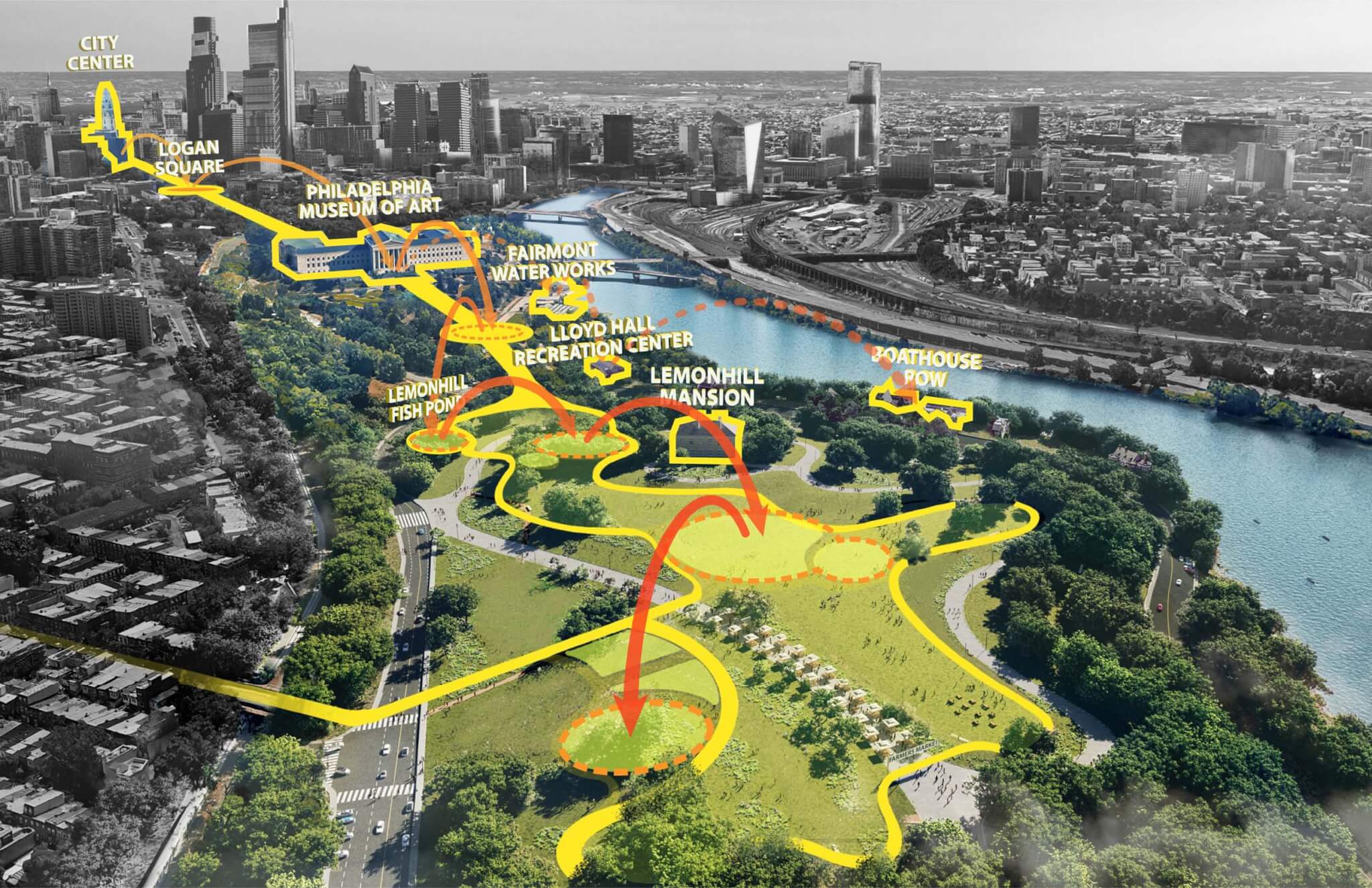 Marvel’s plan places the FIFA Fan Festival at Lemon Hill, with yellow lines tracing pedestrian connections to the
Philadelphia Museum of Art, Fairmount Water Works, Lloyd Hall, and Boathouse Row. (Courtesy Marvel)
Philadelphia
Philadelphia’s Lemon Hill is the birthplace of the largest municipal park system in the country. In 1844, with speculators planning to line the Schuylkill bluffs with canals and high-density housing, the city bought Lemon Hill for $75,000 to protect the river that supplied its drinking water. Eleven years later, in 1855, Lemon Hill was formally dedicated as the first parcel of Fairmount Park. In 1876, the broader park hosted America’s centennial celebration. In 2026, Lemon Hill will host FIFA’s Fan Festival in the lead-up to the country’s 250th birthday on July 4.
Marvel Architects is transforming the historical park. Marvel partner Tyler Silvestro told AN that while previous Fan Festivals had been held in large parking lots—“they’re easy; they’re flat; you can set up a stage, food, and beverage and take it all down”—this project was more complex because it was site-specific. Silvestro framed the Fan Festival as a point of leverage: The community, which is frankly not pleased to lose its park for 39 days, is trading access for improvements long deferred. A $3 million destination playground replaces a defunct 1990s structure. An ADA-accessible path has been built, winding from base to summit. There are two new picnic pavilions, replanted overstory, and new lighting—the list goes on. “I think there’s something really poetic and almost mesmerizing about that,” Silvestro said. “My hope is that people don’t experience this just through the lens of sports and commerce, but through the lens of incredible public space and what cities can offer.”
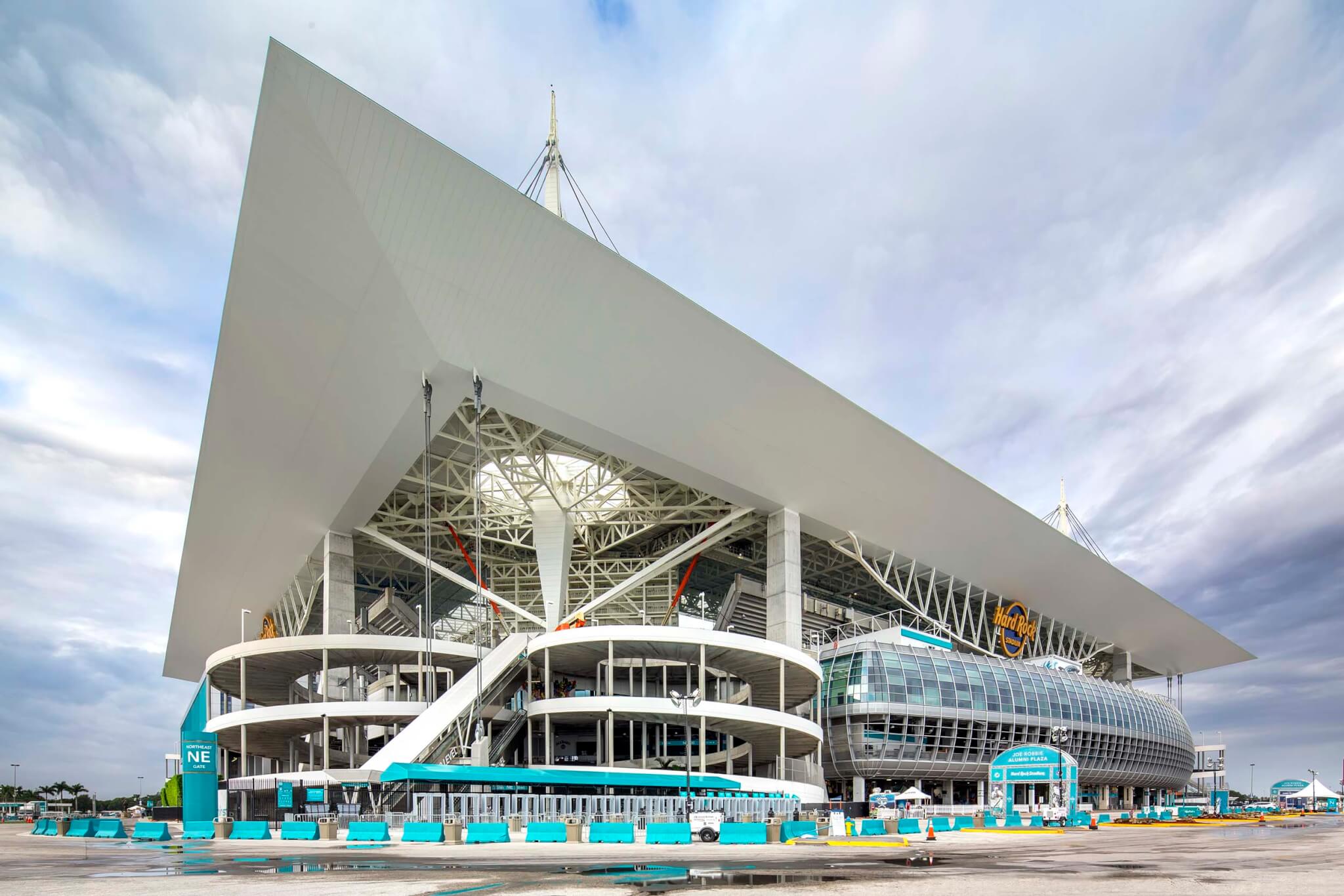 Seven matches will be played at Hard Rock in Miami (Courtesy HOK)
Miami
Inspired by the Wynwood Walls murals, Stephen Ross, owner of the Miami Dolphins, commissioned roughly 30,000 square feet of murals from 18 artists across the Hard Rock Stadium’s concourses. Hard Rock Stadium opened in 1987 as Joe Robbie Stadium and was renovated by HOK in three offseasons and finished in 2016. The defining gesture is a cable-supported openair canopy hung from four 350-foot steel masts that shade the seating bowl while leaving the pitch open to the sky. Eight reinforced-concrete super columns support the masts; 64 locked-coil steel cables up to 300 feet long hold the canopy in place. Thornton Tomasetti was structural; Arquitectonica designed the canopy itself. HOK’s lead architect on the project told AN the renovation was framed around a philosophy of “premium for all”—the idea that every fan, not just suite holders, gets a touchpoint of premium-grade design. The murals run alongside that, giving Hard Rock what HOK describes as a “distinct South Florida feel.” Two design programs holding the place where civic identity meets civic spectacle.
Seven matches will be played at Hard Rock, including the bronze final on July 18. The Fan Festival will take place 17 miles south at Bayfront Park. There is no rail link between the two; the Brightline plus shuttle from Aventura is the only transit route in which a car is not needed.
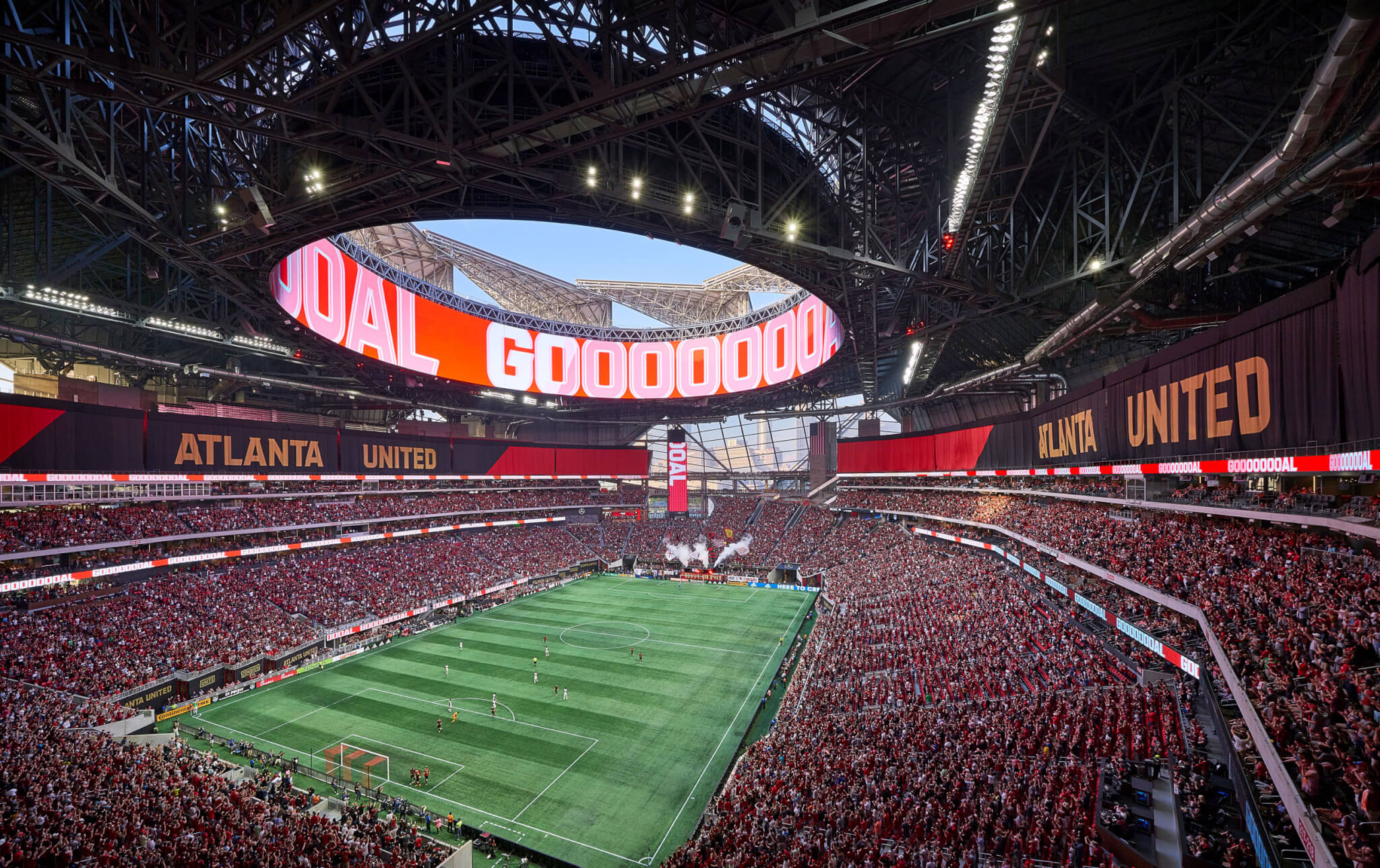 HOK’s retractable roof opens like a camera aperture, with eight ETFE petals moving in unison along 16 tracks. The form was inspired by the Pantheon’s oculus. (Courtesy HOK)
Atlanta
Mercedes-Benz Stadium sits where three railroads from the 1840s met to form the junction that would become Atlanta. Today, the HOK-designed stadium anchors Centennial Yards, CIM Group’s $5 billion development that caps the Gulch, the 50-acre tangle of rail lines and parking lots immediately west of the stadium.
The stadium’s urban integration was intentional, according to Rashed Singaby, HOK’s director of sports, recreation, and entertainment, who said that the design was informed by questions like “How can we connect arrival paths to the stadium? How can we allow for the stadium perimeter to not be focused and potentially open up and be transparent? How can we allow for the activation of plazas with non-game-day amenities?”
Opening to coincide with the World Cup is the 70,000-square-foot, Gensler-designed Cosm entertainment venue, also located in Centennial Yards. It will feature an 8-acre entertainment district with a fan plaza.
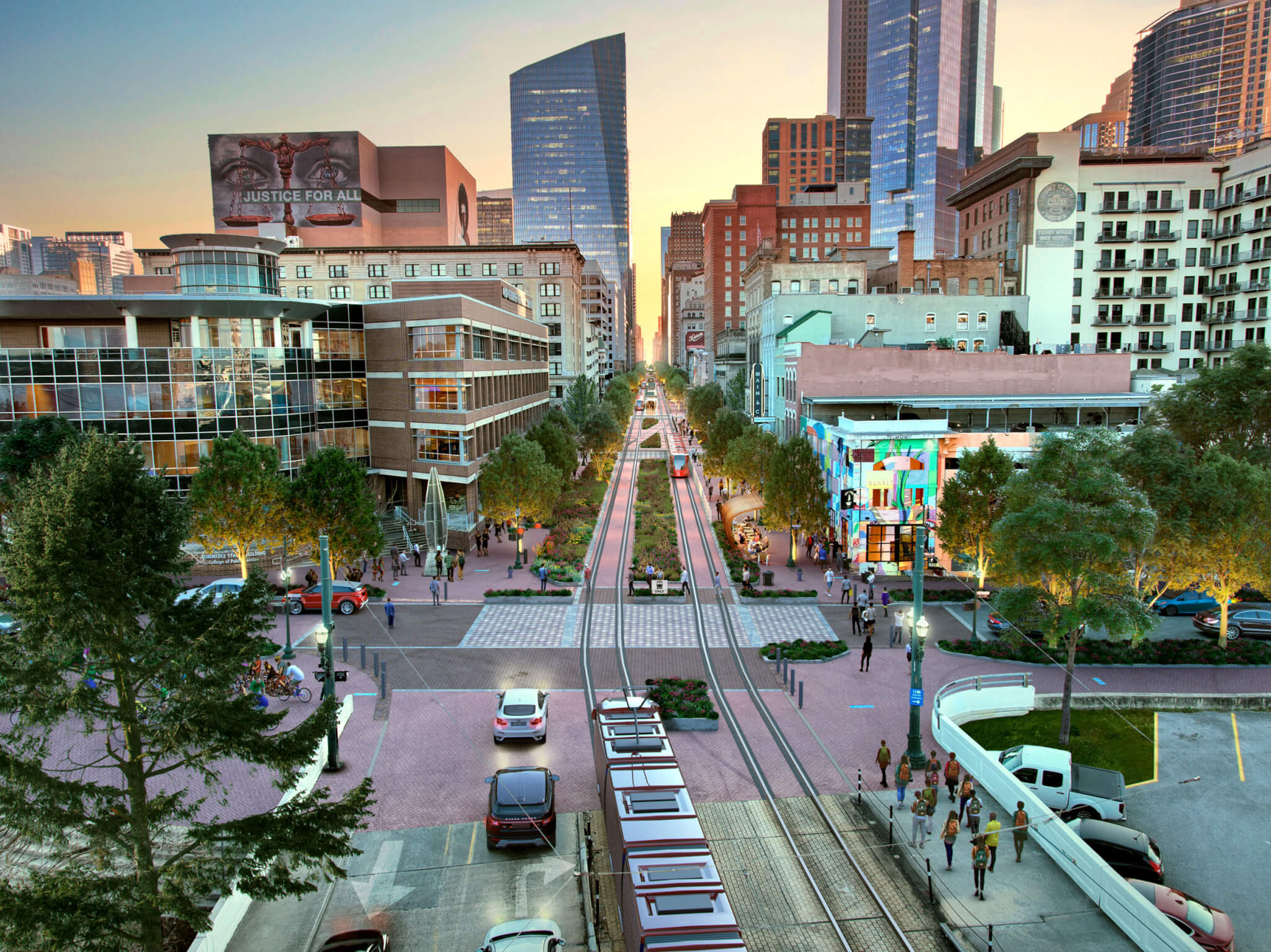 Design Workshop’s rendering of the Main Street Promenade, with METRORail’s Red Line running down the center between widened pedestrian zones. (Courtesy Design Workshop)
Houston
Main Street is the oldest commercial corridor in Houston. Ahead of the World Cup, the city will be permanently closing its seven blocks to car traffic. The catalyst, however, wasn’t FIFA, it was the pandemic. In 2020, Houston launched a program called More Space that let restaurants and bars spill into Main Street’s roadway while indoor dining was shut down. By the time traffic patterns returned, Downtown Houston had hired Design Workshop to study a permanent version. “When we considered this kind of wild idea of removing vehicular circulation from Main Street, it was a big, big ask,” said Alex Ramirez, a Houston-based Design Workshop landscape architect who worked on the project. Nonetheless, it was a vision most could get on board with: The city council voted unanimously in March 2023 to close the lanes, and FIFA 2026 became the deadline.
When Main Street Promenade reopens to the public in May, more than 90 new street trees will have been planted, assisting four new permanent shade structures in cooling the new pedestrian corridor. Ramirez explained that the goal was to reduce the ambient air temperature from 3 to 5 degrees, creating a much needed cooling effect ahead of this summer’s large crowds, “The goal is to ultimately create a connected corridor [so] that people can spend longer amounts of time outside. Texas is known for extreme heat, so shade was a huge piece to make it more comfortable for people to walk outside.”
This project is part of a larger concerted effort to create connected, pedestrian-friendly infrastructure throughout the city. Ahead of the World Cup, Houston has also announced its 14-mile Green Corridor, a continuous walking and biking route between the East Downtown (EaDo) Fan Festival and the city’s NRG Stadium. This broader network also connects the Main Street Promenade to other notable sites throughout Houston.
Kansas City, Missouri
East of downtown Kansas City, on a parcel of land off Interstate 70, two stadiums sit side by side: Arrowhead, home of the Chiefs, and Kauffman, home of the Royals. World Cup matches will be hosted at Arrowhead. Opened in 1972, the stadium was designed by Charles Deaton, with the Kansas City firm Kivett & Myers handling implementation. Among the young Kivett & Myers architects assigned to Arrowhead was a project architect named Ron Labinski, who walked away from the job convinced there was a market for something nobody yet had a name for: an architecture firm that did nothing but stadiums. He went on to cofound HOK Sport, which rebranded as Populous in 2009. Most of the major venues in the 2026 tournament were designed by his office.
With the momentum of the tournament, the city is also ushering in a wave of cultural revitalization. East of the stadium, the historic 18th & Vine Jazz District is absorbing more than $400 million in coordinated public and private investment under a city-led initiative called Revive the Vine. The district was a self-contained Black city within a city during segregation, when it was home to Charlie Parker, Count Basie, Satchel Paige, and a thriving local economy that integration eventually thinned out. Slated to be completed ahead of the games are a $20 million city parking garage at 18th and Lydia and a pedestrian mall on 18th Street. In May, the 1924 Boone Theater, dormant for decades after a stint as a National Guard armory, reopened as the Black Movie Hall of Fame.
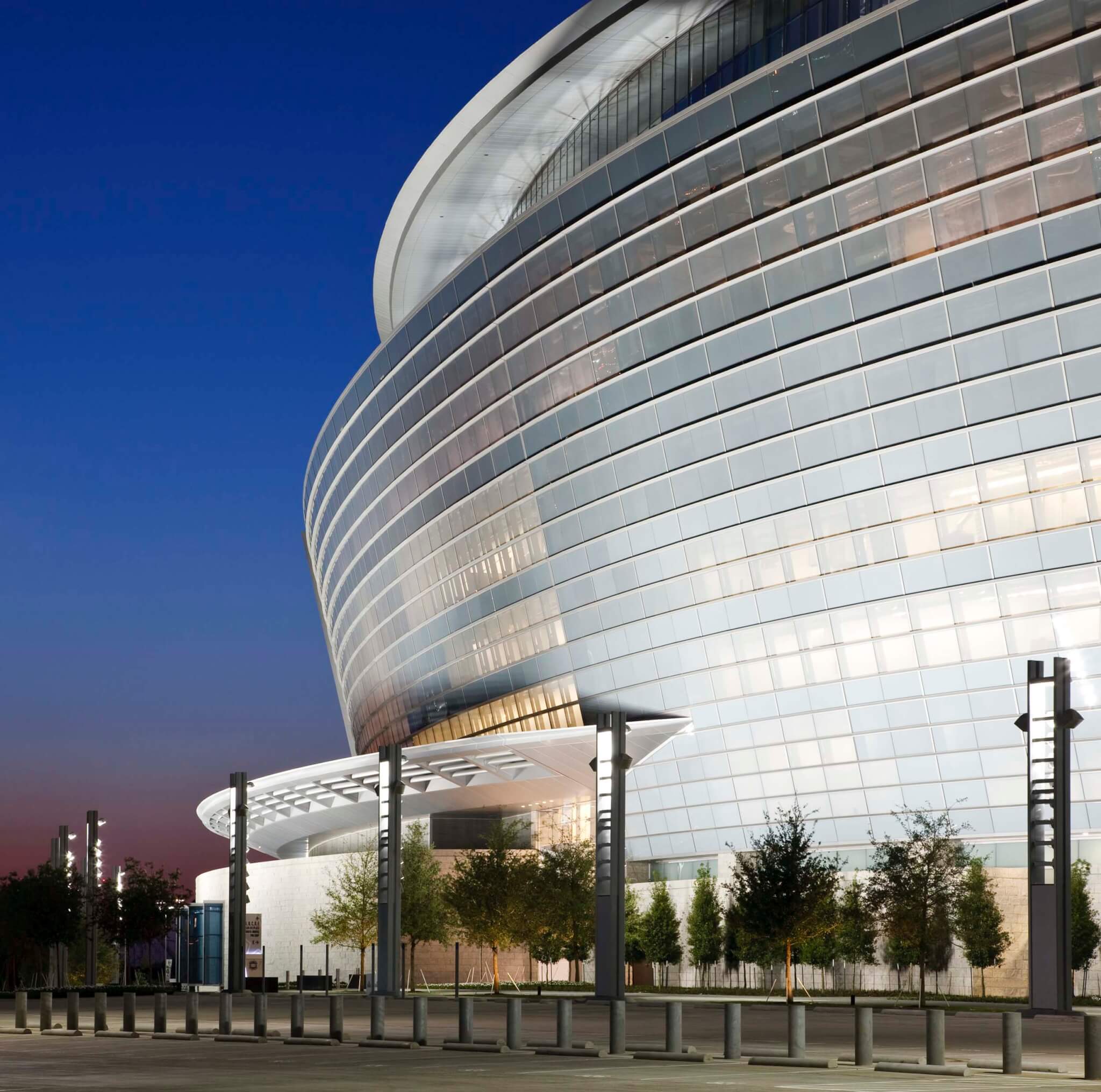 AT&T Stadium is the anchor of an experience district. (Courtesy HKS)
Arlington, Texas
AT&T Stadium will host nine matches in 2026—the most of any venue in North America—including a semifinal on July 14. Designed by HKS in 2009, the stadium is the anchor of an experience district. In addition to featuring three hotels, retail, and hospitality, the district includes the National Medal of Honor Museum, which opened in 2025 in its new Rafael Viñoly–designed home, one of the architect’s final projects. The model for the stadium and its surrounding area was engineered around extended on-site spending and has been replicated by HKS in other stadiums, most notably SoFi Stadium in Hollywood Park, in Inglewood, California: The venue is the central node, and the district is the wrapper.
What the district isn’t connected to is anything else. Arlington is the largest city in the U.S. without a public transit system. And its Fan Festival, which will take place 20 miles east of the stadium, will be inaccessible without a car. Located at Dallas’s Fair Park, one of the world’s largest surviving collections of art deco exposition architecture, the Fan Festival will have a capacity of 35,000, with mini pitches, concerts, and an interfaith prayer space.
Inglewood, California
SoFi Stadium will host eight matches, beginning with the U.S. Men’s National Team against Paraguay on June 12. HKS designed the structure, which has been presented at previous Facades+ conferences. Mark A. Williams, a principal on the project, told AN the stadium was conceived “to be a global stage” from the start, designed for the World Cup, the Olympics, and the Super Bowl before any of them were confirmed. The result, at $5.5 billion, is the most expensive stadium ever built.
On February 10, 2026, before the House Committee on Homeland Security, acting ICE director Todd Lyons told Representative Nellie Pou of New Jersey that ICE’s Homeland Security investigations would be “a key part of the overall security apparatus” for the tournament. On April 16, UNITE HERE Local 11, which represents 2,000 SoFi workers, filed an unfair labor practice complaint with the National Labor Relations Board against FIFA and Kroenke Sports & Entertainment, alleging the operators have refused to commit to keeping ICE out and that the agency’s presence has chilled workers’ Section 7 rights.
Santa Clara, California
Levi’s Stadium, designed by HNTB, is a marvel in seismic engineering. Located three miles from the Hayward Fault, the stadium, which most recently hosted the Super Bowl, was bolstered by buckling-restrained braces—a seismic system established by Magnusson Klemencic Associates. The Bay Area will not host a Fan Festival. The original bid proposed nine, but by April 2026, when the host committee announced its plans, it had shifted to a more decentralized approach, establishing 30 free public viewing sites that are now spread across the region, run by cities, sports teams, and businesses rather than by FIFA itself. Bay Area Host Committee CEO Zaileen Janmohamed framed it as “uniting the Bay through sport.” The Athletic reported the more telling reason: With no Pot 1 top-seed teams playing at Levi’s and no marquee matchup drawing casual fans, a $1 million-per-day Fan Festival didn’t pencil out.
Seattle
The 1962 Seattle World’s Fair sold the city as the future. Twenty-one nations attended; the Space Needle went up in 400 days; the monorail still runs. Sixty-four years later, the World Cup will run along the same spine. The city has introduced Unity Loop, a 4.25-mile walking trail from Lumen Field, where matches will be held, to Seattle Center. It will run through other landmarks such as Pioneer Square, the Chinatown- International District, the waterfront, and Westlake, where the roughly $4 million renovation of Westlake Park by Berger Partnership will open in May. Seattle-Tacoma International Airport is connected to the stadium and downtown by direct light rail, and the Crosslake Connection—the floating-bridge light-rail extension linking Seattle to Bellevue and onward to the airport—opened early this year. At the airport itself, a roughly $400 million expansion of Concourse C designed by Miller Hull and Woods Bagot—originally targeted for 2027—is racing toward substantial completion before the June 15 opener.
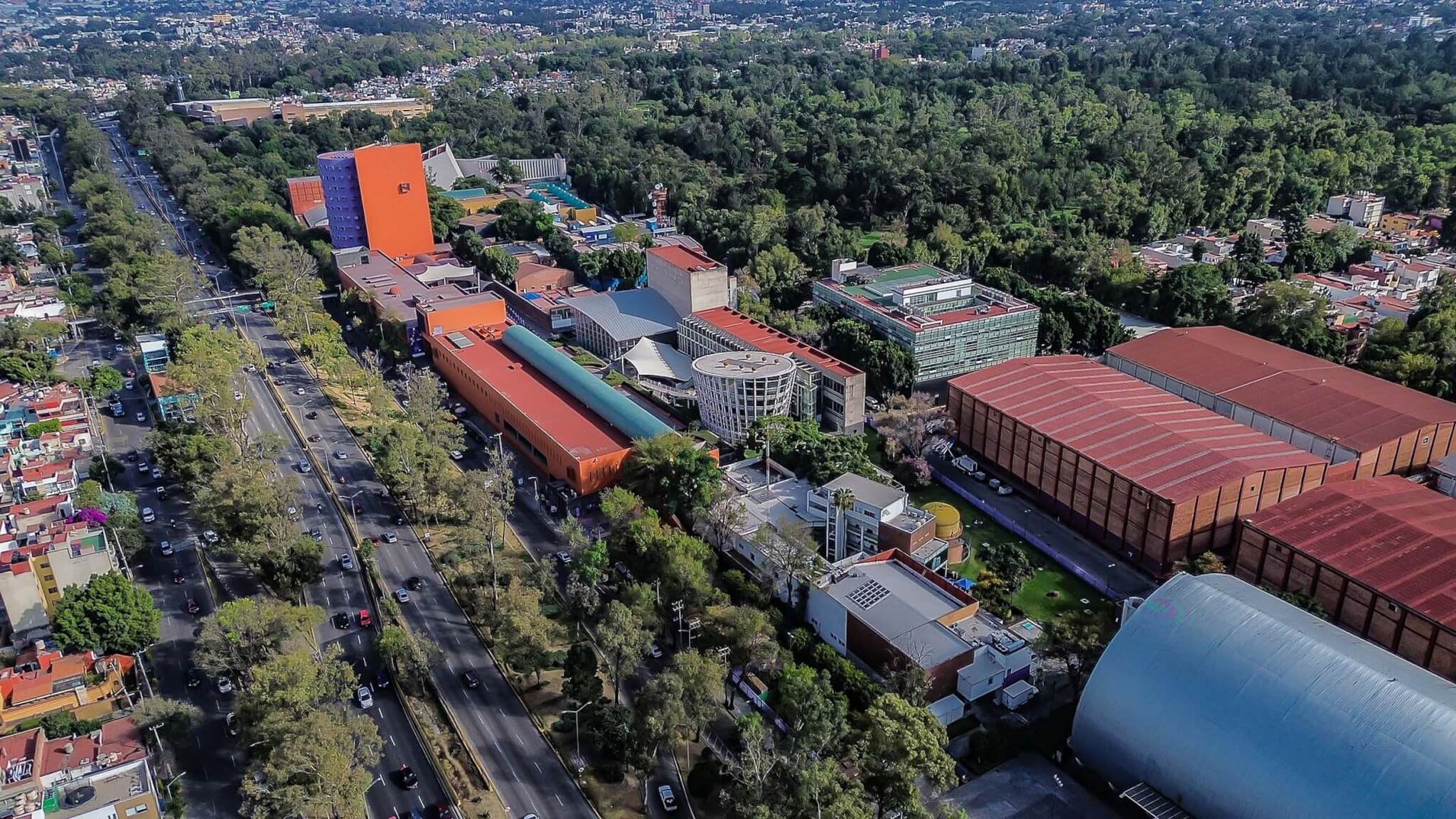 Mexico City’s Calzada de Tlalpan has been renovated with new sidewalks, lighting, and a protected cycleway. (ProtoplasmaKid/Wikimedia Commons/CC BY-SA 4.0)
Mexico City
Estadio Azteca opened in 1966 in the Coyoacán neighborhood after construction crews removed roughly 6,357,000 cubic feet of volcanic rock left over from the eruption of the Xitle volcano to clear the site. Pedro Ramírez Vázquez and Rafael Mijares Alcérreca designed the stadium as a continuous elliptical bowl of reinforced concrete. At this venue, both Pelé and Diego Maradona lifted World Cup trophies in 1970 and 1986, respectively. On June 11, when Mexico hosts South Africa in the opener, it will become the first stadium ever to host matches at three World Cups.
Updates to the surrounding urban fabric ahead of the games radiate outward in concentric rings. Calzada de Tlalpan, the colonial artery linking the city’s main central square to the south of the city, has been renovated with new sidewalks, lighting, a protected cycleway, and the city’s first elevated linear park. The light rail has been rebranded and sports 17 new trains, and the stadium station has been rebuilt. Metro Line 1 has also been overhauled end to end. Two new electro-mobility corridors will run during the tournament: the Chapulín trolleybus from Chapultepec to Universidad and the Ajolote light rail from Taxqueña to Xochimilco. President Sheinbaum’s administration has committed roughly $489 million to airport renovations, including the long-promised rail link between AICM and Felipe Ángeles International, which opened in April. The renovation of Mexico City International Airport (AICM)—the country’s main air gateway—will not be finished in time for the tournament. Instead, construction will be paused from May 31 to July 31 to accommodate passenger flow before resuming in August.
By tournament metrics, the city is delivering roughly 207 miles of “Safe Paths,” 6,458,346 square feet of new or refurbished public space, and 500 rehabilitated football pitches. Though these updates usher in a more connected Mexico City, the impact on residents has not been wholly positive. Rents have tripled in the area surrounding the stadium since the tournament was confirmed.
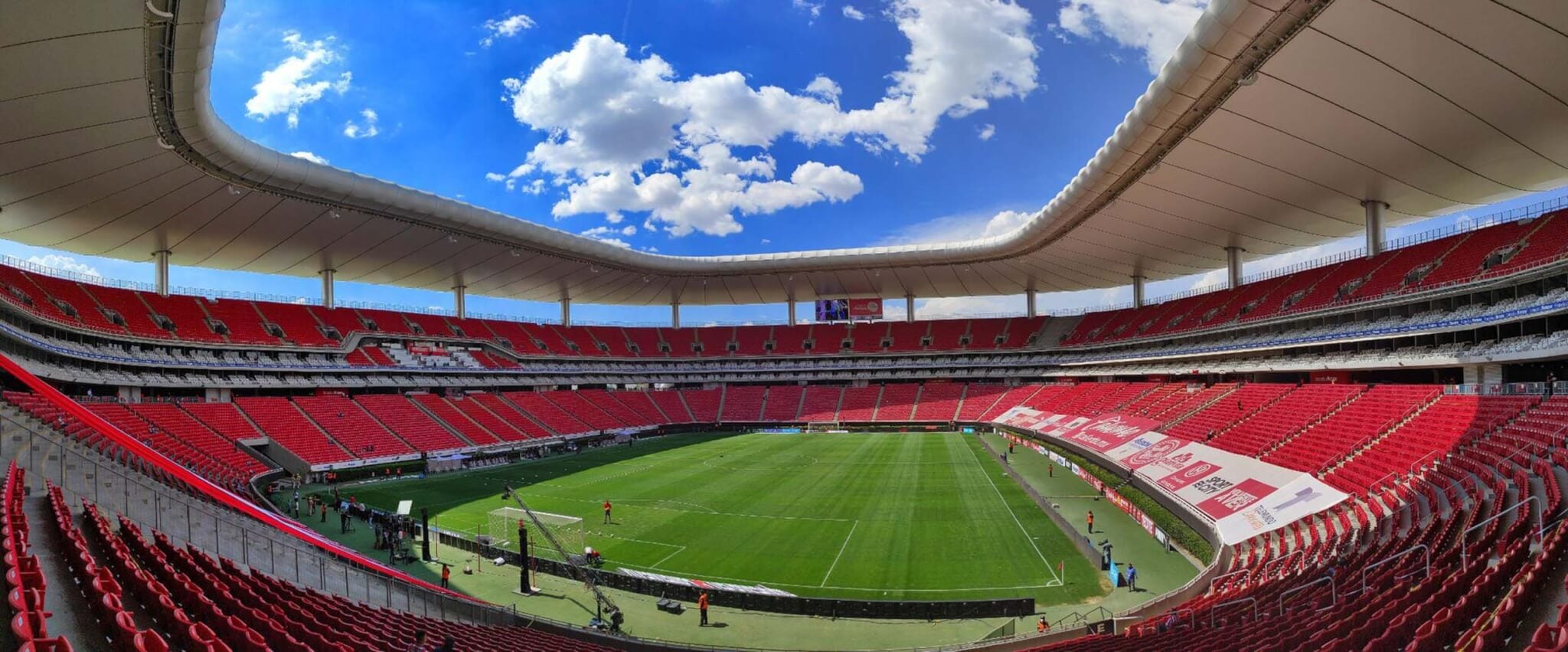 Estadio Akron in Guadalajara, Mexico (HugoGN12/Wikimedia Commons/CC BY-SA 4.0)
Guadalajara, Mexico
Estadio Akron opened in 2010, on the western edge of Zapopan. French designers Jean-Marie Massaud and Daniel Pouzet conceived the stadium as an erupting volcano: 753,473 square feet of living grass draped over a cast-in-place concrete shell, with the seating bowl sunk below ground level so the entire structure appears, from the outside, to be a grassy hill.
In preparation for the World Cup, the local government introduced a new line of Guadalajara’s electric BRT public transportation system for increased connectivity. Additionally, the 3.55-billion-peso (roughly $174 million) renovation of the Chapala highway adds bike lanes, wider sidewalks, and lighting.
Monterrey, Mexico
Estadio BBVA, designed by Populous with VFO Arquitectos as architect of record, opened in 2015. The stadium seats 53,500 and at a distance reads as a single crystalline shape. Ahead of the World Cup, the city is making major infrastructural changes. The FIFA Corridor, a Nuevo León state government project, connects Estadio BBVA, Parque Fundidora, and four other parks through 34 pedestrian and cycling projects. Two new monorail lines will double Monterrey’s rail network from 23 to more than 49 miles. When complete, it will be the longest monorail system in the Americas. The state is delivering 4,000 new buses, 500 new bus stops, and 800,000 newly planted trees. A 247-acre Water Park is also under construction.
What hovers beneath it all is the city’s ongoing water crisis and the inequality engendered by it. This extends to Estadio BBVA’s construction on La Pastora Park in Guadalupe, forested public land that was also a strategic groundwater reservoir. Activists organized against the stadium project under the slogan “Yes to the stadium, but somewhere else.” The city continues to recover from the summer of 2022, when a multimonth drought left millions of Monterrey residents without running water for weeks while Heineken and Coca-Cola kept their plants running. Heading into the World Cup, activists have voiced concerns about how the sports event will further exacerbate water scarcity.
Toronto
Originally designed by Brisbin Brook Beynon Architects and opened in 2007, BMO Field was renovated in 2014–16 to a design by Gensler that added an upper deck on the east side and a roof. A second expansion, also led by Gensler, was completed in March 2026 and added four new LED screens, as well as a new building with two levels of suites and a roof patio. The scope for the $157.9 million expansion also included the addition of 17,756 temporary seats. BMO Field is the smallest stadium in the tournament, and even with these extra spots, the venue will only hold 45,736 seats, just over the minimum FIFA requires for a host stadium. BMO Field is also the only soccer-specific stadium in the World Cup’s entire 16-venue lineup.
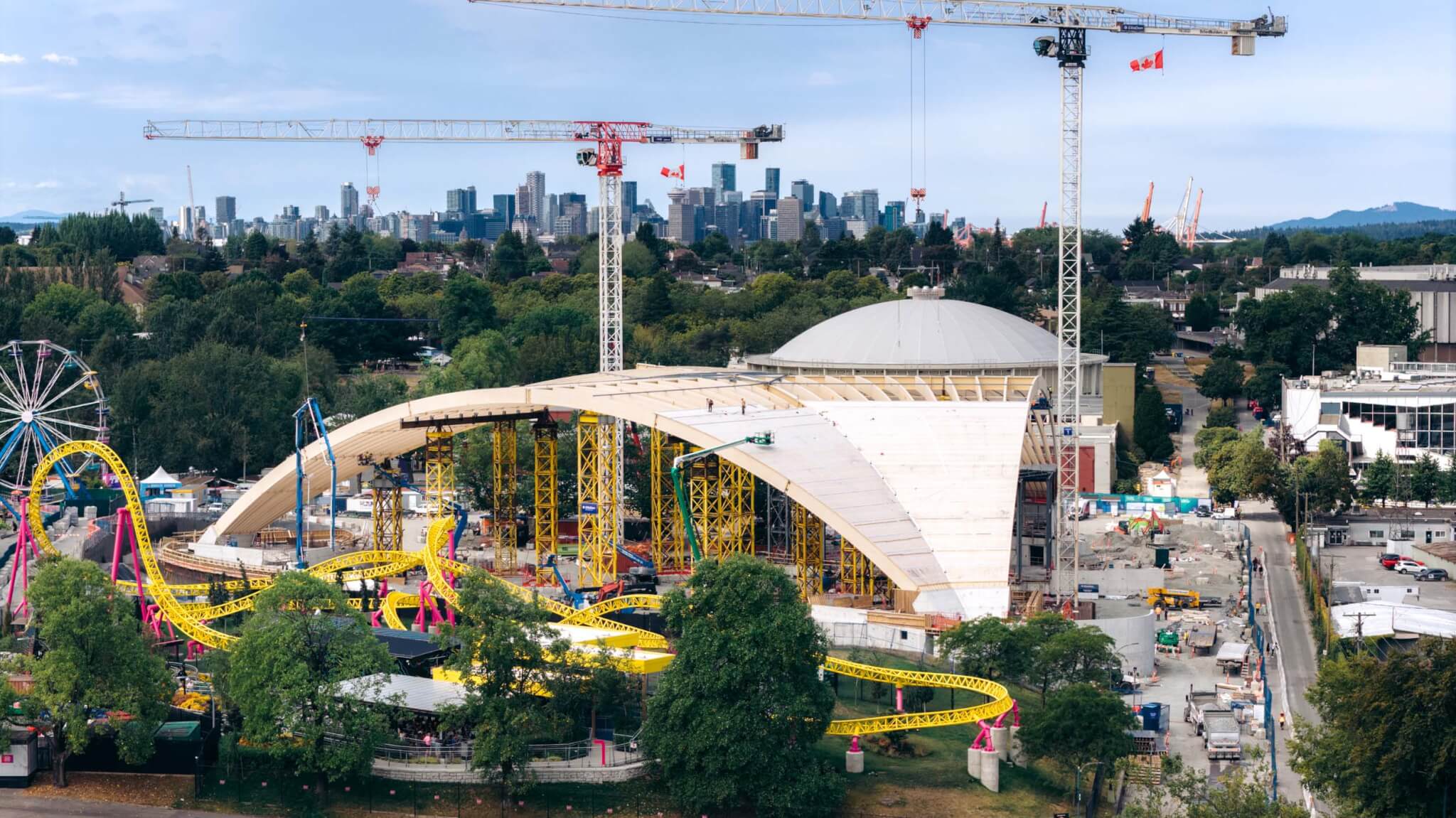 Revery Architecture’s Freedom Mobile Arch covers the 10,000-seat venue with a 105-meter Douglas fir roof, arranged in a starburst pattern and landing on only three points. (Courtesy Revery)
Vancouver
Originally constructed ahead of Expo 86, the Studio Phillips Barratt–designed stadium BC Place will play host to Vancouver’s seven matches.
The Fan Festival runs at the new PNE Amphitheatre at Hastings Park, branded Freedom Mobile Arch—a 10,000-seat outdoor venue by Vancouver’s Revery Architecture with Fast + Epp as structural engineer. Its mass timber roof spans 344 feet between buttresses and rises 25 meters at the peak, landing on only three points: 60 glulam beams in six barrel-vaulted segments, topped with a triangulated cross-laminated-timber deck that acts as a structural diaphragm. “We don’t sculpt wood,” Revery’s Venelin Kokalov said. “We sculpt time, and we sculpt the void.” It will be Vancouver’s first net-zero carbon cultural building.
Vancouver’s hosting cost has climbed from a 2023 estimate of $230 million for five matches to current estimates ranging from $532 to $624 million for seven. The city will also beef up security, with roughly 200 temporary new security cameras installed near the stadium. The work has drawn concern from privacy advocates who have spoken out against increased surveillance ahead of the event.