

Keep an eye on the sky both Monday and Tuesday evening for the conjunction of the galaxy’s two brightest planets: Jupiter and Venus!A conjunction is when two planets align in such a way that they appear to be in the same place in the sky. In this case, Jupiter and Venus will appear around 2 degrees of each other, or roughly the width of a pinkie when held at an arm’s length away.While they will both be visible Monday and Tuesday night, June 9 is the official date of the conjunction, and when they’ll appear closest, at 1.6 degrees, to one another. Where to look The planets will be visible when looking northwest shortly after sunset for about two to two-and-a-half hours and will appear to follow the Sun as it sets in the west. For those interested in viewing the phenomenon, Jupiter and Venus will be visible to the naked eye and, with binoculars, should appear close enough to one another to be seen at the same time.Also visible will be Mercury, which will be located down and to the right of Jupiter and Venus. Its best visibility is coming up in a few days, on June 15, when it reaches its furthest position from the Sun. The Gemini constellation will also appear beside Jupiter and Venus and will become easier to see the farther you get from areas with light pollution. Its most notable features will be its two bright stars, named Pollux and Castor, also located to the right of Jupiter and Venus, but above Mercury.Viewing conditionsSky conditions will be best Monday night if you are interested in viewing the conjunction. While viewing chances remain fair Tuesday night, there’ll be more clouds in the sky that could hinder sightings.The next close conjunction of Jupiter and Venus for the Northern Hemisphere won’t be until late 2028.
Keep an eye on the sky both Monday and Tuesday evening for the conjunction of the galaxy’s two brightest planets: Jupiter and Venus!

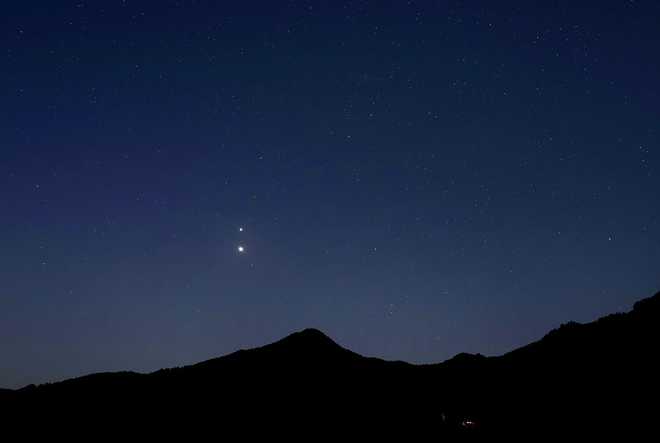
A conjunction is when two planets align in such a way that they appear to be in the same place in the sky. In this case, Jupiter and Venus will appear around 2 degrees of each other, or roughly the width of a pinkie when held at an arm’s length away.
While they will both be visible Monday and Tuesday night, June 9 is the official date of the conjunction, and when they’ll appear closest, at 1.6 degrees, to one another.
picture alliance
August 13, 2025, Bavaria, Schwangau: The planets Jupiter and Venus can be seen in a close conjunction over the Alps.
Where to look
The planets will be visible when looking northwest shortly after sunset for about two to two-and-a-half hours and will appear to follow the Sun as it sets in the west.
For those interested in viewing the phenomenon, Jupiter and Venus will be visible to the naked eye and, with binoculars, should appear close enough to one another to be seen at the same time.
Also visible will be Mercury, which will be located down and to the right of Jupiter and Venus. Its best visibility is coming up in a few days, on June 15, when it reaches its furthest position from the Sun.
The Gemini constellation will also appear beside Jupiter and Venus and will become easier to see the farther you get from areas with light pollution. Its most notable features will be its two bright stars, named Pollux and Castor, also located to the right of Jupiter and Venus, but above Mercury.

Viewing conditions
Sky conditions will be best Monday night if you are interested in viewing the conjunction.
While viewing chances remain fair Tuesday night, there’ll be more clouds in the sky that could hinder sightings.
The next close conjunction of Jupiter and Venus for the Northern Hemisphere won’t be until late 2028.