
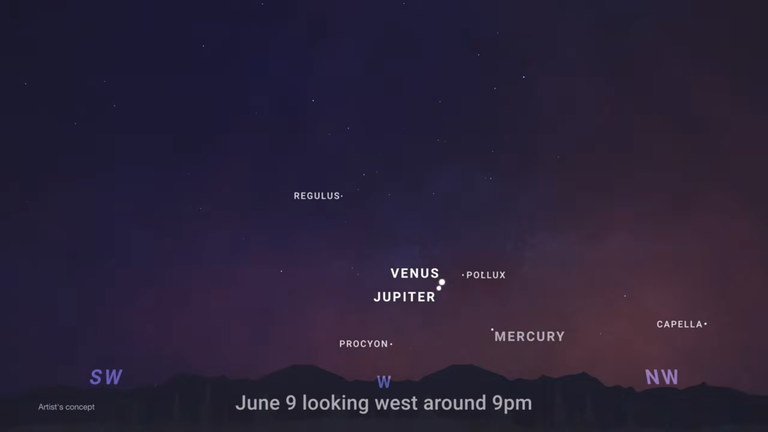
On the evening of June 9, Jupiter and Venus will appear extremely close to each other in the night sky, sharing a “cosmic kiss.” These two planets, which are the brightest visible planets from Earth, will appear as little as 1.6 degrees apart in an event known as a conjunction.
A planetary conjunction occurs when planets appear near each other in the sky, even when they’re really millions of miles apart in space, according to NASA.
Planets move at different speeds along their orbital paths, and sometimes the timing is just so that planets are in the same part of their orbital path and line up according to our perspective from Earth.
Even though Jupiter and Venus will appear to be little more than a pinky’s width apart from each other in the night sky, almost as if they are sharing a kiss, they are separated by hundreds of millions of kilometers in space.
The best time to see the conjunction between Jupiter and Venus will be after sunset on June 9, said Levent Gurdemir, director of the University of Texas at Arlington Planetarium. Sunset is estimated to occur around 8:35 p.m. in Dallas.
The two planets will be very noticeable in the western sky and will be easy to see from Dallas.
“As soon as the sky is clear, light pollution is not a problem for Jupiter and Venus,” Gurdemir said. “They are bright enough to overcome the light pollution.”
The conjunction can be enjoyed with just the naked eye, but a small telescope could provide a closer look at Jupiter’s surface and moons, Gurdemir said.
The planets will still appear close to each other on June 10 and 11, approximately 3 degrees apart. This conjunction typically happens only once a year, so it is worth taking a peek.
Niamh Ordner is a science reporting fellow at The Dallas Morning News. Her fellowship is supported by the University of Texas at Dallas. The News makes all editorial decisions.