
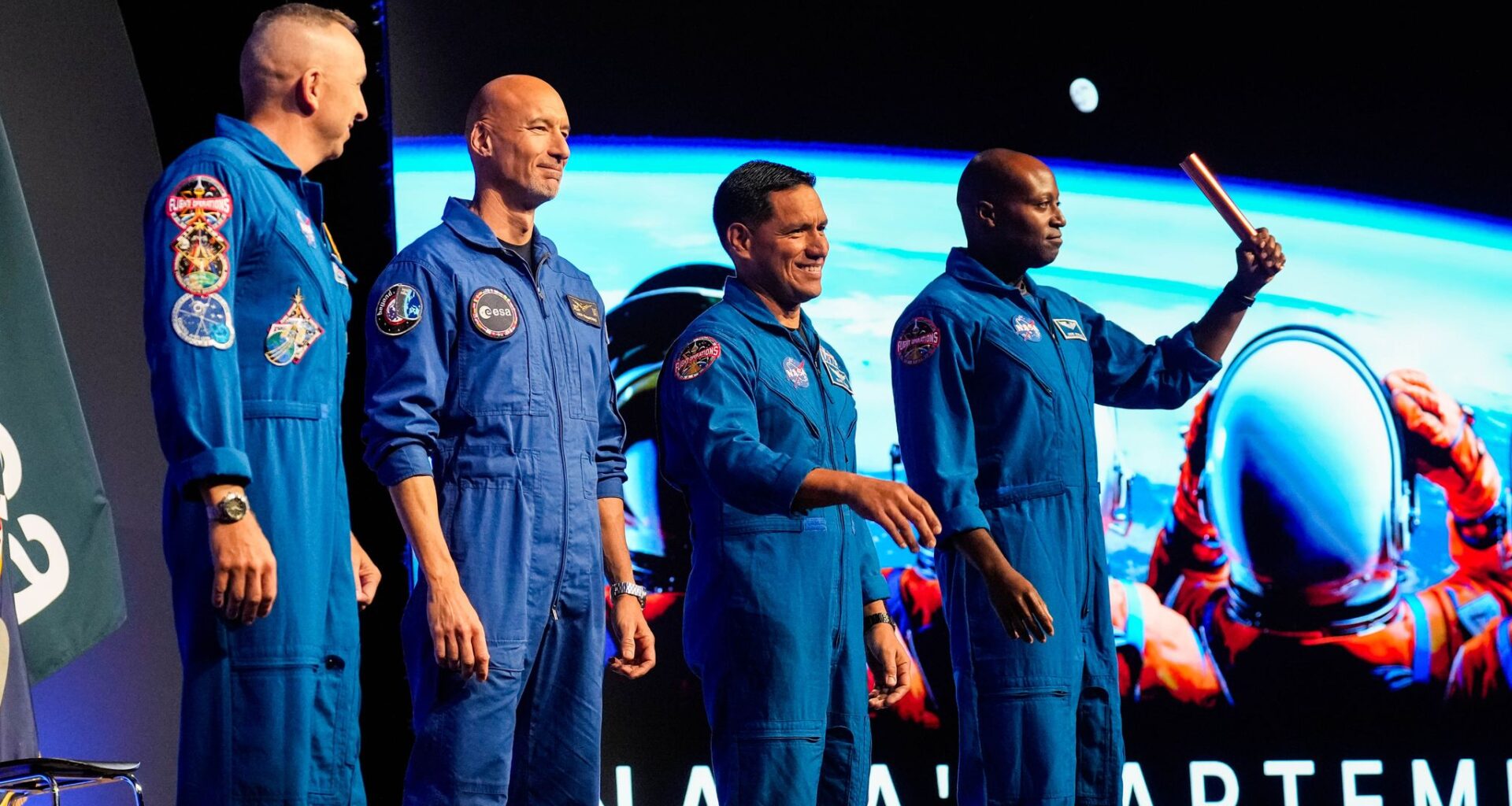
From left, NASA astronaut Randy Bresnik, European Space Agency astronaut Luca Parmitano, NASA astronaut Frank Rubio and NASA astronaut Andre Douglas are introduced as the Artemis III crew at NASA Johnson Space Center in Houston on Tuesday, June 9, 2026.
Raquel Natalicchio/Houston Chronicle
NASA astronaut Randy Bresnik waves to the crowd after being announced as a member of the Artemis III crew at NASA Johnson Space Center in Houston on Tuesday, June 9, 2026.
Raquel Natalicchio/Houston Chronicle
NASA astronaut Andre Douglas waves to the crowd after being announced as a member of the Artemis III crew at NASA Johnson Space Center in Houston on Tuesday, June 9, 2026.
Raquel Natalicchio/Houston Chronicle
NASA astronaut Frank Rubio waves to the crowd after being announced as a member of the Artemis III crew at NASA Johnson Space Center in Houston on Tuesday, June 9, 2026.
Raquel Natalicchio/Houston Chronicle
European Space Agency astronaut Luca Parmitano waves to the crowd after being announced as a member of the Artemis III crew at NASA Johnson Space Center in Houston on Tuesday, June 9, 2026.
Raquel Natalicchio/Houston Chronicle
From left, NASA astronaut Randy Bresnik, European Space Agency astronaut Luca Parmitano, NASA astronaut Frank Rubio and NASA astronaut Andre Douglas are introduced as the Artemis III crew at NASA Johnson Space Center in Houston on Tuesday, June 9, 2026.
Raquel Natalicchio/Houston Chronicle
NASA astronaut Andre Douglas speaks after being announced as a member of the Artemis III crew at NASA Johnson Space Center in Houston on Tuesday, June 9, 2026.
Raquel Natalicchio/Houston Chronicle
Vanessa E. Wyche, director of NASA Johnson Space Center, speaks during an event announcing the Artemis III crew in Houston on Tuesday, June 9, 2026.
Raquel Natalicchio/Houston Chronicle
Attendees cheer as the Artemis III crew is introduced during an event at NASA Johnson Space Center in Houston on Tuesday, June 9, 2026.
Raquel Natalicchio/Houston Chronicle
Attendees wait for the announcement of the Artemis III crew at NASA Johnson Space Center in Houston on Tuesday, June 9, 2026. The mission will orbit Earth and test systems, including spacesuits and lunar landers, needed for future missions to the moon.
Raquel Natalicchio/Houston Chronicle
European Space Agency astronaut Luca Parmitano shakes hands with leadership after being announced as a member of the Artemis III crew at NASA Johnson Space Center in Houston on Tuesday, June 9, 2026.
Raquel Natalicchio/Houston Chronicle
European Space Agency astronaut Luca Parmitano speaks after being announced as a member of the Artemis III crew at NASA Johnson Space Center in Houston on Tuesday, June 9, 2026.
Raquel Natalicchio/Houston Chronicle
NASA astronaut Randy Bresnik speaks after being announced as a member of the Artemis III crew at NASA Johnson Space Center in Houston on Tuesday, June 9, 2026.
Raquel Natalicchio/Houston Chronicle
Members of the Artemis II and Artemis III crews greet one another on stage during an event announcing the Artemis III crew at NASA Johnson Space Center in Houston on Tuesday, June 9, 2026.
Raquel Natalicchio/Houston Chronicle
Members of the Artemis II and Artemis III crews greet one another on stage during an event announcing the Artemis III crew at NASA Johnson Space Center in Houston on Tuesday, June 9, 2026.
Raquel Natalicchio/Houston Chronicle
Members of the Artemis II and Artemis III crews greet one another on stage during an event announcing the Artemis III crew at NASA Johnson Space Center in Houston on Tuesday, June 9, 2026.
Raquel Natalicchio/Houston Chronicle
NASA has unveiled the four astronauts who will fly on Artemis III: Americans Randy Bresnik, Frank Rubio, Andre Douglas and Italian Luca Parmitano.
Bresnik will be the mission’s commander. Parmitano, with the European Space Agency, will be the pilot. Rubio and Douglas will be mission specialists.
ARTEMIS: What’s next for the Artemis program? When NASA could return to the moon — and its race with China
Article continues below this ad
Children dressed as astronauts cheer during an event announcing the Artemis III crew at NASA Johnson Space Center in Houston on Tuesday, June 9, 2026.
Raquel Natalicchio/Houston Chronicle
Their Artemis III mission, set to launch in 2027, will be demanding as NASA, Blue Origin and SpaceX seek to coordinate their separate rocket launches and spacecraft operations.
“This mission will be one of the most complex that NASA has undertaken,” Norm Knight, director of NASA’s Flight Operations Directorate, said during a NASA event.
Artemis III is part of NASA’s effort to return humans to the moon. But this crew won’t actually go there or land on the lunar surface.
Article continues below this ad
The astronauts unveiled Tuesday at NASA’s Johnson Space Center in Houston will spend two weeks in low-Earth orbit, where NASA is planning to dock the agency’s Orion spacecraft with the Human Landing Systems being built by Blue Origin and SpaceX.
Testing the landers in Earth’s orbit on Artemis III will reduce risks for NASA’s next mission, Artemis IV, where astronauts will transfer from Orion into one of these commercially owned and operated spacecraft to reach the lunar surface.
“Every single mission we will do after this will be more challenging and more complex,” Bresnik said during NASA’s event. “We are certainly humbled, as a crew, to be able to be your crew that executes this Artemis III mission in space — being that unifying link between the phenomenal Artemis II mission we just had two months ago and the Artemis IV mission that will follow ours.”
Houston is NASA’s home for human spaceflight. It leads development of NASA’s Orion spacecraft and is working on various parts of the Human Landing Systems, including the crew cabin, personal computing devices and a toilet for Blue Origin.
And all of NASA’s astronauts live and work in Space City.
Article continues below this ad
Bresnik, a test pilot and retired U.S. Marine Corps colonel, has been to space twice: once in NASA’s space shuttle and once in Russia’s Soyuz capsule. He has logged more than 7,000 flight hours in 95 types of aircraft. Selected for astronaut training in 2004, Bresnik has more than 32 hours of spacewalk experience and spent the past several years assisting with the development and testing of Artemis spacecraft and systems.
Parmitano, a test pilot and Italian Air Force colonel, has flown to space twice in the Soyuz spacecraft. One of his spacewalks from the International Space Station turned dangerous as Parmitano’s helmet began filling with water, at one point covering his ears, eyes and nose. He has logged more than 2,000 flight hours across 40 types of aircraft and was selected as a European Space Agency astronaut in 2009.
From left, NASA astronaut Randy Bresnik, European Space Agency astronaut Luca Parmitano, NASA astronaut Frank Rubio and NASA astronaut Andre Douglas are introduced as the Artemis III crew at NASA Johnson Space Center in Houston on Tuesday, June 9, 2026.
Raquel Natalicchio/Houston Chronicle
Rubio, an Army Black Hawk helicopter pilot and family medicine physician, has flown to space once on Soyuz and holds NASA’s record for longest single spaceflight with 371 days in orbit. He was selected for astronaut training in 2017 and has spent more than 21 hours in spacewalks.
Douglas, a test engineer and Coast Guard Reserve commander, was the backup crew member for Artemis II. This mission will be his first spaceflight. He was selected for astronaut training in 2021.
Article continues below this ad
NASA astronaut Bob Hines, who previously flew on a SpaceX dragon capsule, will be the Artemis III backup crew member.
The crew learned they were selected for this mission about two weeks ago. They were called into a room and told they’d be flying together on Artemis III. Rubio said they were asked to keep it a secret from everyone but their immediate families. He said it was tough pretending like he wasn’t on the crew when his colleagues began speculating.
“It was really hard to keep that secret,” Rubio said in an interview.
His first flight was a record-setting marathon on the International Space Station. This mission will be a sprint.
“It really is hard to go 100% every day for more than two or three days,” Rubio said. “A mission like this is going to require us to be in the 95 to 100 range for about 15 days, I would say. So mentally preparing for that, emotionally preparing for that, and just focusing and being able to block out everything else and focus on nothing else but mission success.”
Article continues below this ad
Artemis III was previously expected to return humans to the lunar surface in 2028. But NASA Administrator Jared Isaacman changed the profile earlier this year so NASA could gain more experience with its Space Launch System rocket and Orion spacecraft — launching them more frequently to build muscle memory — and test the Blue Origin and SpaceX landers closer to home.
MOON BASE: Texas companies win and lose NASA contracts as the agency pushes toward a moon base
Blue Origin plans to launch its Blue Moon lander atop the company’s New Glenn rocket. For Artemis III, it will launch ahead of NASA’s Space Launch System rocket and Orion spacecraft, and Orion will meet the lander in Earth’s orbit. The crew will open the hatch and move inside Blue Moon to test the lander and its life support systems.
John Couluris, Blue Origin’s senior vice president of lunar permanence, said the rocket and lander would be ready for Artemis III — despite its New Glenn rocket exploding on the launch pad last month.
Steve Creech, NASA’s Human Landing System acting program manager, said the agency is assuming New Glenn will push the Blue Moon lander into space, but it’s also developing contingencies where the lander could launch atop another company’s rocket.
“It’s too early to really know for sure how quickly Blue will bounce back,” Creech said in an interview, “so we’re always working contingency scenarios.”
SpaceX plans to launch its Starship lander atop its Super Heavy rocket. Both of these vehicles are being developed in South Texas and recently launched on the company’s 12th flight test. Starship has not yet reached orbit. And while its most recent flight was considered a success, several of its engines shut down prematurely or failed to reignite.
For Artemis III, SpaceX would dock with the Orion spacecraft after Blue Origin. The crew will not go inside this vehicle, though Creech said a lot can be learned by maneuvering and docking the Starship spacecraft, which is the size of an Olympic swimming pool, next to the significantly smaller Orion capsule.
NASA astronaut Victor Glover, pilot of the Artemis II mission and the first Black astronaut to travel to the moon’s vicinity, greets the crowd during an event announcing the Artemis III crew at NASA Johnson Space Center in Houston on Tuesday, June 9, 2026.
Raquel Natalicchio/Houston Chronicle
Rubio expects the mission’s complexity will be exciting.
“Do we wish we were going to the surface of the moon? Absolutely,” Rubio said in the interview. “But then the reality is, this step is so critical to get us as a nation to go back to the moon and establish American leadership there.”
Artemis III will build off the momentum of Artemis II, which flew around the moon in April. And astronauts from that mission — NASA’s Reid Wiseman, Victor Glover and Christina Hammock Koch — passed a physical baton to their successors during Tuesday’s event.
Bresnik hoisted it over his head like the Olympic torch.
“We, the Artemis III crew, are honored to be able to carry this torch forward,” Bresnik said, “to be able to execute our mission, to make that flame burn brighter and to be able to pass that flame on to the next crew that’s out here.”