
Your support helps us to tell the story
From reproductive rights to climate change to Big Tech, The Independent is on the ground when the story is developing. Whether it’s investigating the financials of Elon Musk’s pro-Trump PAC or producing our latest documentary, ‘The A Word’, which shines a light on the American women fighting for reproductive rights, we know how important it is to parse out the facts from the messaging.
At such a critical moment in US history, we need reporters on the ground. Your donation allows us to keep sending journalists to speak to both sides of the story.
The Independent is trusted by Americans across the entire political spectrum. And unlike many other quality news outlets, we choose not to lock Americans out of our reporting and analysis with paywalls. We believe quality journalism should be available to everyone, paid for by those who can afford it.
Your support makes all the difference.Read more
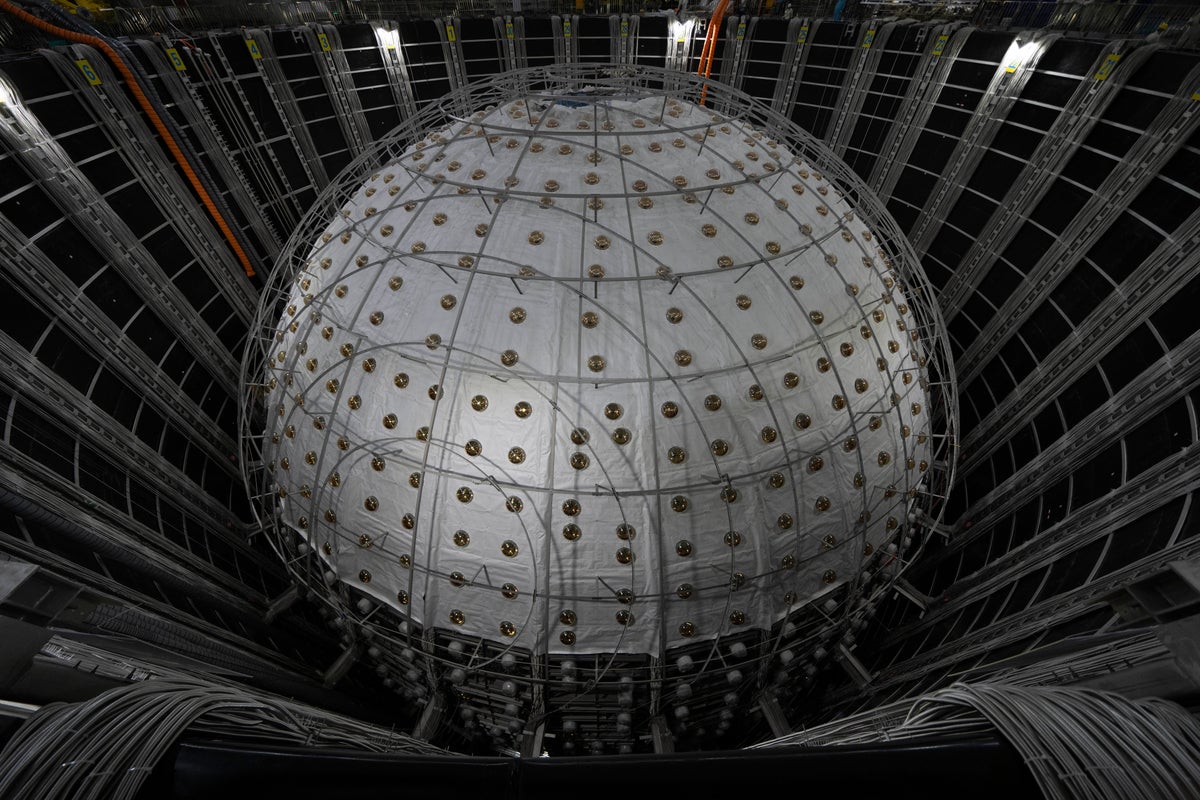
A massive underground detector aimed at understanding the mysterious ghost particles in our universe released its first major results on Wednesday.
The Jiangmen Underground Neutrino Observatory in China started collecting data in August with the goal of understanding neutrinos: tiny cosmic particles that date back to the Big Bang and whiz harmlessly through our bodies by the trillions every second. Yet they weigh almost nothing, making them difficult to sniff out.
In a study published Wednesday in the journal Nature, the JUNO team unveiled its initial findings from two months of data collection — including some of the most precise measurements to date of how neutrinos switch between three varieties, or flavors, as they zip through space.
“It really makes me look forward to more exciting results in the future,” said physicist Kate Scholberg with Duke University, who had no role in the new research.
The spherical JUNO detector is located 2,297 feet (700 meters) underground. It examines antineutrinos that come from collisions inside two nearby nuclear power plants. Antineutrinos are equally mysterious, opposite versions of neutrinos that scientists can study to understand their behavior and how neutrinos work.
When the antineutrinos meet particles within the detector, they produce a flash of light.
Scientists are hoping the detector will help resolve the longstanding mystery of how heavy each neutrino flavor is. They think two are similar in weight and that the third is an oddball, but they aren’t sure whether two are heavy and the other is light or vice versa.
The initial results haven’t answered that question just yet, but they show what the detector is capable of — and that it “will be able to test the finer ripples” that separate the neutrino flavors and their masses, said study co-author Liangjian Wen, a member of the JUNO collaboration.
Two similar neutrino detectors — Japan’s Hyper-Kamiokande and the Deep Underground Neutrino Experiment based in the United States — are set to begin data collection within the next decade, cross-checking the China detector’s results using different approaches.
___
The Associated Press Health and Science Department receives support from the Howard Hughes Medical Institute’s Department of Science Education and the Robert Wood Johnson Foundation. The AP is solely responsible for all content.