
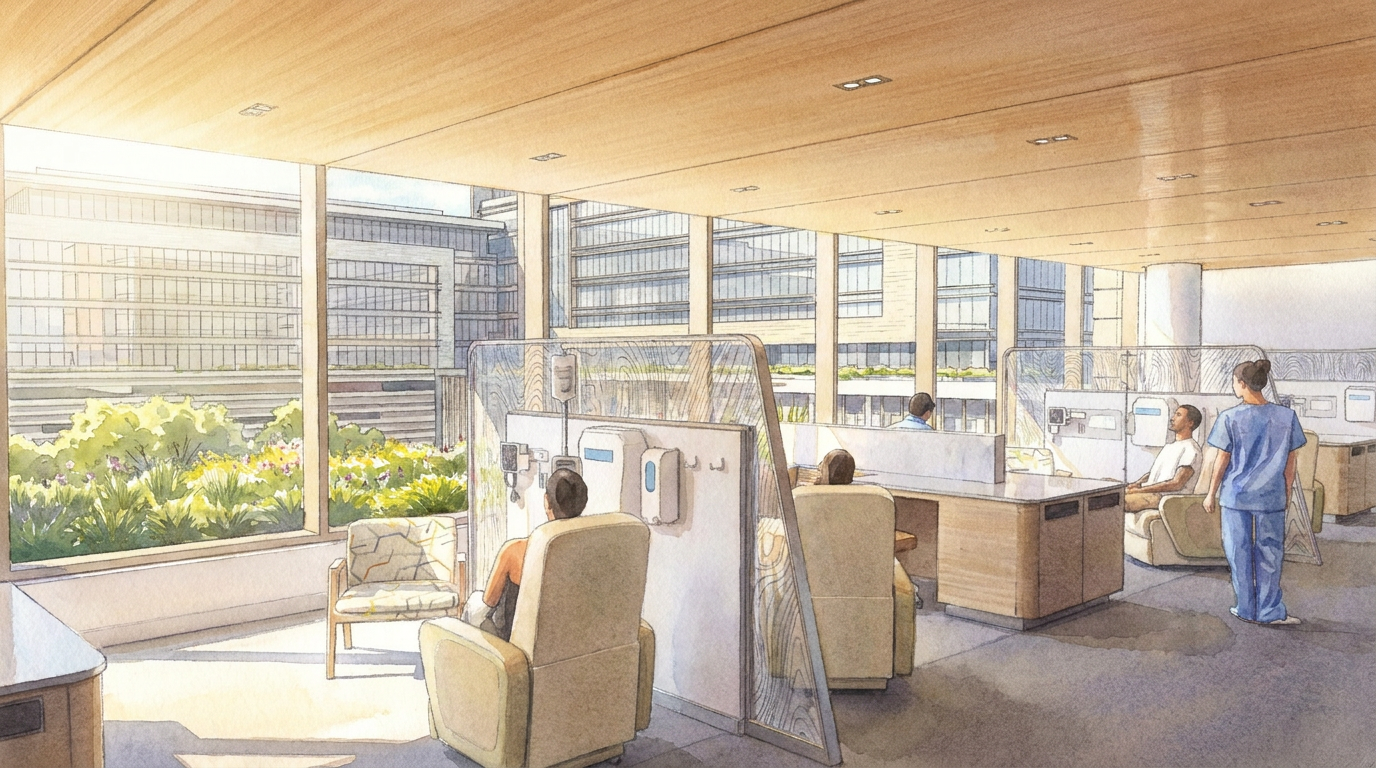
Stanford Medicine plans to begin construction of a major new cancer center in Redwood City as soon as 2029 that, upon completion, will serve the growing number of patients the provider expects to treat in the coming decades.
The proposed project, which requires approval from the City Council, includes a hospital, outpatient clinic and research building totaling up to 1.75 million square feet. The buildings will be connected by skyways and located on the existing Stanford Redwood City campus, adjacent to the Stanford Health Care Outpatient Center, right off Highway 101.
It will be the largest project in the history of Stanford University, and the largest medical facility in Redwood City, said Dr. Steven Artandi, director of the cancer center.
A previous version of the project was approved by the city in 2013. But an updated version that proposes greater height, density and 1.17 million additional square feet must still get city approval. Stanford plans to submit the updated proposal to the city this week, do a city-led environmental review in 2026 and 2027, and begin phased construction around 2029. Patients will begin receiving care in the new hospital and clinic around 2035 to 2037.
The hospital will be the largest building in terms of square footage, and include up to 470 inpatient beds. Stanford is requesting that all three buildings be up to 10 stories or 175 feet tall. Stanford did not say how much the project is expected to cost.
Having a dedicated cancer center will shift the center of gravity for cancer care from Stanford’s main hub in Palo Alto to Redwood City, Artandi said. It will expand the provider’s ability to treat more cancer patients to meet the growing demand for such services.
“One of our plans is to expand the scope of what we can do to treat cancer patients because our cancer services are so in demand, as cancer treatment has become more complicated,” Artandi said. “We’re basically out of capacity. We envision we’ll be serving a larger number of cancer patients, on a larger campus in Redwood City.”
While cancer mortality has declined steadily over the last few decades — thanks to smoking cessation and better therapies and screening — the number of new cancer cases is rising. The World Health Organization estimates that new cancer cases will grow 77% between 2022 to 2050.
This is being driven by two main factors, Artandi said: more young people are getting cancer, particularly colorectal cancer; and an aging population developing cancers such as breast, colon, pancreatic, lung and blood cancers in their advanced years.
“We see very little of that up to age 40 to 50, then a dramatic uptick in those cancer cases,” he said. “It’s pretty linear up to the 60s, 70s and 80s.”
Stanford will hold virtual meetings by webinar Wednesday evening to inform the community about the plans. The meeting in English will be from 5:30 p.m. to 6:30 p.m.; the meeting in Spanish will be from 7 p.m. to 8 p.m.
Correction: A previous version of this article gave an incorrect calculation of the square footage change between the original proposal and the current one.