
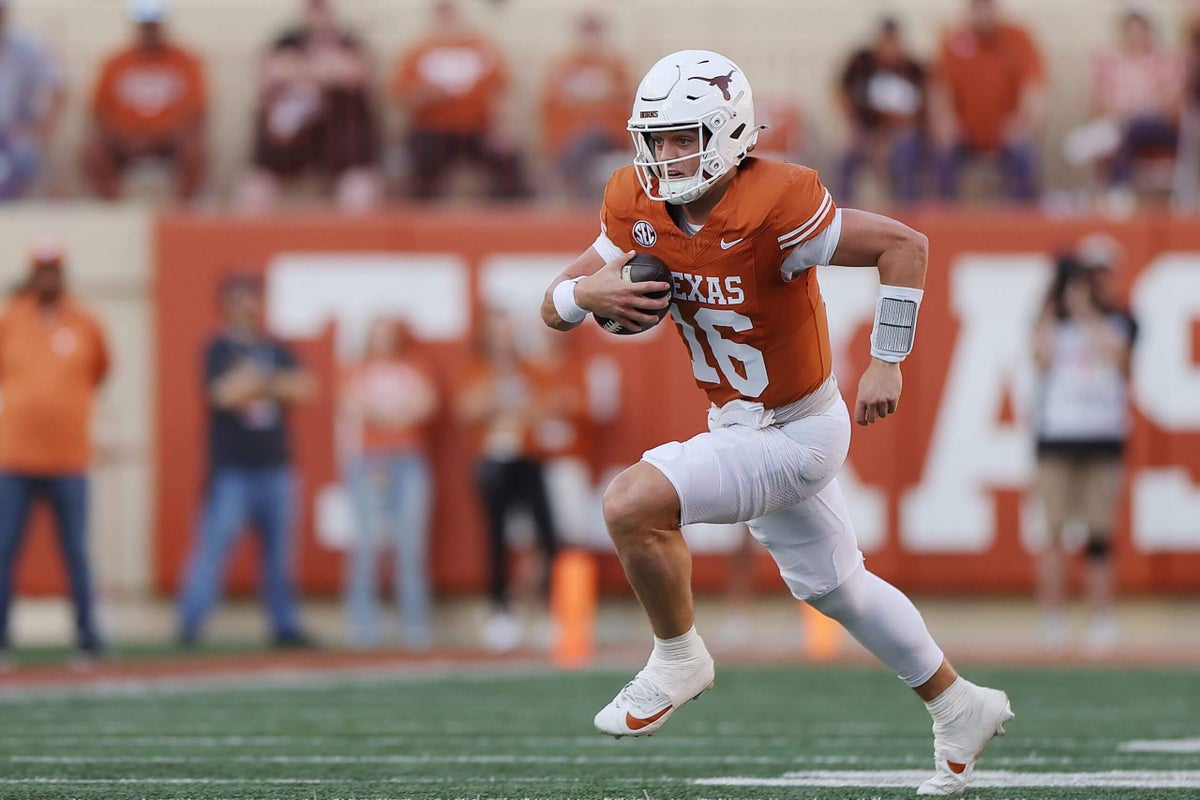
Nothing’s ever for certain in today’s version of college football. Barring something unforeseen, however, it’s safe to say the 2027 NFL Draft will feature more high-level quarterback talent than the 2026 draft did.
That list could include controversial Texas Tech quarterback Brendan Sorsby, who this week was granted a temporary injunction in his lawsuit against the NCAA to restore his college eligibility, despite having placed bets on his own team while at Indiana.
Will he actually be part of the ’27 class? How many of the other potentially big-name prospects will join that draft? Quarterbacks are no longer in a rush to turn pro, thanks in large part to name, image and likeness — regardless of how you feel about the state of college football, that’s a good thing.
In April, we gave a rough sketch of the top quarterbacks on scouting radars for the 2027 draft. Now, on the heels of the latest Sorsby news, we’ll rank them in tiers.
Tier 1 QBs
QBSchoolEPA/dropbackEPA vs. pressureOff-target rateAir yds/attThird-and-long rate
Arch Manning
.20
-.09
14.6
8.9
29.1
Dante Moore
.21
-.26
11.7
7.9
34.3
Drew Mestemaker
.32
-.19
13.4
7.8
29.2
CJ Carr
.35
-.22
13.7
10.1
41.3
Julian Sayin
.39
-.10
8.4
8.3
31.8
Jayden Maiava
.38
.01
13.2
9.3
35.7
Arch Manning, Texas (redshirt Jr.)
6 feet, 4 inches tall, 219 pounds; 21 years old
Manning was inconsistent in his first year as Texas’ full-time starter, which should have come as no surprise. He played one of the tougher schedules a young quarterback can see, on a team with huge expectations. Despite your thoughts about the marketing machine behind him, though, his talent and the improvement he showed were undeniable.
Inconsistency with pocket mechanics, especially during the first half of last season, was probably Manning’s biggest issue. His blend of size, arm talent and athleticism is better than any prospect in this class, but that’s a double-edged sword for young players — Manning can be guilty of leaning too much on his raw ability to save him rather than making sound fundamentals his North Star.
If Manning can throw and react against pressure with calmer feet in 2026, he could be the No. 1 pick. We have to see those things in action, of course.
Dante Moore, Oregon (Sr.)
6-3, 206; 21 years old
Like Manning, had Moore declared for the 2025 NFL Draft, he absolutely would have been a first-round pick. The positives he showed as a first-year starter for Oregon greatly outweighed the negatives, especially from a poise standpoint. Moore’s ability to remain even and play without fear regardless of the environment last season (see his performance at Penn State) reminded me of Jayden Daniels.
Moore wasn’t perfect, though, and his worst outings came in Oregon’s two losses to national champion Indiana. Moore has to be better when facing pressure, period. Far too often against the better defenses on Oregon’s schedule, we saw Moore dip his eyes and abandon his process too early. As is the case with Manning, he has to play calmer in the pocket.
The Hoosiers were easily the best team Moore faced last season. This season, scouts will get to see him face a tougher schedule, including games at Ohio State, USC and Michigan State, and at home against Michigan.
Drew Mestemaker, Oklahoma State (Jr.)
6-3, 211; 20 years old
Manning and Moore are the top two prospects as we sit today, so these next four Tier 1 QBs could be in a 1b/2a situation. A lot can happen in a year, though, and the potential beauty of the 2027 class is how many QBs with actual first-round tools could be available.
Mestemaker, who followed new Oklahoma State coach Eric Morris to Stillwater from North Texas, is absolutely on that list. He is a big-time athlete with a big arm. He was a fearless thrower as a first-time starter in Morris’ air raid system last year, too, putting up gaudy counting stats (4,379 yards, 34 TDs, nine INTs, 68.9 completion rate) against an AAC schedule.
Confident over the middle and very consistent with his footwork for a player his age, Mestemaker is also a capable mover with a natural ability to throw on the run from either side. His arm is strong, even if his release starts around his ear. The biggest question is how his game will translate to an FBS schedule.
CJ Carr, Notre Dame (Jr.)
6-2, 210; 21 years old
The 2027 NFL quarterback prospect who best resembles a great baseball shortstop, Carr is a smooth and bouncy athlete with a big-play mindset. He plays like the perfect blend of his two grandpas: former Michigan coach (and accomplished ex-college QB) Lloyd Carr and former Michigan Hall of Fame safety Tom Curtis, one of the best athletes in Wolverines history. CJ Carr’s escapability and off-platform playmaking as a first-year starter last year were outstanding.
Another tough, fearless passer who isn’t afraid to run someone over, Carr has an explosive and almost effortless throwing motion. He can rip the ball from several arm slots and body angles without losing velocity, and he throws on the run the way an infielder might. All of this can get him into trouble, though, as Carr last season tended to abandon ship too early in favor of sandlot ball.
We’ve seen the rabbits he can pull out of his hat. Now we need to see what he can do down to down as a consistent pocket passer. If he improves in that area, he could be a top 15 prospect in the 2027 class.
Julian Sayin, Ohio State (Jr.)
6-1, 208; 20 years old
Perhaps except for Manning, no other player on this list had the benefit of playing with as much talent as Sayin last year. His favorite target (Jeremiah Smith) might be the best player in America; his second favorite (Carnell Tate) was a top-five pick in April. However, Sayin’s ability to walk in the door and keep the machine moving so smoothly was special.
He’s not as big as the rest of the guys in this group, but Sayin plays tall in the pocket and isn’t afraid to climb into the face of pressure. He throws with good touch, plus he’s a great processor for his age and is difficult to rattle. Sayin is one of the youngest players in Tier 1, but he played like a veteran last season and could be a Heisman candidate again in 2027.
There are physical limitations, but if Sayin’s processing goes from good to elite and he’s able to iron out some mechanical inconsistencies, then teams are going to overlook that he’s not huge and doesn’t have an overwhelming arm.
Jayden Maiava, USC (fifth-year Sr.)
6-4, 230; 22 years old
An older prospect, Maiava’s first year as a college starter came at UNLV in 2023. He played seven games at USC in 2024 before taking over full time last season.
Maiava isn’t super quick athletically, but he plays with great rhythm as a passer. He knows what he’s doing with his feet, knows where the ball’s supposed to go, and doesn’t waste time getting it there. He’s not a bad athlete, but he’s at his best when he can scan and drive the ball from the pocket.
He also showed good touch on layered throws (and hit several tight windows) last year. He could be more accurate, though, and has ground to make up athletically. But if Maiava can show Fernando Mendoza-level growth as a pocket passer, he could fly up draft boards.
Tier 2 QBs
QBSchoolEPA/dropbackEPA vs. pressureOff-target rateAir yds/attThird-and-long rate
Brendan Sorsby
.26
-.01
13.4
9.7
25.0
Brendan Sorsby, Texas Tech (fifth-year Sr.)
6-3, 235; 22 years old
Sorsby gets his own tier, as his situation is unique (if that’s the right word). For now, Sorsby will be eligible to compete for Texas Tech this season after serving a two-game suspension. Whether he winds up having to go through the supplemental draft or the 2027 NFL Draft, he’ll present an interesting case for NFL teams.
Purely from a talent standpoint, Sorsby probably fits somewhere in the middle of Tier 1 as a potential first-round pick. He’s huge but a great athlete at 235 pounds, with plus burst and natural escape skill. He’s a smooth passer on the run, and he has good arm talent and a lot of confidence over the middle. As a player, at times, he might remind you of a bigger Jaxson Dart.
Off the field, however, teams will have to do serious homework.
Tier 3 QBs
QBSchoolEPA/dropbackEPA vs. pressureOff-target rateAir yds/attThird-and-long rate
Sam Leavitt
.13
.02
13.4
8.6
16.7
Darian Mensah
.28
-.21
10.8
8.7
26.0
Trinidad Chambliss
.36
.16
11.7
8.2
43.3
LaNorris Sellers
.06
-.27
14.3
8.8
23.0
Darian Mensah, Miami (Sr.)
6-3, 205; 21 years old
The last two guys to take the Miami job (Cam Ward and Carson Beck) wound up having the times of their lives while playing their best football. Mensah, a Duke transfer, has a chance to make it three in a row for Mario Cristobal and the Hurricanes. He owns a great frame (even if he’s a tad thin right now) and a live arm, which allows him to mix slots and rip the ball off platform, on the run and from pretty much anywhere else on the field.
Mensah is arguably a better fit for Miami’s offense than Beck was and has the potential to make it sing — maybe not as well as Ward did, but we shouldn’t rule anything out.
Mensah needs to improve his footwork, but he doesn’t have far to go. He’s a capable runner, too, and doesn’t play as a run-first quarterback. If his throwing mechanics and pocket presence improve, Mensah could have first-round buzz.
Sam Leavitt, LSU (Sr.)
6-2, 205; 21 years old
An explosive athlete with plus arm talent and an ability to rip the ball from any arm angle, Leavitt should be a great fit for just about everything Lane Kiffin’s offense wants to do at LSU. He’s not real big, but he plays tall in the pocket and flashes terrific feet for a player his age. When he’s on, he’s an athletic passer who can play on time, and he can be a serious threat to do damage with his legs.
When he’s off, however, he can be a mess. Leavitt, who missed half of last season after undergoing foot surgery near Halloween, needs to be much more decisive in the pocket. He got caught unprepared and confused far too often at Arizona State, resulting in unnecessary scrambles, hits and risks. He missed too many layups, was hesitant over the middle and telegraphed too many throws.
Kiffin’s system simplifies so much for the quarterback, which should help quite a bit, but Leavitt still needs to show an ability to throw from the pocket if teams are going to see him as more than a potential Day 2 draft pick.
Trinidad Chambliss, Ole Miss (sixth-year Sr.)
6-0, 200; 23 years old
Chambliss won his court battle and will get to play another season at Ole Miss. This one will be without Kiffin, but Chambliss flashed serious potential during his first year as an FBS quarterback. A former Division II star at Ferris State, Chambliss made some huge throws last season for the Rebels, with some gaudy numbers on third-and-long. He was generally fearless, both as a passer and runner.
An elite mover who can play the position like a point guard, Chambliss definitely has some college-aged Russell Wilson to his game. There are obvious physical limitations, and his arm isn’t overwhelming, but he’s been very good with the football and has proved himself a winner everywhere he’s gone.
This draft class might be too crowded at the top for him, but Chambliss still feels like a potential Day 2 investment down the road — so long as his improvement continues.
LaNorris Sellers, South Carolina (Sr.)
6-3, 240; 20 years old
One of the biggest wild cards in this class, Sellers has the athletic potential to be the No. 1 pick. He’s 6-3, 240 with terrific arm talent and great ability as a runner, plus he’s smart, young and a team captain. There is so much to like.
There’s also still way too much mystery, and some of it remains beyond his control. Sellers can get better from a mechanical standpoint, but more importantly, he needs to be more decisive this season. He also suffered last year from playing inside a poor offense, as South Carolina’s line struggled and Sellers often found himself fighting upstream.
Sellers has first-round tools. But unless we see a big improvement from both player and team, he could wind up a Day 2 prospect in this group.
Others to watch: Josh Hoover, Indiana; John Mateer, Oklahoma; DJ Lagway, Baylor; Byrum Brown, Auburn; Nico Iamaleava, UCLA