
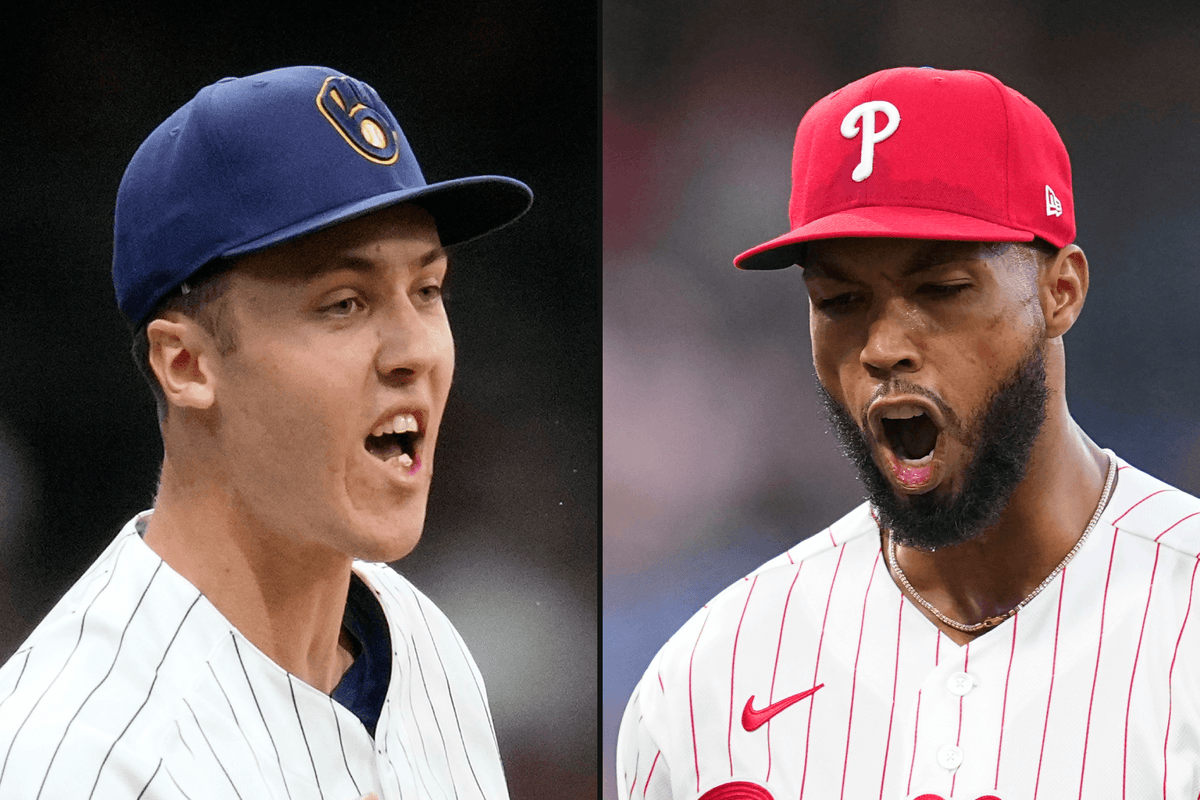
It’s time to savor a historic series in dominant pitching, coming up this weekend. Two starting pitchers will take the stage. They are occupying rarified territory.
One man throws a baseball harder than any starting pitcher has ever thrown it — at least since we’ve had the scientific tools to measure this stuff.
The other delivers a changeup that disappears in mid-air, somewhere between when it leaves his hand and where the most confused hitters on Earth are standing, trying to detect it on their radar screens.
Those two men are Jacob Misiorowski and Cristopher Sánchez. And when the Brewers and Phillies meet in Milwaukee this weekend, both of those aces will take the mound — and give us a glimpse at greatness that comes along rarely in this sport.
At one point last weekend, it seemed possible they might actually face each other. Instead, the Brewers will send Misiorowski to the mound on Friday, and Sánchez will pitch for the Phillies on Sunday. But even though they won’t step into the ring on the same day, this is still special.
Why? Just check out your qualified National League pitcher leaderboard this morning:
ERA
1. Misiorowski — 1.50
2. Sánchez — 1.54
STRIKEOUT PCT.
1. Misiorowski — 38.4 percent
2. Sánchez — 30.1 percent
According to STATS Perform, this will be only the second series in the last century-plus, since ERA became an official stat in 1913, that featured two starting pitchers who each had an ERA under 1.55 and a strikeout rate of at least 30 percent.
That’s with a minimum of five starts, and openers excluded. Believe it or not, the first one involved two starters for the same team (the Astros), back in May 2018:
Gerrit Cole (1.43 ERA, 41.3 percent strikeout rate)
Justin Verlander (1.21 ERA, 34.5 percent strikeout rate)
But that’s not all. Miz (116) and Sánchez (113) are also the only two pitchers in their league with 100 strikeouts or more. And STATS tells us this will be the first series since 1913 in which two of the starting pitchers ranked 1-2 in the major leagues in strikeouts and entered with ERAs under 1.55. (That’s also with a minimum of five starts.)
So who knows what their next acts will bring us this weekend? All we truly know is that the only thing similar about them is their stats.
“They’re obviously both extremely effective — for different reasons,” Phillies catcher J.T. Realmuto told me and my co-host, Doug Glanville, on this Saturday’s edition of our Starkville podcast. “Miz’s fastball is obviously just — it’s in a league of its own. I’m excited to face him.
“I remember facing him last year, and he was throwing hard. But I want to say he was topping out at, like, maybe 100 — throwing more like 98 to 100 (mph). Now he’s more 100 to 103 — so I don’t know if I’m excited for that, but it’ll be fun to see the difference.”
Of all the adjectives you can find at dictionary.com, “fun” should rank about 1-billionth on the list of descriptions any hitter would use to describe this Miz-Sánchez battle. But it’ll be fun for the sport, at least. So there’s that.
Let’s just consider what the two of them did in the month of May — because you can’t beat that kind of fun for the hitters in our favorite solar system.
Miz faced 136 batters. One of them scored. One of them had an extra-base hit (a double). The dudes who had to bat against him “slugged” .116. That’s the lowest slugging percentage in a calendar month in the modern era against a pitcher who threw as many innings as he did.
Oh, and he also threw 242 fastballs at 100 mph or swifter — in one month.
So who won the National League Pitcher of the Month Award? Amazingly, it was not him.
That’s because Sánchez’s ERA in May was a picturesque 0.00. Those 39 innings worth of doughnuts he served up rank No. 2 in the live-ball era (since 1920), for any pitcher in any month, behind only Orel Hershiser’s 55 shutout innings, in September/October 1988. In Sánchez’s case, they were part of a historic 50 2/3-inning scoreless streak that stretched from April 30 to June 3.
But here comes the important part — and the part that makes Sánchez so different from Miz.
In May, the Phillies’ gravity-defying left-hander threw 207 changeups. Hitters swung at 125 of them. They got precisely eight hits against that pitch — and whiffed on 64 of them. That works out to a 51 percent swing-and-miss rate — which is incredible for any pitch, let alone a changeup.
“To get that much swing-and-miss out of a changeup is pretty rare,” Realmuto said on Starkville. “Changeups are usually a pitch you’re using to get a guy out in front and maybe hit a weak groundball. But it just shows how rare his changeup actually is, that he gets that much swing-and-miss. And it’s turned into a strikeout pitch, as opposed to: ‘Let’s get weak contact here.’
“It’s just his hand speed. It spins the exact same as his fastball. It looks the same coming out of the hand — the same movement. I faced him in live (batting practice) a couple spring trainings in a row now. And you can look for the changeup, and when it comes out of his hand, there’s a split second in your head where you go, ‘Oh, that’s a fastball.’ And then you swing at it, and it’s not, (because) it looks that much like the sinker.”
It seems hard to fathom, but the full-season whiff rate against Sánchez’s changeup (50 percent) is somehow even greater than the whiff rate against Miz’s four-seamer (42 percent). But that’s the beauty of the pitching artistry that will be on display in Milwaukee this weekend.
“Neither one is fun to face,” Realmuto said. “That’s for sure. It’s completely two different styles of pitching — and both extremely effective.”
So once Realmuto had officially dumped “fun” off his adjective list, we asked him: How does a hitter prepare to face a guy throwing 103, anyway? He laughed.
“Get your foot down,” he said.
That’s just a taste of the great Starkville conversation with Realmuto, one of the most thoughtful catchers in this sport. He took us inside the Phillies’ managerial change — and why Don Mattingly can have a powerful impact on modern players. Realmuto also dug deep on how ABS is changing the job of catchers everywhere. He told us why Freddie Freeman kicked dirt on him in L.A. He gave us the scoop on Kyle Schwarber’s other Three True Outcomes. And so much more.
The show drops Saturday on The Athletic’s Rates and Barrels feed. It’s available everywhere you find your podcasts. And we’re now on YouTube. So don’t miss this one.