
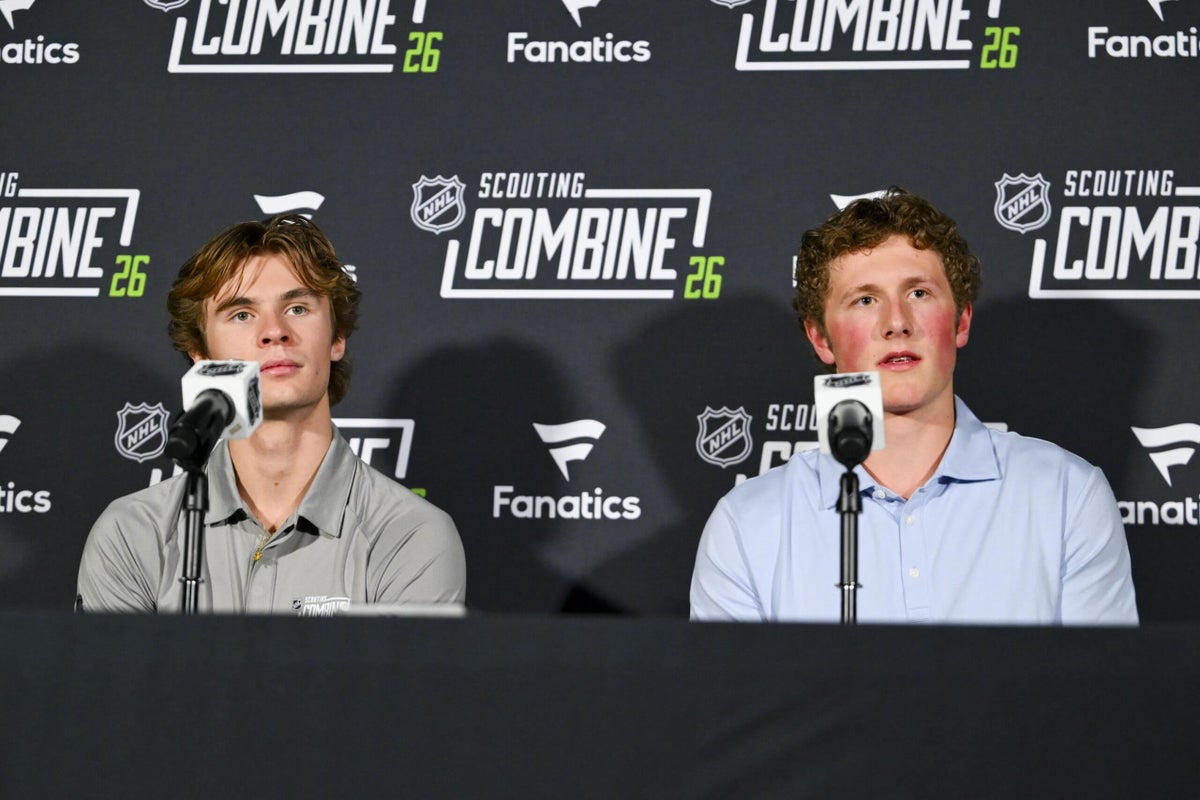
You’ve seen their rankings. You’ve read their evaluations. Now, it’s time to hear The Athletic’s NHL prospect writers debate each other.
Today, Corey Pronman and Scott Wheeler go head-to-head on the players and topics they most disagree about in the 2026 NHL Draft. You can judge the arguments for yourself, but the real value in this exercise is hearing the cases for each side on each of these debates.
How big is the top tier of players in this class? Does Gavin McKenna belong at No. 1? These are questions that could define the draft, and this conversation between Corey and Scott is a window into the different perspectives driving them.
Max Bultman: Let’s start here: You two define the top group of names in this class very differently. Scott, your most recent ranking has only two players in the top tier, Gavin McKenna and Ivar Stenberg. Corey’s top tier has five names.
Why do McKenna and Stenberg stand alone?
Scott Wheeler: It starts with what they’ve accomplished. From a pedigree standpoint, their body of work stands alone, and they’re the only two players who have done things (McKenna at his first U18s, in the WHL, etc., and Stenberg in the SHL and at men’s worlds) that put them in a historic all-time context as draft eligibles.
I think it’s important to see that from a player when you’re picking them at the very top of a draft, and none of the D in this class have lived in rarified air like that. If Chase Reid, who is my third-ranked player, had had the kind of offensive production that Zayne Parekh, for example, had at the same age (well, actually, younger), and then he had the 6-foot-2.5 frame, and the skating, and the better defending than Parekh, then that’s how you go from No. 3 to No. 1 worthy. But he hasn’t done that.
If you were to take one of these D at No. 1, I think you’re hoping you’re getting an Aaron Ekblad/Owen Power tier of player and not a Matthew Schaefer, Rasmus Dahlin, Cale Makar, Quinn Hughes tier of one. And as good as those two players are, in the history of No. 1 picks, they’re disappointing outcomes. I think McKenna has a clear path to finishing in a higher historical echelon in that fraternity.
Then there’s the players, and from a skill standpoint, I also think we’re talking about the two most talented players in the class with McKenna and Stenberg (in that order), and so I think there’s another gap that presents there.
Bultman: Corey, you have not only more players in your top group (McKenna and Stenberg, plus defenders Reid, Alberts Šmits and Keaton Verhoeff), but your most recent list has the three defensemen all above the two wingers, with Reid at No. 1.
What makes those three blueliners compelling enough picks to take ahead of McKenna and Stenberg? And is McKenna’s offensive ceiling not enough to overcome some of the positional factors with wingers?
Corey Pronman: I think all three players project as 22-24 minutes per game defensemen who can play on both special teams and be go-to guys at even strength, matching up with good players. Stenberg and especially McKenna have way more skill than them, but those defenders are also way more athletic and projectable to the NHL. If I felt like McKenna was going to be a 90-100 point threat regularly, it would get him over the hump for me, but I have his offensive projection a notch below.
I agree with Scott that these aren’t typical No. 1 overall type of defensemen, but I would have McKenna/Stenberg 3 or 4 in last year’s draft and in next year’s draft too, based on my way too early projection of 2027. That’s just what this draft is, and I’ve actually compared it to the Power draft in 2021.
Bultman: With McKenna, specifically, there has been huge hype for years. So, when you say this year is more like the Power draft, what changed that McKenna wouldn’t be seen as a special type of prospect?
Pronman: I never really shared that opinion. If you go back to all my way too early previews of this draft class.
Aside from his world U18s two years ago, I’ve never really walked away from a viewing thinking this guy is a freak/future elite NHL player. I could be wrong, but he’s a lot closer to someone like Will Smith (although better than Smith) as a player than Connor Bedard for me. His skill is elite, his brain is elite, but he’s a 5-foot-11 winger without great speed or compete. The number of guys with that athleticism/compete combination who become superstars is incredibly small.
In terms of his season, he had a great season, but it’s fair to say it fell below expectations to a degree after how dominant a junior player he was. He basically did what Adam Fantilli did in the Big Ten, but not as a 6-foot-3, physical center (and McKenna had a way better World Juniors than Fantilli).
Bultman: You mentioned McKenna having a clear path to become one of those elite NHL players. So first, how would you respond to Corey there? And second, since you have Stenberg tiered with McKenna, does that mean you believe Stenberg can similarly be an elite NHL producer?
Wheeler: You’re telling me when McKenna was setting the CHL’s modern-era record 51-game point streak (129 points in that span!) in his draft-minus-one, you didn’t come away from some of those viewings thinking he was elite? Seems pretty elite to me.
I also don’t think there was a forward in the Power draft who was in the same stratosphere as McKenna and Stenberg, so I don’t really see the comparison between 2021 and 2026, to be honest. The only reason the D from that class (Power, Edvinsson, Hughes, etc.) have a case for No. 1 in a re-draft is that the forwards sucked, and the highest-scoring player to date from that class went 23rd. I’d be pretty surprised if this draft class plays out anything like how that one has.
These two are way more talented than Matty Beniers, Mason McTavish, Kent Johnson and company were at the same age, Stenberg included, to answer your second question, Max. I think he’s going to be one of his team’s top 1-2 scorers in his prime.
Pronman: I’m aware of his numbers; I also have Google.
Bultman: All right, let’s move on to one of those defensemen in particular, Verhoeff. Corey has him in the top three, but Scott, you have him down at No. 8. He’s another player who had a lot of hype coming into the year. It’s one thing to have him behind McKenna or Stenberg, but what is your hesitation with Verhoeff that moves him that far down the list?
Wheeler: My hesitation in taking him with a top-five pick would be twofold: 1. His decision-making. 2. His boots.
I’ve had concerns about the latter dating back to my first live viewings in Sarnia at U17s more than a year and a half ago, and I think the former was highlighted more as an issue playing at the college level (though I’ve also seen it at the World Juniors and U18s). In higher-pace environments, he has struggled with his reads and with his pivots/clumsy feet when he has to change directions or get somewhere from a standstill in a scramble.
Those are two things that can really hold a defenseman back at the next level and aren’t always guaranteed to come. I also don’t think his skill level leaps off the page, and I have seen him bobble and mishandle his fair share of pucks.
I still view him as in the same tier as the top D prospects in this class, but I think he has enough yellow flags to slot at the back of that group.
Bultman: Verhoeff — like McKenna — jumped from the WHL to college hockey this year. Clearly, you still rank him very highly, but Corey, did you see anything from him at the college level that raised concerns for you, as Scott alluded?
Pronman: I see his skating differently than Scott. I don’t think his first few steps are the prettiest, but I think he skates well overall and very well for being 6-foot-4.
I’ve seen him pull away from forecheckers and not get caught from behind on rushes plenty of times at the faster college level. 17-year-old defensemen don’t play up levels, major minutes at U18s a year ago, WJC this winter, college hockey as a U18 in the top four of a good team, if they are iffy skaters.
I don’t think his IQ is a major selling point, but neither was Ekblad’s, who is my comp for him. I’ve seen him make enough skilled plays to see the offense. I actually think the two times he’s shared ice with projected top-10 picks Carson Carels and Daxon Rudolph at Hlinka, and Carels at WJC, he made more plays (but it’s fair to say he’s riskier/more mistake-prone).
Bultman: Let’s talk about another defender you two differ on, Ryan Lin.
Scott, you have him at 10, in the same tier as the rest of the top D group, while Corey has him at 21. At 5-foot-11, Lin is a smaller player than the rest of that group, and didn’t outproduce his fellow WHL D Carels and Rudolph. Why does he belong in that tier with them?
Wheeler: I have both of those D ahead of Lin, but I don’t think there’s some massive gap between them, and the results of my upcoming player survey suggest their peers view them in the same group as well, so I’m not alone in that.
There isn’t some giant gap in their production, either. Over their two full WHL seasons, Lin is actually the most productive of the bunch (points per game in brackets):
Lin: 110 points in 113 games (0.97)
Carels: 108 in 118 (0.92)
Rudolph: 119 in 132 (0.90)
He was slightly less productive on a points per game basis this year, but he also dealt with injury and played on the lowest-scoring team of the bunch, and I’m confident his production would look like the other two’s in their situations and theirs like his if they played for the Giants.
Whenever they’ve played together (U17s, Hlinka, U18s, CHL-USA Prospects Challenge), Lin has also looked every bit their equal as well. I think he’s the smartest D in this class and one of its most polished and most well-rounded, and I don’t see a single thing in his profile that gives me pause.
I have full belief that he’s going to be tremendous for Denver and then have a long career as a top-four defenseman in the NHL. Denton Mateychuk (who is 5-11) went No. 12 and was a top-four D in the league who registered 13 goals, 31 points and played to positive defensive results last season as a 21-year-old. I see Lin similarly.
Bultman: Corey, you’ve been cautious about ranking smaller offensive defensemen in the past, but certainly some do turn out to be very impactful players. What would stop Lin from becoming that, and how do you feel about the comparison to Mateychuk?
Pronman: Mateychuk is a high-end skater, so that’s a distinction for me, as I don’t think Lin is that kind of skater. I also don’t think Mateychuk is a no-doubt top four D on a good team, and think he’s close to Lin, so that comp doesn’t offend me. I’ve thought more of Cam York for Lin or Rasmus Sandin, who are good NHL players, but I think the above I think applies to them as well.
Lin has been a wonderful junior player, but again, I know he’s been productive. The question is about the projection to the next level. In a game tomorrow in the WHL, I would take him over Rudolph. In the NHL, where the forwards are all quicker and bigger, I would want Rudolph’s athleticism on the back end. For a player with his size/feet profile to be a top-10 guy, I think the offense can’t just be close, but world-class, and I don’t think he’s shown that to date in the WHL or at the major events.
Bultman: Corey brings up a fair point there when you look at some of the D still playing deep into the Stanley Cup playoffs. Among the remaining teams, Sean Walker and Shayne Gostisbehere are the only D under 6 feet. Both are impactful players, but considering Carolina was able to acquire both rather inexpensively, is that worth a top-12 pick, Scott?
Wheeler: There’s a long list of D Lin’s size in the league. There were 87 D in the league last year who were 6 feet and under. The Avalanche won the Cup with a blue line full of them and have since made Sam Malinski a success story.
It’s not just Cale Makar, Quinn Hughes and Lane Hutson who are successful, even though that’s often how it’s painted. Josh Morrissey, Erik Karlsson, Adam Fox, Vince Dunn, Kris Letang, Zeev Buium, MacKenzie Weegar, Jared Spurgeon, etc., are all also top 12 picks in re-drafts, so you can play that game both ways. He’s a better player at this stage than Sandin was, too, and has had a better WHL career to date than Morrissey, who went 13th.
Bultman: Let’s say he slots in like Dunn, Weegar or even Spurgeon. That’s kind of the crux of my question: is the offense dynamic enough to be a key player on a top team, or is he more of a complementary piece? I think that’s a fair distinction to draw in the top-12 or so picks
Wheeler: I think those guys have all been key players at different times in their careers and complementary pieces in others. And I suppose I would argue that that’s a solid outcome for a player in that range, especially if Morrissey, who’s a star, is a possible outcome (even if it’s not promised).
I would also argue that the other players in that 10-15 range who likely will go ahead of Lin (Oscar Hemming, etc.) are also likely to be somewhere between complementary and impact, and that there may not be a possible Morrissey-level outcome at their ceiling.
Bultman: That’s a good transition to some players Corey has in that teens range, Casey Mutryn and Gleb Pugachyov. Corey, why do those two belong in the same tier as more consensus power winger prospects Ethan Belchetz and Oscar Hemming? And is their offensive level enough to justify ranking them ahead of Lin?
Pronman: I think Pugachyov and Mutryn are rather similar to Hemming. Both are fast and 6-foot-3, both are highly physical, and they have good, but not great skill like Hemming. I would liken Lin to someone like Walker, who has been excellent (and I think Lin can help a good team), but I would argue players like Brett Howden and Ivan Barbashev have been more impactful in the playoffs.
Bultman: Scott, you have those two forwards much lower on your board, including Mutryn outside the top 50. What keeps them from first-round grades for you?
Wheeler: I think there’s a skill gap between Mutryn and Pugachyov and then another one between Pugachyov and Hemming, and view those first two a lot more like Ryder Cali as second-rounders rather than first-rounders. Corey also has Cali as a second-rounder, which is why I was surprised to see Mutryn and Pugachyov in his top 15. I view all three of those players as good-sized, hardworking, average-skill, projectable bottom-six forwards.
I just haven’t seen enough offense from any of the three of them to give them a first-round grade, let alone a front half of the first-round one. I think Hemming can become a Barbashev/Howden as the third guy on a top-six line for a good team. I’m not confident Pugachyov and Mutryn will get there (though it wouldn’t shock me as an outcome for Pugachyov, which slotted him in my 30s with Cali instead of the 50s with Mutryn). Mutryn, in particular, I just don’t think makes many plays, and you’ve got to in order to get picked in the heart of the first round for me.