
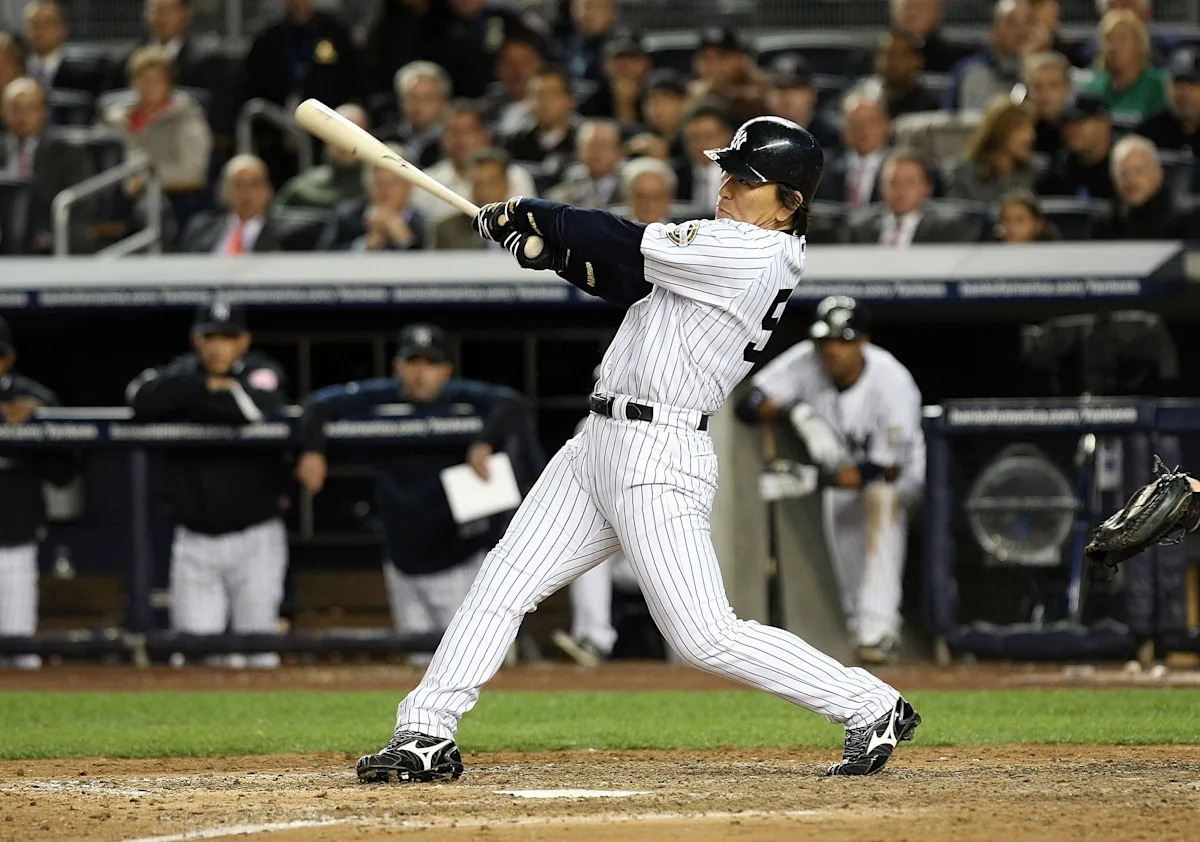
Nearly everyone who makes their big-league debut with the Yankees arrives at square one. Whether a heralded prospect or an expected placeholder, a future Hall of Famer or a one-and-done, everything accomplished in the lower rungs of pro ball takes a back seat as one begins their MLB journey.
By the time Hideki Matsui broke in with New York, he was already a nine-time All-Star and three-time champion, with an international following that equaled if not exceeded that of any of the Bombers’ cavalcade of stars. Entering with expectations as high as any player to debut with the team before or since, he showed himself to be not only a star but a consummate professional and, most endearingly to his adopted fanbase, a champion.
Advertisement
Hideki Matsui
Born: June 12, 1974 (Nomi, Japan)
Yankees Tenure: 2003-09
Matsui seemed always to be destined for greatness. Growing up, he hit well enough from his natural right side that his older brother forced him to bat from the left to give everyone else a chance. That seemingly innocuous decision would unlock one of the most ferocious lefty strokes in baseball history. Matsui became a household name in Japan while still in high school, where his excellence was so pronounced that he was intentionally walked five straight times during a Kōshien high school tournament, drawing attention not only for the dominance implied by the decision but by the youngster’s stoic reaction to having the bat taken out of his hands on what was, to date, the biggest stage of his life.
He began playing with the NPB’s Yomiuri Giants in 1993 at the age of 19, quickly establishing himself as a precocious hitter and disciplined all-around ballplayer. After three strong seasons, he took the inevitable step to superstardom in 1996. While the Yankees were on the path to their first title since 1978, their future left fielder was slashing .314/.401/.622 with 38 home runs to earn his first Central League MVP. He would sustain that level of performance for six more seasons, earning another two MVPs and establishing himself alongside Ichiro Suzuki as one of Japan’s brightest baseball stars. In addition to his larger-than-life performance, he earned a reputation for his work ethic and commitment to his team, playing in 1,250 consecutive games as he helped the Giants to three titles. This included the 2000 Nippon Series, in which Godzilla hit .381 with three homers and eight RBI to earn MVP honors.
At the conclusion of the 2002 season, Matsui — still just 28 — had hit 332 home runs with a .996 OPS in 10 seasons with Yomiuri. Seeing the success Ichiro had moving to MLB, winning Rookie of the Year and MVP honors in 2001, Matsui decided to take the leap as well. After reportedly turning down a five-year deal after the 2001 season that would have made him the highest-paid player in the history of Japanese baseball, he hit the open market. Japan’s gentlest baseball giant announced his intent to play in the U.S. in typically understated fashion. ”This year, I hit 50 home runs with 107 R.B.I., and my batting average was .334,” he wrote in an email to all 30 teams. ”I hope your team will be interested to offer me a contract for next season.”
Advertisement
The Yankees were interested, as were other teams, including the Orioles and Mets. Matsui had to contend with the familiar concerns about how his game would translate to a new league in addition to some concerns specific to his personality. ”In games, he is not bold,” said Kiyoshi Nakahata, Matsui’s hitting coach his first two seasons. ”He is so kind that his kindness doesn’t mesh well in the game.” Matsui’s most heralded compatriot came to his defense, trumpeting his transferrable offensive approach. ”Some power hitters can’t react to all pitches,” Ichiro said during the free agency process. ”Matsui can.”
Matsui ended up coming to New York on a three-year, $21 million deal, almost certainly less than he could have gotten had he stayed in Japan. The news was covered by the American press as much as a curiosity as a baseball move, as they emphasized the question marks in his game and the financial value of courting the Japanese baseball audience.
His introductory press conference was representative of this unique partnership between player, team, and city. ”Today has been one of the happiest days of my life,” Matsui said. With New York Mayor Mike Bloomberg in attendance, he added, ”To be able to come to this beautiful city, New York, and to be able to play for the Yankees, the most beloved team in the city, I’m really happy to be here.”
The anticipation around the Yankees’ newest star remained at a fever pitch throughout spring training and into the regular season. In his first game at Yankee Stadium, Bernie Williams walked to load the bases for Matsui in the fifth. With the Bronx faithful looking on, he smoked a 3-2 pitch to right center. By the time it landed, Godzilla had become the first Yankee to hit a grand slam in his home debut, beginning a love affair on the part of Yankees fans that continues to this day. The feeling was reciprocated. ”This was the greatest moment that I’ve ever had,” said the player who’d reached such heights in his home country.
Despite these early theatrics, Matsui would not be the 50-home juggernaut he had been in Japan in his new home. He hit 16 homers in ‘03 while finishing runner-up to Ángel Berroa for AL Rookie of the Year (albeit due to two voters leaving him off their ballot altogether). On a team chock full of attention-drawing superstars, he proved to be something perhaps more valuable. Playing in all 163 Yankees games that year (one more than the usual 162 due to a rainout ending in a tie), Matsui drove in 106 runs hitting mostly out of the five-hole to help anchor a franchise in transition. His manager expressed his appreciation for the steady contributions of his left fielder. ”Whether he’s recognized as a great player league-wise, I don’t know,” said Joe Torre. ”I don’t think there’s anybody you’d want hitting with men on base more than him. Maybe a few guys as much as him, but not more. To me, that makes him a great teammate.”
Advertisement
Matsui continued to perform into the postseason, hitting .281 with two homers in 17 games. He was a critical part of the iconic eighth-inning rally off Pedro Martínez in Game 7 of the ALCS that tied the game and set the stage for Aaron Boone’s walk-off homer three innings later. Down two and with Bernie Williams on first, he turned on an 0-2 pitch to lace a ground-rule double down the right field line.
After scoring the tying run one batter later on a bloop single off the bat of Jorge Posada, he leaped into the air and let out a primal shout before spiritedly high-fiving his teammates. It was a rare show of emotion from the normally reserved Matsui, one that revealed the tenacity and competitiveness that necessarily exists within a player of his caliber.
After a year of adjustment, Matsui would record his best season with the Yankees in ‘04. He surpassed 30 homers for the only time in the States while hitting .298 and getting on base at a .390 clip. He was also a force in the postseason, hitting .412 with three homers and 13 RBI in the first two rounds of the playoffs while managing two separate five-RBI games in the ALCS.
Advertisement
Matsui signed an extension after the 2005 season which kept him in pinstripes through 2009. His defense declined as he aged into his 30s and injuries snapped his consecutive games played streak. Still, Matsui remained a remarkably consistent offensive force. In his seven seasons with New York, he was 23 percent better than league average with the bat, slashing .292/.370/.482 while averaging more than 100 RBI per 162 games. By the end of his deal, as a 35-year-old full-time DH, he was still providing the reliable production and quiet leadership-by-example for which he was known. On a new-look 2009 team, he was once again something of an afterthought despite hitting well, batting mostly out of the five or seven spots in the order as the Yankees won 103 games to take the AL East.
Godzilla lay mostly dormant through the first two rounds of the playoffs, getting on base at a high clip but drawing few key hits. Heading into a World Series in which he’d face limited playing time due to the National League’s lack of a DH in their home park, it seemed possible Matsui’s time in New York would end with an elder statesman quietly bidding farewell. Instead, he would deliver one of the greatest performances in the Yankees’ long postseason history.
The Phillies started a 37-year-old Martínez in Game 2. Crafty but diminished, he would prove no match for his old foe. Matsui reached base in each of his three at-bats against the starter, culminating in a sixth-inning solo homer to stake the Yankees to a lead they would not relinquish.
Advertisement
Matsui homered again coming off the bench in Game 3 but was a non-factor over the next two days as he appeared again only as a pinch-hitter. In Game 6, with Pedro back on the bump at Yankee Stadium, the Bombers had a chance to clinch their 27th championship. For a player who’d experienced so much winning with Yomiuri but narrowly missed the Yankees’ dynastic run, it was not an opportunity to be missed.
After Alex Rodriguez reached to start the second, Matsui stepped to the plate. The two veterans, Pedro and Hideki, dueled for eight pitches until, with a full count, the batter won the battle, obliterating a center-cut pitch into the second deck in right field to give the Yankees a 2-0 lead.
Advertisement
He came up next again the next inning with the bases loaded, singling to center to plate another pair. In the fifth, with the Yankees up 5-1 and two runners on, he clubbed a hanger from future Yankee J.A. Happ for a double that cleared the bases and all but put the World Series in the bag.
It also cemented Matsui’s case for World Series MVP, an achievement made even more remarkable by the fact that he started only three of six games. He ended the series a ridiculous 8-for-13 with three homers and eight RBI, six of which came in the clincher, tying Bobby Richardson for most in any World Series game. “I guess you could say it’s the best moment of my life,” Matsui said of taking home MVP honors, believably echoing his sentiments after his first game at the old Yankee Stadium. “All I can say right now is I feel great. I’m so happy.”
Game 6 would be Matsui’s last in pinstripes. He’d play three more seasons, one each with the Angels, Athletics, and Rays, before retiring at the age of 38. Including both his NPB and MLB stats, he finished with 507 homers and 2,643 hits. But his legend in both Japan and the U.S. transcends his statistics. Matsui’s humility, grace, and grit have made him a legend among baseball fans everywhere. In 2018, he was inducted into the Japanese Baseball Hall of Fame on his first ballot. He remains immensely popular whenever he returns to Yankee Stadium, including in what has become something of an informal annual tradition of throwing out the first pitch before a playoff game.
Join us in celebrating the 52nd birthday of number 55, Hideki Matsui.
See more of the “Yankees Birthday of the Day” series here.