
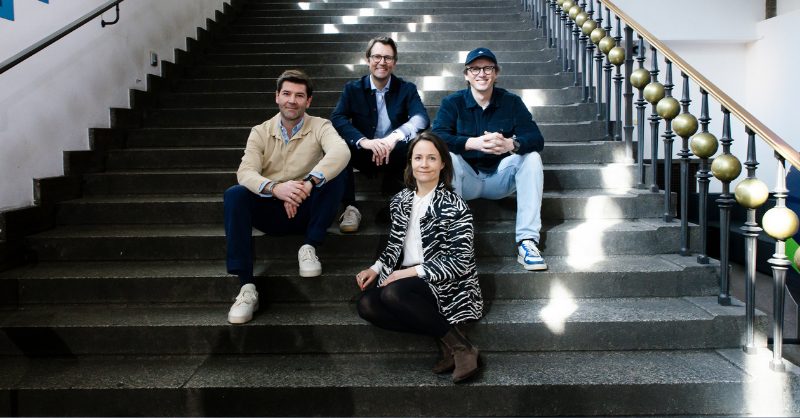
Germany’s first dedicated deep tech fund, Vsquared Ventures, opened a London office on June 11 — but Companies House records show its UK entity was incorporated in October 2024, 18 months before the public announcement.
The move puts Vsquared in direct competition with London-native deep tech investors, including Atomico ($4.7B AUM) and Balderton Capital
The office is led by general partner Lise Rechsteiner, who co-founded Norwegian deep-tech fund Propagator Ventures and holds a PhD from ETH Zurich
Europe’s oldest dedicated deep tech fund went public, announcing it had opened a London office and framing the move as a fresh expansion into new territory. Companies House tells a different story: Vsquared Ventures UK Ltd was incorporated in October 2024. The firm has been building in London for the better part of a year and a half before saying a word about it.
“The future of European deep tech depends on coupling frontier engineering with long-term capital and global commercial scale,” Lise Rechsteiner, the general partner leading the London office, says.
“Europe already produces world-class scientists and engineers. The challenge — and opportunity — is ensuring the next generation of breakthrough companies can access the capital, networks, and commercial scale needed to become global category leaders from Europe,” she adds.
Why London, why now
The timing of going public is not incidental. London pulled in more than £7 billion in venture capital in Q1 2026, its strongest quarter in four years, driven by AI, advanced computing, climate, and defence.
Deep tech funding hit €15 billion across Europe in 2024, accounting for nearly a third of all venture capital deployed on the continent, with London attracting $2.2 billion of that, second only to Paris. The sector is estimated to generate more than $5 trillion in global economic impact over the coming decade, as governments race to secure leadership in critical technologies.
Founded more than a decade ago in Munich, Vsquared built its reputation as Germany’s first deep tech-only fund before most institutional investors took the sector seriously. Today, it manages more than €450 million in assets under management across nearly 50 portfolio companies spanning 13 countries.
Its portfolio includes Isar Aerospace, Europe’s leading private launch provider; IQM Quantum Computers and Zama, both unicorns; NEURA Robotics, now Europe’s top-funded humanoid maker; Hyperscale Power; and Lace Lithography.
The firm invests from pre-seed to Series A across AI, energy transition, new computing and sensing, new space, robotics, and tech-bio.
Not your typical German satellite office
What makes the London move interesting is who Vsquared has chosen to lead it. Rechsteiner is not from Munich’s industrial deep tech world. She co-founded Norwegian fund Propagator Ventures in 2018, backed companies across Europe and North America, and holds a PhD in management, technology, and economics from ETH Zurich.
Her roots are Nordic, which gives the London office a different brief from that of a straightforward German outpost focused on LP relations.
In London, Vsquared enters a market dominated by larger, longer-established players. Atomico, founded by Skype co-founder Niklas Zennström, manages $4.7 billion in AUM and backs deep tech alongside its broader technology portfolio.
Balderton Capital, founded in 2000, has raised $4.5 billion and holds a portfolio of more than 275 companies. Both are native to London. Vsquared’s differentiator is specialisation: it writes only deep tech cheques, and it has been doing so since before the category attracted mainstream capital.
A reshuffle that points to something bigger
Alongside the London launch, Vsquared announced a wave of internal changes. Michael Jobst, Patrick Tucci, and Jakob Lingg move to investment partner; Maria Juesas Portoles joins as investment partner; and Gina Krymalowski steps up to VP of platform and communications.
The breadth of the reshuffle — investment, platform, and communications shifting simultaneously — points to a firm preparing for a larger operational footprint.
Whether the London office becomes a genuine second hub or a capital-raising base will depend on Vsquared’s ability to win deals on the ground. The European Commission allocated €1.4 billion to deep tech entrepreneurs and researchers in its 2026 innovation programme, and governments across the continent are treating the sector as an industrial policy priority.
The window for a specialist to carve out territory is real. If 18 months of quiet preparation was enough of a head start, is the question Rechsteiner now has to answer.