
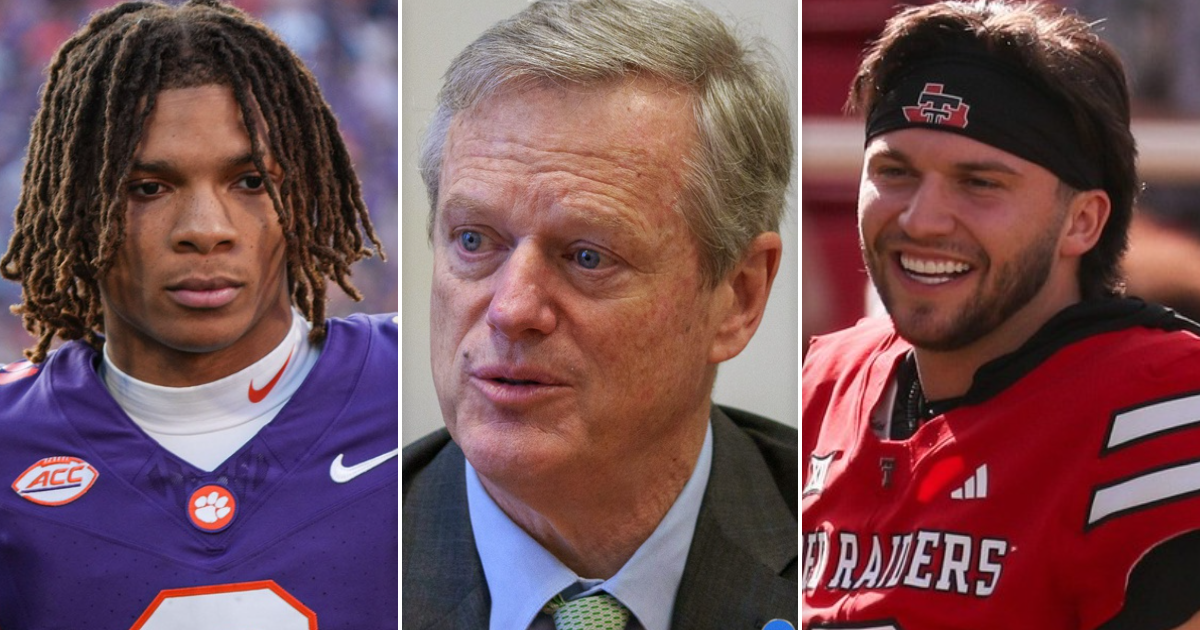
NCAA president Charlie Baker doubled down on his call for Congressional legislation Saturday after a difficult week in which his organization lost not one but two court battles. In addition to Monday’s controversial ruling reversing the NCAA’s eligibility ban against Texas Tech quarterback Brendan Sorsby, Clemson receiver Tristan Smith was granted an injunction Friday that made him eligible to play in 2026.
In a post on X/Twitter, Baker specifically pointed to language in Smith’s ruling Friday that directly cited the Sorsby v. NCAA case in its decision to award the veteran Tigers WR a fifth season of eligibility. For Baker, it’s just the latest example of why the NCAA needs immediate antitrust relief with the passage of the bipartisan Protect College Sports Act that is currently working its way through the Senate.
[ $19.99 gets you a FULL year of On3 | Rivals national coverage ]
“The Sorsby decision was never about only one student-athlete,” Baker’s X/Twitter post Saturday began. “We are already seeing downhill effects in other eligibility cases in which state courts are allowing student-athletes to circumvent longstanding eligibility rules, citing Sorsby outcome as part of the court’s precedent.
“Another example of why we need Congress to pass the Protect College Sports Act, authorizing the association to apply common sense eligibility rules consistently for all student-athletes and schools, regardless of the state or local court system.”
The Sorsby decision was never about only one student-athlete. We are already seeing downhill effects in other eligibility cases in which state courts are allowing student-athletes to circumvent longstanding eligibility rules, citing Sorsby outcome as part of the court’s… pic.twitter.com/RVIbFPRB3P
— Charlie Baker (@CharlieBakerMA) June 13, 2026
Smith’s attorney, Darren Heitner, shot back at Baker’s post with his own Saturday afternoon, highlighting inconsistencies in how the NCAA has ruled on past eligibility claims. That includes denying Smith’s request for a fifth season of eligibility in January despite previously granting a blanket waiver for players with past JUCO experience following last year’s Diego Pavia v. NCAA injunction ruling.
“State courts are not ‘allowing student-athletes to circumvent longstanding eligibility rules.’ They are holding the NCAA accountable to its own rules, which the NCAA has and continues to arbitrarily enforce,” Heitner wrote Saturday on X/Twitter. “The solution is simple. Stop selectively enforcing rules. The NCAA gave JUCO players in Diego Pavia‘s graduating class an extra year of eligibility. It needs to do the same for all former JUCO players. Otherwise, it’s an arbitrary exception for one class of athletes without any foundation whatsoever.”
Pickens County (S.C.) District Court judge Jessica Salvini‘s temporary injunction ruling for Smith specifically referenced the Sorsby decision Monday in Lubbock, Texas, that rescinded the NCAA’s decision to rule the Texas Tech QB permanently ineligible after years of admitted gambling activities, including betting on his own team while a member of the Indiana football program in 2022.
“As the district court found in the most recent decision issued on June 8, 2026, in the matter of Sorsby vs. NCAA,” Salvini’s ruling read, “the irreparable harm includes, but is not limited to, benefits from the coaching staff, trainers and being a member of a Division I college; and being able to make an informed decision as to whether to enter the 2026 NFL Supplemental Draft.”
Retired Texas state district court judge Ken Curry ruled Sorsby properly “demonstrated that he will suffer a probable, imminent, and irreparable injury if this court does not issue this temporary injunction because he will be unable to participate as a member of Texas Tech University’s 2026 football team.” Curry’s ruling also levied several strict conditions Sorsby must adhere to maintain the injunction. That includes serving a two-game suspension to open the 2026 college football season, as well as continuing his ongoing rehabilitation work related to his clinically diagnosed gambling addiction.