
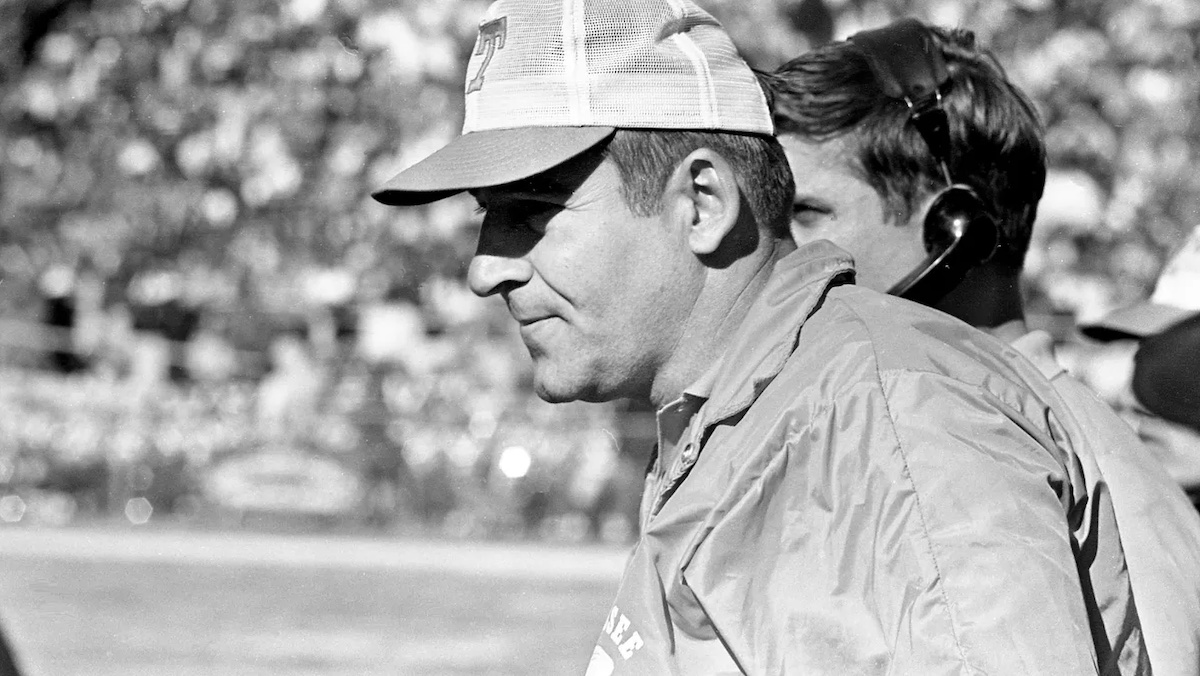
The train from Memphis rolled into Knoxville under the cover of darkness.
A trip that began the previous night in Fayetteville, Arkansas and included a national guard helicopter ride to Mud Island in the Mississippi River, a ferry to Memphis and a cab to Union Station at 10 p.m. ended on a train platform just before sunrise in Knoxville on Dec. 2, 1963.
Douglas Adair Dickey, the 31-year-old assistant coach under Frank Broyles at Arkansas, stepped off and was greeted by Tennessee athletic director Bob Woodruff. Tennessee was hours away from naming its next head coach.
The covert operation to get Dickey to Knoxville was meant to keep it from the press, but when young Knoxville News-Sentinel reporter Marvin West was tipped off by a phone call to the Dickey house in Fayetteville earlier that day and was waiting alongside Woodruff at the station.
Dickey was tabbed as the 17th head coach in program history before 11 a.m., replacing Jim McDonald who had held the position for just one season.
“(Dickey) is a man who just had to be a head coach,” one Arkansas sports writer told the Knoxville Journal’s Ben Byrd. “He is just that outstanding. It was all just a matter of time.”
The ushering in of a new era of Tennessee football took place at the end of another.
Two days before Dickey arrived, the Vols finished off a five-win season with a 14-0 triumph of Vanderbilt at Neyland Stadium. It was the final time that a Tennessee team ran the single wing offense, one of the last tangible reminders of the legacy of Robert R. Neyland.
This is the story of how a covert coaching search led to a program-changing hire and the end of a Tennessee epoch.
‘See him anyway’
The national guard helicopter landed in a field near Union City as a car approached.
One day after President John F. Kennedy was assassinated in Dallas, Doug Dickey stepped off of a helicopter and into the back of University of Tennessee Board of Trustees member Tom Elam’s car.
Around the same time, 3-5 Tennessee was kicking off against Kentucky at McLean Stadium in Lexington.
“It made me mad to begin with because I had never heard of Dickey,” Elam later recalled in Russ Bebb’s book VOLS: Three Decades of Big Orange Football, 1964-1993. “I asked Woodruff who he was. He said this guy was the next Darrell Royal or Frank Broyles…I said I didn’t care if he was another Knute Rockne. ‘We’re playing Kentucky that day and I haven’t missed a Kentucky game.’ He said, ‘See him anyway.’”
Dickey had been on Woodruff’s radar for at least three months when he attended a cookout hosted by Frank Broyles in Fayetteville on the eve of the 1963 season, but their relationship went back a decade.
Dickey played quarterback for Woodruff at Florida in the mid-1950s. Broyles was one of his assistants. Now, Broyles was in the middle of a hall of fame career with the Razorbacks and Dickey was a young up-and-comer in the profession.
Woodruff’s position was on less firm footing. He was named acting athletic director at Tennessee earlier that year and over-seeing first-year head coach Jim McDonald, the successor to Bowden Wyatt after six seasons.
McDonald took the position in mid-June, signing a one-year contract. During his statewide media circuit that summer, Woodruff said confidently that McDonald’s appointment was a permanent one. Behind closed doors, he was putting together a list of names.
Bobby Dodd and Murray Warmath were at the top. Both played for Robert Neyland at Tennessee in the 1930s and both had won national championships at their respective schools at Georgia Tech and Minnesota.
The tipping point was Tennessee’s 20-0 blanking to No. 3 Ole Miss in Memphis on Nov. 16. Woodruff had an in-person meeting with Warmath a few days later, offering him a $28,000 contract and the added role of athletic director.
Warmath showed interest but didn’t accept on the spot, so Woodruff reached out to Dickey. He told his former player that he was prepared to offer the job, but wanted him to meet with Elam first.
As Tennessee was putting the finishing touch on a 19-0 bounce-back victory over Kentucky, Dickey and Elam were riding around somewhere in West Tennessee. They talked about recruiting and how to land the best players in-state. They also talked about the offense.
Tennessee had clung to the single wing, a formation that won four national titles for the Vols and placed the program among the college football elite for all time. But it was starting to have its detesters.
Tennessee’s commitment to it was costing the program local talent. Steve Spurrier, who starred up the road at Science Hill in Johnson City and Steve Sloan, a standout at Bradley Central in Cleveland both ended up at SEC foes Florida and Alabama.
The Vols, who won the league in 1956 under Wyatt, hadn’t been to a bowl game since 1957 and were 25-22-3 in the five seasons after.
Dickey was a student of the T-formation. After his playing days at Florida, he got into coaching initially in the high school ranks. He joined the national guard to earn extra money by jumping out of planes before an opportunity opened up on Broyles’ Arkansas staff in 1957.
Arkansas ran a variation of the T-formation, similar to what other programs like Alabama and Ole Miss were running at the time. His description of it impressed Elam during their two-hour car ride, enough to sign off on the hire. Nine days later, Dickey was named the Vols’ next head coach. The interim tag was removed from Woodruff and McDonald was promoted to assistant AD.
“The single wing is no more at Tennessee,” Tom Siler penned for the Knoxville News-Sentinel. “The time-honored offense devised by the late, great Bob Neyland is finished at UT. It was laid to rest today with the hiring of the young Doug Dickey…The single wing is gone, but it won’t be forgotten.”
A fitting send-off
A cloud of uncertainty loomed over Neyland Stadium.
Tennessee’s home field was only a little over half full on the final Saturday of the 1963 season. Some 15,000 fans braved the cold and a snowy forecast to see the Vols try and avoid their second-straight losing season against rival Vanderbilt.
The build up to the game was upstaged by the unavoidable headlines about the future of Tennessee head coach Jim McDonald.
An All-Big Ten halfback at Ohio State and first round NFL draft pick in 1938, McDonald had been at Tennessee since 1955, first as an assistant under Bowden Wyatt and now at the helm of the program on a one-year contract.
A .500 finish would be considered by many a minor miracle considering he had only been on the job since June. Yet, it was no mystery that Tennessee’s brass had a meeting planned that would decide if McDonald returned or the program was going to go in another direction.
A list of candidates appeared in the Knoxville Journal the day of the game. Among them were Texas’ Darrell Royal, Minnesota’s Murray Warmath, Missouri’s Dan Devine and Ole Miss’ Johnny Vaught.
“The contest has more than the usual significance,” Marvin West wrote in the Knoxville News-Sentinel. “The performance of the Tennessee Vols could have a profound effect on the action of the UT athletics board Monday when it meets to rehire or dismiss coach Jim McDonald.”
Coaching rumors swirled around Neyland Stadium like the late-November snowflakes as the masses huddled to watch Robert Neyland’s single wing make its heroic final stand.
Mallon Faircloth helped send it off in the second quarter when he broke through the weak side of the Vanderbilt defense, getting a block and then out-racing two defenders along the sideline for a 72-yard touchdown to break up the stalemate.
The scoring trek was the headliner of a 179-yard rushing performance by Faircloth, who became the first Tennessee tailback to rush for 1,000 yards since Johnny Majors did it in 1956.
Stan Mitchell applied the dagger in the third quarter, leaping over the Commodores’ defense from the 1 to score and go up 14-0.
Tempers flared. Tennessee’s Billy Tomlinson and Vanderbilt’s Sim Davis threw punches near the Commodores’ sideline before being ejected. Both teams went at each other as time expired, nearly breaking into an all-out brawl before they were separated.
Doug Dickey was hired a few days later, bringing the T-formation with him. Two years later, Tennessee reached its first bowl game in eight seasons. Two years after that, it won its first SEC title in more than a decade.
The Vols won two league crowns under Dickey in 1967 and 1969. He coached a slew of All-Americans, turned the tide in Tennessee’s rivalry with Alabama and oversaw the program’s resurgence.
That final game before the Dickey era was a fitting finish for the single wing—Tennessee’s long-standing brand of hard-nosed football, soon to be replaced by a more modern brand.
“I will never be any prouder of a football squad than I am of this gang,” McDonald told reporters. “They tossed out the word ‘quit.’ They gave their best in every game.”