
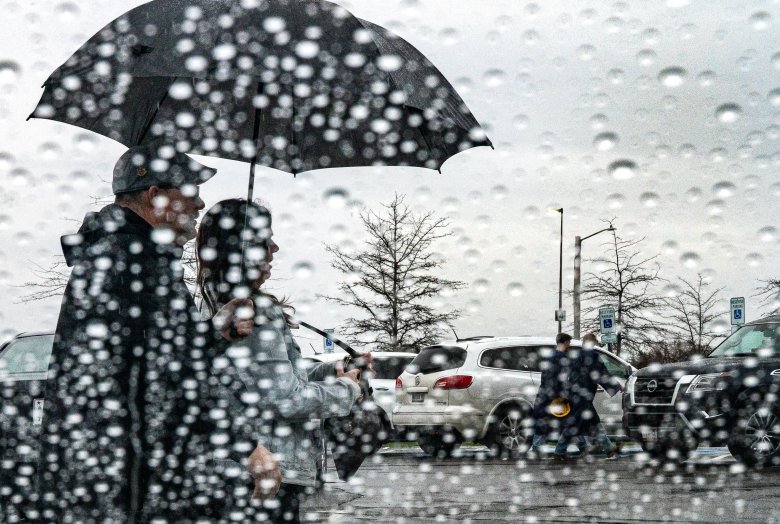
Rain, rain, don’t go away.
Maine’s drought conditions are improving thanks to a rainy spring, but experts say more precipitation is needed to get out of the woods — that, and avoiding the long dry spells the state saw last summer.
But even if conditions continue to improve on the surface, the issue may persist beneath.
“It’s one of those ‘don’t judge a book by its cover’ situations,” said Sarah Jamison, senior service hydrologist at the National Weather Service in Gray, in an interview Monday. “We’re still not where we want to be in our groundwater, and that could be around for a long time.”
SPRING SHOWERS
Many factors go into how the U.S. Drought Monitor calculates drought conditions, including input from a variety of federal and state experts.
While rainfall can have an impact, the ultimate determination is based on a wide array of evidence drawn from the state’s hydrologic system, Jamison said, which can differ from region to region, and even backyard to backyard, based on an area’s geology.
Only one area of the state remains under severe drought conditions, according to the U.S. Drought Monitor’s latest update: southwestern York County.
Most of the state either finds itself in moderate drought conditions or abnormally dry as of last week. Almost all of Aroostook County, about half of Washington County, and slices of northwestern Piscataquis and Penobscot counties are not considered to be under drought conditions at all.
That’s a significant improvement over early March, when all of the state was at least experiencing moderate drought and many areas were still seeing severe drought conditions. That’s also a solid step over the last six weeks: As of May 5, all of the state was considered to be at least abnormally dry.
But is it really as simple as getting a lot of rain? It is, Jamison said, if there’s enough to overcome the odds.
“It’s usually quite challenging to see drought improvements after we have leaf out and green up,” Jamison said in an interview Monday. “But the pattern is what the pattern is, and we’ve trended wetter.”
Jon Palmer, a meteorologist at the weather service’s office in Gray, used the Portland region as an example, which was under extreme drought in early March but is now considered moderate. The area saw above-average rainfall in March, roughly average in April and then got dumped on in May.
“We were four inches above average for precipitation in May,” Palmer said. “That trend is even more pronounced across the interior, in New Hampshire and the western part of (Maine).”
Consistency is also key, even if the numbers aren’t individually eye-catching.
Much of northern Maine saw significantly below-average snowfall, but steadily above-average rain this spring. In Caribou, precipitation was nearly 1 inch above average in March, about 1.25 inches above average in April, and nearly 1.6 inches above average in May, according to the weather service’s office there.
The first half of June has seen its fair share of rain as well.
CAUTIOUS OPTIMISM
Lots of rain has helped this spring, and it would still be a help this summer, but warmer months can pose a challenge, Jamison said.
“Between plants taking what they take for water and evaporation, we need at least an inch of rainfall a week to break even,” she said.
Something else also needs to go Maine’s way to continue steady forward progress, even if there’s enough rain: avoiding prolonged periods of hot, dry weather.
That’s what got us here in the first place, Palmer noted.
“We were normal last summer and then, towards the end, we had a pretty long hot spell,” he said, which triggered a flash drought. “Then, we just never got the precipitation to compensate for that.”
And that can happen quickly, Jamison said.
“Where we still have our largest deficit is our groundwater,” she said. “We are nowhere near where we want to be on groundwater.”
A rainier-than-average summer without any long dry streaks can only go so far.
“There will be, in some form, some level of drought that will persist even if we made it through summer with flooding rains,” Jamison said. “There is still that underlying drought that’s been carried over now for a couple years.”
But Maine’s rainy spring is a solid step in the right direction.
“We’re at least starting off strong in the growing season,” Jamison said. “I’m actually hopeful at the start of this summer season compared to where I was last year.”