
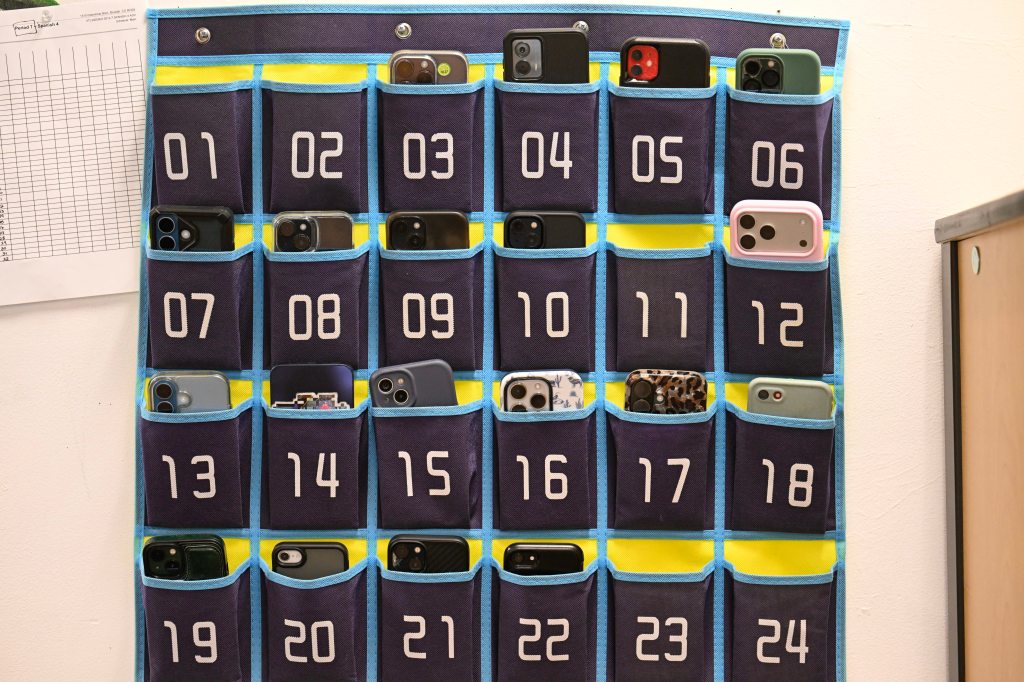
As Colorado school districts adopt stricter cell phone policies, Boulder Valley leaders say they’re seeing more connection and fewer distractions after a year-and-a-half of nixing cell phone use during school hours.
But, district leaders acknowledged, enforcement at the large, comprehensive high schools remains challenging.
“Our biggest schools are harder to manage,” school board President Nicole Rajpal said. “Those schools are very complex. There’s not grown ups everywhere. There are a lot of places to be without supervision. But in their own ways and on their slightly delayed timelines, our big comprehensive high schools are trying to engage and move the needle, even if they haven’t been as quick to change.”
The Boulder Valley school board agreed to a “bell-to-bell” ban on cell phone use at its high schools in November 2024, with the new policy going into effect after winter break in January 2025. Since then, a new state law was passed that requires every K-12 school district to create a cell phone policy by July 1.
Denver Public Schools, the state’s largest school district, is mirroring Boulder Valley by banning all students from using cellphones during school hours starting in August after its school board unanimously approved the new policy last week. The Denver and Boulder Valley policies are more stringent than mandated by the state law, which only requires districts to create policies that address smartphones in schools.
The neighboring St. Vrain Valley School District has what appears to be an administrative policy on cell phone use in schools that was added before the start of last school year. But it’s not a formal policy that was approved by the school board and open to community feedback.
St. Vrain Valley spokeswoman Kerri McDermid said the state law made an exception for school districts with a cell phone policy in place before Aug. 31, so the district wasn’t required to add one. The policy also was communicated districtwide before Aug. 31, she said, and the school board hasn’t modified the district policy based on the new law.
Two Boulder Valley high school principals, John McCluskey at the 300-student New Vista High and Greg Doan at the 1470-student Monarch High, recently shared their cell phone policy experiences with the school board.
As a small, relationship based school, McCluskey said, New Vista focused on talking to students “about the why.”
“We really started with the idea that you didn’t break any rules,” he said. “As adults, our society handed you this phone, so you’ve done nothing wrong. We just changed our minds on whether its good for you or not and now we actually think its not. We’ve shifted, and we want you in on the conversation.”
Doan said Monarch’s students are connecting more outside of class and generally understand that phones are going to be put away in the classroom.
“Kids skip class more to play hacky sack than they do to get on their phones,” he said.
But, he said, enforcement is more difficult during passing periods and off periods. He added using a schoolwide system, like locking pouches, would be difficult to manage with an open campus and a large number of students coming and going throughout the school day.
“If nobody is seeing them, they’re going to get their phone out, and they’re going to use it … It’s that challenge of what our campuses are when you’ve got a couple thousand students, and its a couple of you versus them,” he said.
Both principals said another challenge is getting all the teachers on the same page. Some are enthusiastic about policing phones because they find them annoying, McCluskey said, while others aren’t interested. He added he started tracking data on which teachers turn in phones taken when students use them during the school day, allowing him to have conversations with the teachers who never turn in phones.
“We’re just going to have an open discussion about that so that we’re all really buying in at an equal level,” he said.
Several school board members raised concerns about uneven enforcement at Boulder and Fairview high schools, based on conversations with students that many teachers still look the other way. The two Boulder schools each enroll around 1800 students.
School board member Alex Medler said he wants to see teachers take students using cell phones in class as seriously as they would take students vaping in class.
“If Fairview takes a third year to do this, I’m ready to buy them pouches,” he said. “I’m ready to buy them lockers and take a stronger position. I know we need to get to why with the students, but apparently we need to get to the why with the adults.”
Other board members said they’re happy with the current approach, which hasn’t resulted in increased discipline for specific student groups as some feared.
“I would hate to see us go towards a purely punitive ban and really embracing that,” school board member Jorge Chavez said. “I think that it’s a cultural shift that we’ve got to make. It’s one we’re battling outside the schools as well as in the schools, and it’s not fair to come crashing down.”
For the coming school year, district officials said, high schools plan to incorporate conversations about the negatives of cell phone use and social media into classes and continue to ask students how schools can support alternatives.
“As we continue to move forward, as we hear concerning data, the board can expect we will continue to lean in,” Superintendent Rob Anderson said.