
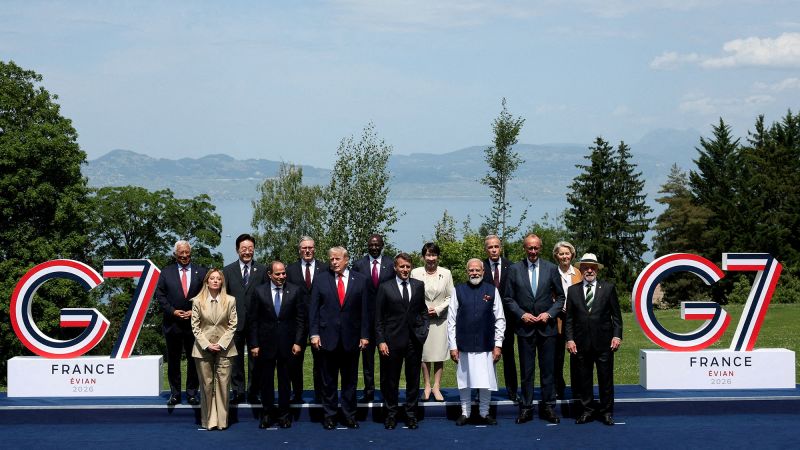
Arriving in France for the G7 summit Monday, US President Donald Trump announced that Iran had agreed to “strong policing powers” over its nuclear program.
Trump didn’t expand on what he meant, and the contents of the memorandum of understanding (MoU) he was referring to have not been made public. Vice President JD Vance has said that agreement was “built around verification,” with the UN’s nuclear watchdog, the International Atomic Energy Agency (IAEA), “at its core.”
IAEA inspectors were part of the last Iran nuclear deal, the Joint Comprehensive Plan of Action (JCPOA), struck in 2015 during President Barack Obama’s administration, and which Trump pulled out of in 2018.
Trump rarely talks about Iran without trashing the 2015 nuclear deal, under which Tehran agreed to allow the IAEA to inspect its sites in exchange for the lifting of some sanctions on its oil wealth and unfreezing billions in frozen Iranian assets.
Iran viewed the inspectors as untrustworthy stooges of the US and thwarted their efforts to monitor its compliance with the deal. Over time, it curtailed access for inspectors, limited the numbers allowed in the country, and cut the time they could spend there. Although there was a dispute mechanism in the JCPOA, technical tensions quickly became political and disputes were rarely resolved.
When Trump pulled out of the JCPOA, leaving the UK, France, Germany and Italy to oversee it, Iran increasingly ignored the agreement and further restricted the IAEA’s access.
Tehran’s relationship with the current IAEA chief Rafael Grossi has grown increasingly frosty, with Iranian leaders accusing him of ignoring war damage near their nuclear facilities.
Relations between Iran and the IAEA are already freighted with mistrust. If and when a new agreement is reached, they will inevitably be tested even further.