
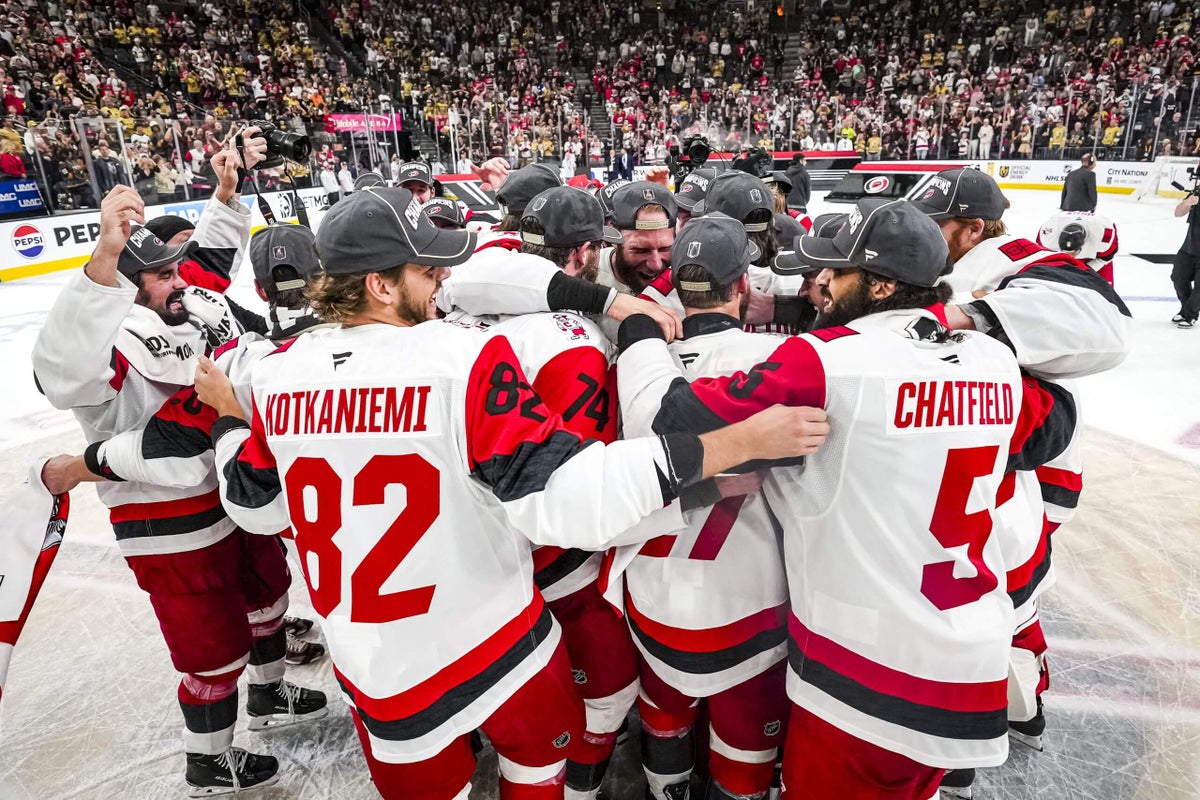
It’s fair to call the Carolina Hurricanes unique among NHL teams, in many ways.
They play a different defensive system, one marked by man-to-man coverage and high pressure. They’ve invested more in analytics than almost anyone, from general manager Eric Tulsky on down. They lack a true superstar up front, a traditional No. 1 defenseman and a high-end goaltender. And their owner has a different approach from any other in the league, too.
We often say after a team wins the Stanley Cup that it will inspire copycats, as others attempt to learn from what worked and integrate it into their processes. Sometimes this leads to teams around the league trying to win with size and/or physicality, taking after the Florida Panthers’ back-to-back titles in 2024 and 2025. Sometimes it sees the league veering toward more of a speed-and-skill mentality, as the Chicago Blackhawks and Pittsburgh Penguins did earlier in the salary cap era.
I don’t know that you can place this year’s champs neatly into a simple category like those examples, and whether they’ll remain an NHL one-off or have some company in the years to come is an interesting and open question. That said, some of the Hurricanes’ innovations and team-building strategies are worth additional consideration in the aftermath of their big win. Some of the lessons worth taking away aren’t singular to Carolina, but together they represent a championship-winning team using a different approach than anything that’s come before.
Will other executives around the league take note and try to borrow from the Tulsky model?
How Carolina built the Hurricanes to win the Stanley Cup
Sean Gentille and Jayne Orenstein
Lesson 1: Goalies can be interchangeable
After these playoffs, it’s clear we are fully moving into the NHL’s tandem goalie era. Few teams have embraced that more effectively than Carolina.
The Hurricanes’ two goaltenders this year, Frederik Andersen and Brandon Bussi, earned a combined $3.5 million against the salary cap, one of the lowest figures across the league over the past decade.
And Carolina frequently alternated between the 36-year-old Andersen and a waiver claimant in Bussi, en route to a 113-point regular season and historic 16-3 playoff run. By contrast, the team they beat in the final, the Vegas Golden Knights, had a $6.25 million backup in Adin Hill who remained on the bench even when starter Carter Hart struggled mightily during the series.
That salary could have obviously been better spent elsewhere. And it’s further proof that unless you have one of the few sure-thing No. 1s in net and that person rarely gets injured, you need to be able to trust both your netminders in all situations.
“His basic stat line in the early part of the year wasn’t great, but even then I don’t think he was playing badly,” Tulsky told The Athletic of Andersen, who has missed considerable time with injuries in recent years and finished the regular season with a .874 save percentage. “He was the victim of some unfortunate circumstances, some games where there were big breakdowns in front of him. Some plays were sort of a medium-grade chance, and the shooter put it bar-down in a place where he didn’t have a real chance to make the save. Those basic numbers suffered for that.”
The Hurricanes also believed Bussi and No. 3 Pyotr Kochetkov were capable of stepping in, too, which proved the case with Bussi’s star turn to close out the Stanley Cup Final. Especially in an era when goalie salaries don’t line up with how many saves they’re making, could more teams look to exploit it as a new inefficiency and develop the willingness to deploy an underpaid tandem?
Lesson 2: Bigger isn’t always better
When the Hurricanes traded 6-foot-4, 230-pound superstar Mikko Rantanen to the Dallas Stars last year for 5-foot-8, 165-pound Logan Stankoven and draft picks, the move was criticized in some league corners as a major misstep — an analytics-driven decision that didn’t properly value the physical frame of the players involved.
A little more than a year later, Stankoven ended up playing a vital role in the Hurricanes’ title run as the center of their most effective postseason line. The 23-year-old led the team in scoring with 11 goals and proved a perfect fit in coach Rod Brind’Amour’s aggressive forecheck system.
While Tulsky hadn’t anticipated Stankoven playing down the middle when the Hurricanes acquired him, they correctly identified him as someone who would excel playing their style given his skating speed and puck-hounding ability. Stankoven showcased that well in setting up Carolina’s second goal in Sunday’s Game 6 win.
The Hurricanes apply that mindset — prioritizing style of play over the player’s size — all over the ice, including on the blue line, where smaller defensemen like Sean Walker and Shayne Gostisbehere played significant roles all season. It’s another way Carolina has unearthed additional value when they add players.
“In our defensive zone coverage, our defensemen will often have to pressure all over the zone, where another team might have them stand at the net-front and wrestle for position,” Tulsky said. “And somebody who’s going to stand at net-front and wrestle for position needs to be big and strong and doesn’t have to be a great skater.
“Somebody who’s going to be skating around the zone pressuring needs to be a powerful skater who can stay with you and close out and get into you, needs to be competitive to win that battle, but doesn’t have to be someone who can just win wrestling matches all day. So there are players who will fit the way we play better than they would with another team.”
Rod Brind’Amour is the Canes’ one true superstar
Max Bultman and Shayna Goldman
Lesson 3: Find your standard-bearers
In spending time around the Hurricanes, it’s quickly clear who their leadership group is and why they’re in those roles. What jumps out is how long most of them have been in the organization, even with how much the rest of the lineup has turned over.
Captain Jordan Staal is the best example on the roster, hoisting the Cup in his 14th season in Carolina, and you could see what the win meant to him afterwards. “I just wanted to win; I wanted to win so bad,” Staal said on the ice.
But alternate captains Jaccob Slavin, Sebastian Aho and Jordan Martinook, plus Andrei Svechnikov, have all been around for eight-plus seasons and play huge roles both on the ice and in the dressing room.
Brind’Amour is obviously an enormous influence, too, having been part of the organization for more than 26 years, going back to not long after the franchise relocated to North Carolina. His assistant coaches, Jeff Daniels and Tim Gleason, both played for the Hurricanes and have been around seemingly forever.
Justin Williams, another former captain, works as an advisor to the GM. Associate GM Darren Yorke has been with the franchise for 17 years, and Tulsky for 12. Others in the front office, like vice president of communications Mike Sundheim, were on staff for the last Cup win 20 years ago.
In what can be such a transient business, there’s simply a lot of continuity for Carolina. Part of that is because they’ve enjoyed consistent success in recent years, but it’s also been a conscious decision to commit to the right group of people for a long period of time, even when they haven’t broken through in the playoffs.
This year, everyone stayed healthy, their path lined up and they won.
Lesson 4: Don’t be afraid to walk away
When Tulsky was named GM in 2024, the Hurricanes were at a bit of a crossroads. Four key cogs were poised to hit unrestricted free agency — Jake Guentzel, Brett Pesce, Brady Skjei and Teuvo Teräväinen — and re-signing all of them would’ve been impossible under the salary cap.
Guentzel ultimately chose to join the Tampa Bay Lightning, but Tulsky decided to pivot off the others and seek players who offered better value for their salaries. After signing Walker, Gostisbehere, Eric Robinson and William Carrier to reasonable deals, Carolina used its remaining cap space to improve in other ways, including adding Nikolaj Ehlers a year later in free agency.
“We’ve had a lot of times that there was a veteran with our team who was heading free agency who we really valued and didn’t want to lose,” Tulsky told The Athletic before Game 1 of the Eastern Conference final. “But we are willing to bet on ourselves to find a replacement if there isn’t a deal to work out that we’re comfortable with. A lot of times I think teams get themselves into trouble feeling like they will just get worse if they let that player go. …
“That was my first summer as GM and we had a team that if we had just matched the salaries of all the free agents we had and kept the players who were under contract, we would have been $22 million over the salary cap. So we had to do major surgery. It was hard and your first instinct is to try to cling to as much of what you have as you can, but the team already wasn’t quite good enough and if you’re going to lose a few players it’s going to take a step back.
“So instead of trying to hold onto as many of them as we could, we tried to get things done where we could and then pivoted when we had to. I think we’ve turned over 12 players on our roster in the two years since then. And I think we’re just as good now as we were then. Maybe better.”
The results say better.
The NHL award some players don’t want
Peter Baugh
Lesson 5: There’s still value to be found
Free agency may be dying. The draft may feel like a crapshoot beyond the top handful of picks. Great trades seem few and far between, especially with star players now increasingly calling their destinations.
But a savvy team can still find bargain buys in free agency, useful players beyond the first round, and undervalued talent from other teams. The Hurricanes roster is a great example of all three.
Their Cup-winning lineup had just one first-round pick made with their own selection: Svechnikov, chosen No. 2 in 2018 at the very beginning of this new, successful era for the franchise. (The team’s only other player they drafted with a first-rounder is Seth Jarvis, whose draft pick rights were acquired from the Toronto Maple Leafs in an ill-fated Patrick Marleau contract dump in 2019.)
The franchise has also made a few sharp picks in later rounds, selecting Slavin in the fourth in 2012, Aho in the second in 2015, Alexander Nikishin in the third in 2020 and Jackson Blake in the fifth in 2021.
The vast majority of Carolina’s roster, however, is made up of players airlifted in from elsewhere. Taylor Hall, Stankoven, K’Andre Miller, Staal, Martinook and Mark Jankowski all arrived via trades, big and small, that added positive value. Andersen and Jalen Chatfield, meanwhile, joined the list of UFA signings that worked out.
Altogether, of the 20 regulars who played for the Hurricanes in these playoffs, five were drafted, seven were traded for, seven were signed as free agents and one, Bussi, was claimed off waivers. It’s proof that you can be successful by constantly making sharp acquisitions without relying on bottoming out again and again and hitting on lottery balls.
“(Almost) every player comes into the league through the draft,” Tulsky said. “So the question of whether a team holds onto their draft picks and waits for them to develop or moves them depends on where they are in their life cycle. I think we have, probably more than most (contending) teams, tried to keep a pipeline of young, homegrown talent coming in. That being said, you always have to be ready to take advantage when opportunities come up.”
Adding Miller — from the New York Rangers at the cost of first- and second-round picks and prospect Scott Morrow — last July is the perfect example. And he ultimately became the Hurricanes’ top minute-eater in the postseason, logging more than 24 per game.
Lesson 6: Depth can beat star power
No one on the 2025-26 Hurricanes made more than Aho at $9.75 million, which ranked 19th league-wide this season. Only one other Carolina player makes more than $8 million (Ehlers at 47th overall), and only three more earn over $6.4 million: Svechnikov, Miller and Jarvis, all of whom rank 85th or lower.
After failed bids to acquire and lock up several stars — including Guentzel, Rantanen and Mitch Marner — the Hurricanes adapted. That relatively low top end, combined with having three contributors on entry-level contracts in Stankoven, Blake and Nikishin, allowed Tulsky to spend more on the roster’s depth, including a highly skilled $3.2 million third-pair defenseman (Gostisbehere) and a nearly $15 million checking line centered by Staal, the eventual Conn Smythe Trophy winner as playoff MVP, and supercharged by Ehlers.
Carolina is well-positioned to add again this offseason, too, with more than $12 million in cap room to maneuver with and Andersen as the only pending UFA of note. They’ll also have the option to buy out Jesperi Kotkaniemi, who didn’t play in the postseason, and free up an additional $4 million.
An adorable tradition: Putting babies in the Stanley Cup
Joe Smith and Madison Eades
Lesson 7: Analytics aren’t going anywhere
Hockey’s analytics movement started to take off in 2014 when Tulsky and others were initially hired full-time by NHL teams, often as low-ranking analysts.
Many of those hires have since risen to more prominent positions, including the New Jersey Devils’ new general manager Sunny Mehta. That’s a hire who, after Tulsky, serves as the second example of a franchise choosing a top hockey executive with a significant educational background in statistical analysis.
It’s now not uncommon for NHL teams to staff at least a handful of people in this area, a trend that’s likely to continue to grow given the Hurricanes have now won a championship with a front office that was built with analytics concepts at the forefront.