
TORONTO — By rule, NBA executives are incentivized not to publicize their plans around big transaction windows. All that can be accomplished, the thinking goes, is that your team loses leverage in negotiations if you say too much.
However, it is hard to speak for 20 minutes and deliver only vagaries. Dan Tolzman, the Raptors’ assistant general manager and vice president, player personnel, spoke to the media on Tuesday, a week before the first round of the NBA Draft. Tolzman has been at the centre of the Raptors’ draft process since 2013.
He did not reveal a short list for Raptors fans to study. Armed with the 19th and 50th picks of the draft, however, Tolzman offered some insight not only about the Raptors’ position, but also the league in general, heading into the summer. Here are the five comments that stood out most to me.
“It seems like, in the past, there was always the top, top guys, and then after that, it kind of can be anybody. This year, it seems like the depth at the top is a lot higher than normal to where it’s a different tier group that we’re really trying to know.”
Why it’s interesting: Essentially, Tolzman is calling this a top-heavy draft, with the top being much better than in most years. That is not to say there are 10 potential franchise changers. However, he is saying it would be a surprise if anyone sneaks into the top 10 or 12, causing a player thought to be a mid-to-low lottery pick to fall.
Accordingly, this is who I believe you can take off the board for the Raptors at No. 19, with help from Sam Vecenie’s must-read draft guide.
Top big four: AJ Dybantsa, Darryn Peterson, Cameron Boozer, Caleb Wilson
The hotshot guards: Darius Acuff Jr., Keaton Wagler, Kingston Flemings, Brayden Burries, Mikel Brown Jr.
The Michigan bigs: Yaxel Landeborg, Morez Johnson Jr., Aday Mara
Those are 12 players who will not fall to 19, barring a huge surprise. And while there is always a possibility of trading up to get one of those players, Tolzman said it would cost “a premium” to move up. It would surprise me if they paid it if Tolzman is saying that out loud.
“Regardless of what position the team is in, we’ve always kind of taken the same approach of just trying to get the best player that’s there on the list. If it can line up with what the team needs at that time, positionally or depth-wise, that’s the best-case scenario. But I don’t think we’ve ever really worried too much about what the team has done or what we’re trying to do next year as much as just get as much talent in the building as we can.”
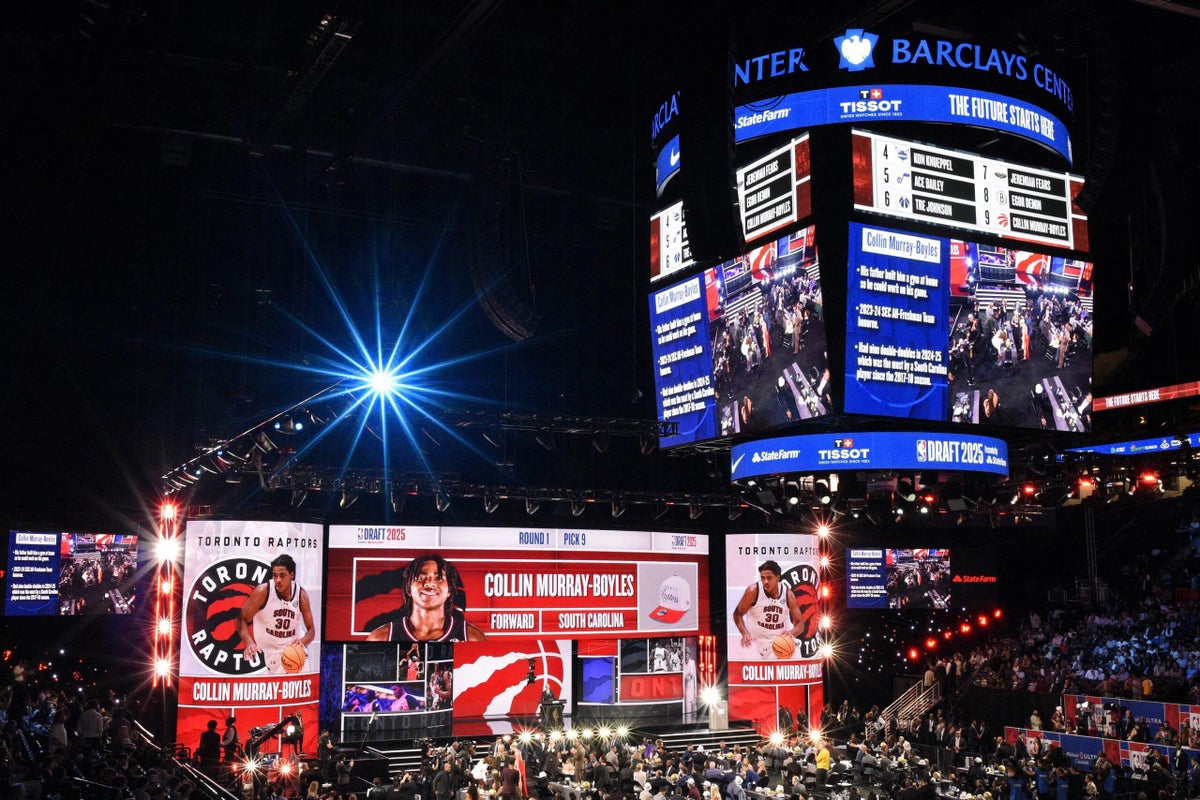
This is just a helpful reminder. Heading into last year’s draft, the last type of player the Raptors needed was a burly, undersized big with defensive versatility, given they have Scottie Barnes, as well as Jonathan Mogbo, who fits a similar archetype as a prospect. But they took Collin Murray-Boyles anyway.
A year later, Raptors fans should feel great about that pick. You can argue that Cedric Coward and Carter Bryant have similar upsides to Murray-Boyles and would have fit a bit more cleanly, or maybe you love Derik Queen. But getting a player as good as Murray-Boyles at No. 9 is a massive win.
In other words, focussing on the roster holes is a waste of time when it comes to the draft.
“For our team, we’ve got a lot of really interesting bigs, but I think everyone knows that we don’t (have) lob threats, shot blocking. That’s probably the kind of … big that we have lacked.”
This runs counter to the above quote, but it’s important to note that Tolzman said this could be addressed in any transaction, not just the draft. Still, it is interesting that a member of the Raptors’ front office said this out loud. Coach Darko Rajaković mentioned rim protection as an area of need for the Raptors, but GM Bobby Webster kept his cards closer to his vest when he spoke after the season.
As you hopefully know by now, the Raptors will have limited means to add to the roster in free agency, especially if they find a way to retain Sandro Mamukelashvili by using some of their exception money. To address this weakness, the Raptors would have to use a draft pick on such a player, trade for one, or sign one, probably at the league minimum. The latter rarely produces any usable players, although Mamukelashvili and Landry Shamet were notable exceptions this season.
Kentucky’s Jayden Quaintance and Houston’s Chris Cenac Jr. are the best bets to fit that role. Due to injuries or development, it’s not likely either would do that immediately for the Raptors.
“We don’t really know quite yet, but I would say I’m guessing the days of the five-pick deals are probably a thing of the past … especially for the teams that are kind of living in that range in the middle where it could end up being a pretty high pick.”
This isn’t Raptors-specific — although, given the Raptors have all of their first-round picks, it could apply to them. There has been league-wide speculation about how the value of picks would change in trade talks after the league passed lottery reform that will further randomize which teams get the top picks.
This is just one person’s opinion, of course, but I haven’t heard a lot of executives comment on this yet. Maybe it doesn’t apply to trades for no-debate superstars, or even trades for valuable starters made by championship contenders. However, I think about trades such as Atlanta acquiring Dejounte Murray for a package that included two of its own picks and a pick swap, or Cleveland getting Donovan Mitchell for a package including three of its own picks and two pick swaps. Neither the Hawks nor the Cavaliers had established themselves as contenders then.
Good or bad, Tolzman is saying he doubts those teams would make those trades with the new setup. We’ll see whether he’s right.
“The second round, (NIL) has really impacted it, the depth of those guys. It used to be (that) if they could get a good guaranteed contract somewhere in the early second round, a lot of players would stay (in the draft) for that. There are some people that are saying top-20 is the cutoff now, just for like the amount of money that is being thrown around in NIL to where some of those players that are late first, early second, they’re kind of on the fence more so than they used to be in the past.”
The Raptors have generally had success in the back half of the first round. While they have had some loud whiffs (Bruno Caboclo, 20th in 2014, Malachi Flynn, 29th in 2020), their successes (Pascal Siakam, 27th in 2016, OG Anunoby, 23rd in 2017) have more than made up for them, considering the expected value of a late-first-round pick. That is to say nothing of either Delon Wright (20th in 2015) and Ja’Kobe Walter (19th in 2024), both of whom have provided positive value.
Of the four successes, only Wright had used up all of his collegiate eligibility. Siakam and Anunoby had two potential years left, while Walter, who entered the league after the NIL rules changed but before they were fully understood, had three years remaining. Perhaps those players would have stayed in college longer now under the current rules, or used the transfer portal to put themselves in a higher-profile slot, particularly in Siakam’s case.
Tolzman is saying the middle of the draft isn’t what it used to be. That doesn’t mean there will be no gems available in that range; it might just be harder to find them.