
Sign up for the Slatest to get the most insightful analysis, criticism, and advice out there, delivered to your inbox daily.
This article contains spoilers for the ending of Disclosure Day.
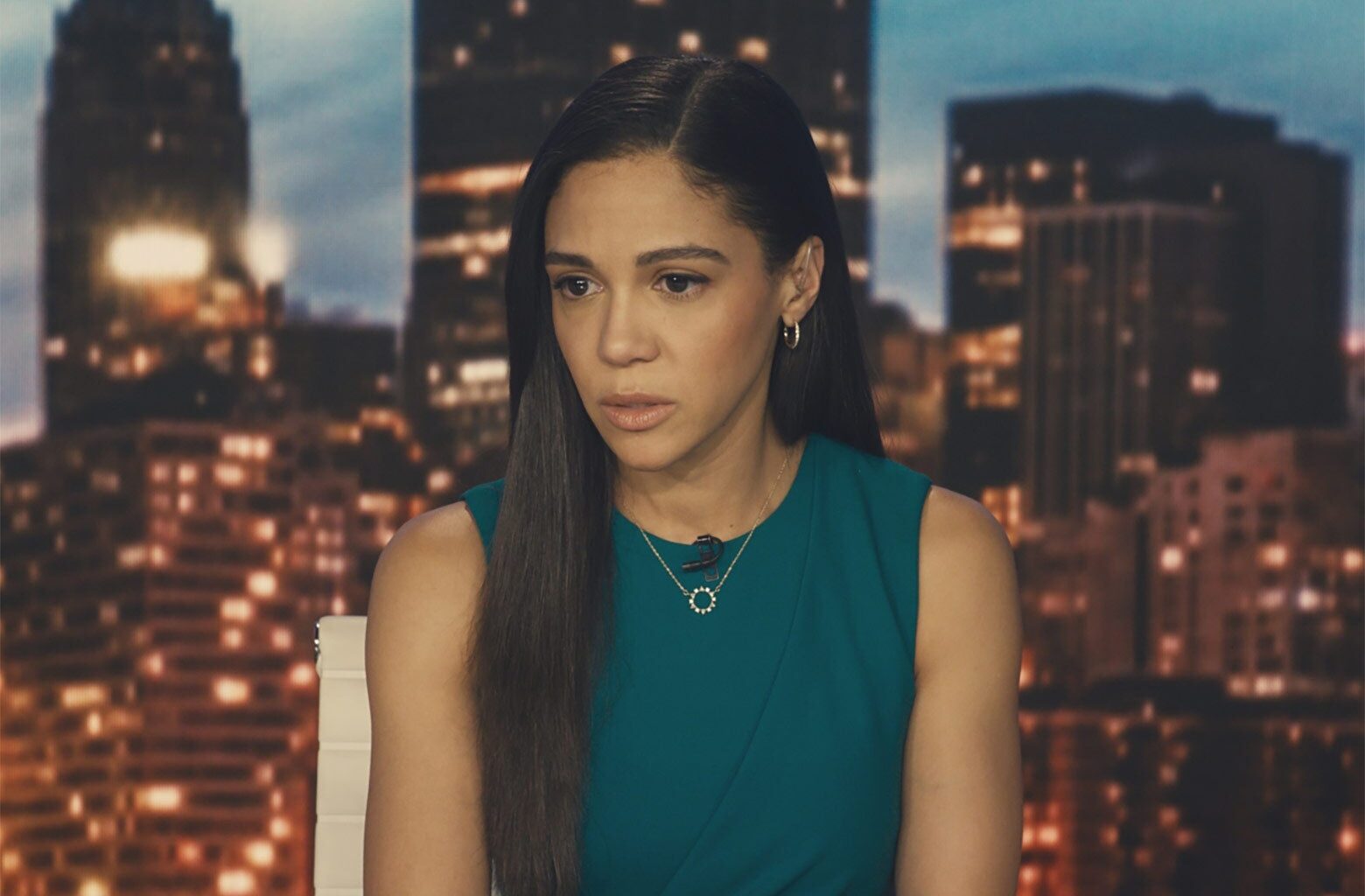
At the end of Steven Spielberg’s Disclosure Day, our heroes finally get around to, well, some disclosing. Having been chased by an army of shadowy government contractors trying to stop them from revealing the truth about alien life, a group of whistleblowers (Emily Blunt, Josh O’Connor, and Colman Domingo) are at last able to broadcast decades of top-secret footage to a stunned world. But the scene only really works thanks to a performance from an unlikely character: an unnamed TV news anchor tasked with covering, and reacting to, the extraordinary revelations in real time, both as a journalist and as a human being.
The role, credited simply as “NBC Anchor,” is played by Courtney Grace, a performer who officially made the switch to acting just three years ago, after working as an actual TV reporter. Grace’s news background assists with her unexpectedly moving performance, which carries a great degree of verisimilitude as she juggles the breaking news, transitioning from one major story about escalating conflict on the Korean peninsula that has the potential to devolve into World War III to something even more historic.
We often see these kinds of broadcaster characters in films, but they typically exist solely to provide exposition. What feels rarer is to see such a character, especially one played by a largely unknown actor, actually become the chief emotional barometer for a film’s climax. Grace’s character has to move between confusion and shock, distress and confoundment, awe and terror, until she ultimately becomes overwhelmed by the ramifications of this event for her species and sobs on air. She’s an avatar for those watching the broadcast and those watching Spielberg’s film. “If you are watching this,” she says through tears, “you are not alone.”
Though she’s a newcomer whose name is listed deep in the movie’s credits, Grace has been repeatedly singled out online for her performance. On X, one post with thousands of likes and retweets notes that she “absolutely sold everything this scene required,” while a TikTok with hundreds of thousands of views describes her as “stealing” the movie. “Her performance is extremely precise and exacting, carrying the weight of being human and the unbiased professionalism of a national news anchor,” writes one critic on Threads. “She nailed it.”
I spoke with Grace about the life-altering week she’s had since the movie premiered, how her years as a journalist prepared her for the role, and the one thing she’s glad Spielberg never told her during filming. Our conversation has been edited and condensed for clarity.
David Mack: Congratulations on what appears to be a real breakout role for you! What has the past week been like since the film came out?
Courtney Grace: Oh my goodness, I don’t know how to really put it into words. I went to sleep one night, and I woke up to a very different world. The outpouring of people’s kindness toward me, toward the work, toward the project has really meant the world to me. It’s overwhelming.
What’s so interesting is that I wasn’t sure where my scene was going to live in the film when I watched it for the first time. I was taking a little mental note so I could tell my family and friends, like, “OK, I’m 10 minutes in, or 30 minutes in.” And the movie starts, and 10 minutes goes by, 30 minutes goes by, 45 minutes, an hour, an hour and a half. I went, Oh my gosh, Steven Spielberg! I can’t believe you trusted me with this! I was shaking in my chair because I was so overcome with shock and disbelief and so much gratitude.
You weren’t worried you’d been cut?
He did say to me on set, “You’re going to be in the movie!” I didn’t know what that meant at the time, and watching it, I was like, Oh, wow. So that’s what he meant!
So you had the script only for your scene? You didn’t know where it was going to fall in the movie when you shot it?
Correct. Yes, I didn’t have the full script. I had my two-page monologue.
How surreal does it feel to have your breakout be for a character with a job that you used to do yourself?
It’s like coming home, in a way. I never thought in my wildest dreams that all of my experiences from that season of my life would equip me for the season that I’m in right now. I think it’s just an important message to myself and to other people that we never know how the experiences we’re having right now are leading us and guiding us and preparing us for the next chapter.
Tell me about that chapter of your life. What was it like working in news?
I started in college, and I did it off and on for seven and a half years. I worked in Texas, then I went to Michigan, then I landed in Tampa.
Some of my proudest moments were as a journalist, and yet that desire to act never went away. In fact, it just kept getting louder. Sometimes I couldn’t sleep at night because I just knew I wasn’t being fully honest with myself. So on my birthday one year, I had to look at myself in the mirror, and I got really honest with myself, and I thought, It’s now or never. I had a great support system who said, “It’s now.” So I quit my job. I got into acting classes. I booked my first $500 industrial, and the moment that I walked on that set was the first time that I truly felt fully home, and I finally listened to that voice that had been talking to me since I was a kid.
I can hear the emotion in your voice as you’re talking about this. This is obviously something that you know is deeply part of you.
So many of us don’t listen to the thing that actually sets our soul on fire, and I didn’t for decades. I had this false sense of belief that I wasn’t cut out to be an actress, so the fact that I’m getting to live that dream right now—man, there is nothing sweeter.
I was going through your IMDb page, and you’ve actually played a reporter a few times now, including in the TV shows Tulsa King and Murdaugh: Death in the Family, as well as the Sydney Sweeney movie Christy. Are you worried you’re being typecast?
Fortunately, people have given me opportunities to do a lot of different characters. But being a journalist is something I really do love playing on television and film. It’s such a joy. I really like sitting in the shoes of these different characters and trying to better understand them as people because, again, that’s what brought me to journalism.
For someone who’s been acting full time only since 2023, what’s it like to audition for—and then land—a Spielberg movie?
Oh, my goodness. I was like, What is going on?! I didn’t know what the job entailed when I booked it. I just knew I was going to be an anchor. I was filling in the blanks of what it could be. I’ve been on a show where my dialogue was muted, so I was just anticipating helping with whatever he needs. And so, when I got the material, I was like, Oh, this is a two-page monologue? I was not expecting this!
I had an acting coach at the time. I didn’t even show her my script material because I was so afraid. I didn’t want to share anything confidential! As a journalist, you take that stuff seriously!
Tell me about being on set. Where did you film the scene? What feedback were you getting?
We shot it in New York at 30 Rock, on the NBC set, which is really cool. It was kind of crazy, because when I started as a journalist, the goal was to get to network news. What a full-circle moment to actually sit behind an NBC News desk and do that.
We were shooting two scenes simultaneously. They were filming the control-room scene a couple of floors down, and my scene was a couple of floors up. Mr. Spielberg was downstairs in that control room, and I had somebody in my ear giving me directions on what was going on. They’d say, “We’re seeing you right now but not hearing you.” So they got all that footage they needed, then they said, “OK, we’re going to open up your mic and go for one.” So we did it and I went for it, and they said, “Steven’s coming up. He wants to speak with you.” I just told myself, Courtney, you’re on the biggest set of your life. You might get a note you may not like. Just have a heart that is open and ears to receive it all. Don’t panic. And then he came in to affirm me in the work that I was doing, and that was very overwhelming. I started instantly crying right in front of him. It was just a tearful moment for me. It’s going to be hard for something to top that.
Your character is listed merely as “NBC Anchor,” but obviously she’s much more than that. Her reaction to the disclosure is profoundly emotional and human. As you were preparing for the film, how did you come to think about her and who she was in that moment?
As journalists in real life, and in film and TV, it is not your job to show emotion. So the fact that they wanted that in that scene was so liberating. It liberated me to be able to say, Oh, I get to be a human right now. I get to show emotion. We journalists have a heartbeat. We have a soul. Things break our hearts when we hear them on the news, but you have to be that strong anchor—metaphorically and literally—for people to make sure that they have what they need to know. There have been times when I’ve had to give news on air that broke my heart, and when they went to commercial I cried, because you can’t show that. So the fact they allowed me to be a human in that moment? What a gift.
It’s certainly what makes the scene so powerful, her representing this explosion of empathy. Tell me about her journey in that scene and how she transitions from journalist mode to human. How is she feeling? What is she processing?
When you’re talking about World War III, there’s nothing that’s going to logically be more important than that, right? So when you get in your ear that we’re cutting to breaking news, it’s like, What’s more important than this right now?! OK, I’m not really sure what this is, but the fact this is on air means they have fact-checked this, which means that this is real, which means I’m not sure what to do right now.
You know that you have the world relying on you to give them what they need to know, so when I apologize but then can’t move past that, it made me feel like I let people down because my human side showed. Like, I couldn’t keep going for the audience. This is a childlike wonder. We’re experiencing something collectively together that changes the scope of how we see ourselves in the world. So it was alternating between I need to get through this. Let me say these words. I can be the authority. I’m good, but then also I don’t have words anymore. I just have to sit here and experience this.
In the moment when I say, “Footage that raises profound questions about what has been happening in our skies, and what is the nature of who we are, and what is our place in—,” my cutting off there was real, because it’s like, This is mind-blowing to think that everything that I’ve known and believed could be wrong, and yet that’s OK. It was quite beautiful to experience that, while also being able to say, “If you’re watching this, if you’re seeing this, you are not alone.” She’s thinking, We can all come together right now, and we’re going to figure this out together, we’re going to explore this together. Just know that though you might be scared or amazed, we are more connected than we are separated.

Dana Stevens
Disclosure Day Is Like a Towering Sculpture Spielberg Has Been Molding for Decades out of Mashed Potatoes
Read More
There is something overwhelming and beautiful in realizing how small we might be in the bigger picture and yet, somehow, none of us becomes insignificant. Every person still matters. I really find hope in that.
Toy Story 5 Takes On a Dark Subject—and Comes Away the Best Pixar Sequel in Years
It’s the Most Controversial Scene in One of the 2000s’ Most Polarizing Movies. Even the Screenwriter Was Baffled. What if We Got It Wrong?
I had that line—“If you are seeing this, you’re not alone”—written down as the line of the movie. It has the double meaning of not being alone in the universe but also not being alone here on Earth either. It doesn’t sound as if you were aware you were essentially carrying that final act of the movie.
Right? I’m grateful to Steven Spielberg that he didn’t tell me! It allowed me to just focus on what was right in front of me, and to experience that scene in all of its wonder in real time. I love that he surprised me with that.
So why do you think your character has resonated with so many people? Why do they feel such a connection to her and to you?
I would say for me that that moment was very, very real. The message of it really did move me. There’s nothing in there that was not authentically something that was coming out. I’m curious if that’s what people saw—if they just saw this realness and authenticity, and wearing your heart on your sleeve, and not being afraid to show emotion and how you’re feeling about something, allowing something to break your heart and not trying to mask it. I hope it’s an invitation for people to know that they should be human. Please be human. It’s a beautiful thing to be.
Get the best of movies, TV, books, music, and more.