
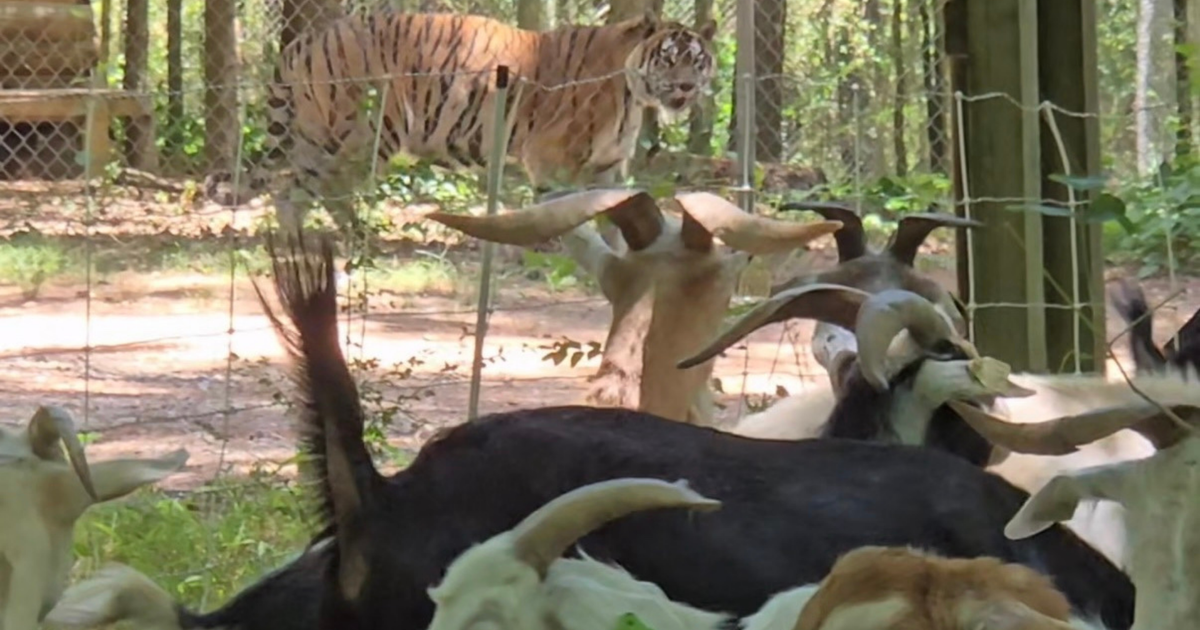
The newest grounds crew at Carolina Tiger Rescue arrived without chainsaws, leaf blowers or pickup trucks. Instead, they came in a trailer, stepped cautiously into a fenced clearing and immediately found something to eat.
Within minutes, they attracted an audience.
On one side of the fence, 32 goats from Goats on the Go Raleigh-Durham spread out through a tangle of greenery, lowering their heads into patches of privet and other invasive plants. On the other side, Saber, a white tiger, paced along the edge of her enclosure, stopping every few steps to study the newcomers.
For the goats, it was another workday. For many of the tigers, staff believe, it may have been their first time seeing a goat.
The scene felt improbable enough to draw visitors to the fence line, cameras in hand. Yet beneath the novelty lies a serious environmental mission, one that is becoming increasingly common as landowners, conservation groups and municipalities search for alternatives to herbicides and fossil-fuel-powered equipment.
“North Carolina is so lush,” said Stephen Paul, owner of Goats on the Go Raleigh-Durham. “Unfortunately, a lot of the predominantly Asian species like kudzu, privet and English ivy have really taken root and thrived here, and it really smothers the native species that you really want in your backyard or your landscapes.”
Paul’s business is part of a growing industry built around an old agricultural reality: goats are remarkably effective vegetation managers. They scramble across steep slopes, maneuver through dense undergrowth and happily consume many of the invasive plants that land managers spend years trying to control.
Unlike mowing, targeted grazing produces no engine noise. Unlike chemical treatments, it introduces no herbicides into the surrounding environment. And unlike many invasive species, whose seeds hitch rides on tires, boots and machinery, many of the seeds consumed by goats never survive the journey through their digestive systems.
“When they eat the plants, they consume the seeds,” Paul explained. “The majority of the seeds are destroyed in their rumens. So it’s really great to stop it spreading the problem.”
At Carolina Tiger Rescue, however, the environmental benefits were only part of the appeal.
The sanctuary’s residents include animals rescued from private ownership, roadside attractions and other captive situations. Many arrived carrying the effects of chronic stress. Creating a calm environment is a constant consideration, even when routine maintenance work needs to be done.
“A lot of our rescues are very sensitive to really loud, consistent noise,” said Nick Keller, communications director for Carolina Tiger Rescue. “We were searching for an option that would be very quiet, but also visually enriching for them.”
The goats, it turns out, accomplish both.
As they work, they make little more than the sound of chewing. There is no roar of machinery, no smell of fuel, no disruption beyond the occasional bleat. Yet their presence introduces something entirely new into the tigers’ daily routines.
Enrichment is a cornerstone of modern animal care. Keepers routinely provide scents, toys and puzzles designed to encourage curiosity and stimulate natural behaviors. The arrival of several dozen goats created an enrichment opportunity that nobody could have purchased from a catalog.
“They don’t ever get to see goats,” Keller said. “This is definitely a new experience for them.”
The tigers seemed to agree.
Throughout the morning, several cats lingered near the grazing areas, watching the herd move through the brush. Whether they were captivated by the novelty, intrigued by the scent or simply contemplating the food chain was impossible to know. Keller suspects instinct plays a role.
“For many of our predators like tigers, goats are definitely within the ballpark of animals they would predate upon,” he said. “So it’s very exciting for them.”
The goats appeared somewhat less enthusiastic about the encounter.
Paul noticed them paying close attention when they first spotted a tiger beyond the fence.
“I think instinctively that this animal is king of the jungle and top of the food chain,” he said. “Goats are a prey animal, and that’s why they like to stay together in herds.”
For now, the relationship remains strictly professional. Multiple layers of fencing separate the two species, while GPS-enabled virtual boundaries help keep the goats exactly where they are supposed to be.
In another week, the herd will move on to its next assignment, leaving behind a noticeably thinner stand of invasive vegetation and a fresh layer of natural fertilizer. The tigers will return to their normal routines. The goats will find another hillside, another thicket, another patch of stubborn greenery in need of attention.
But for a brief stretch of summer in Pittsboro, one of North Carolina’s most effective conservation tools happened to double as one of its most unusual wildlife exhibits.