
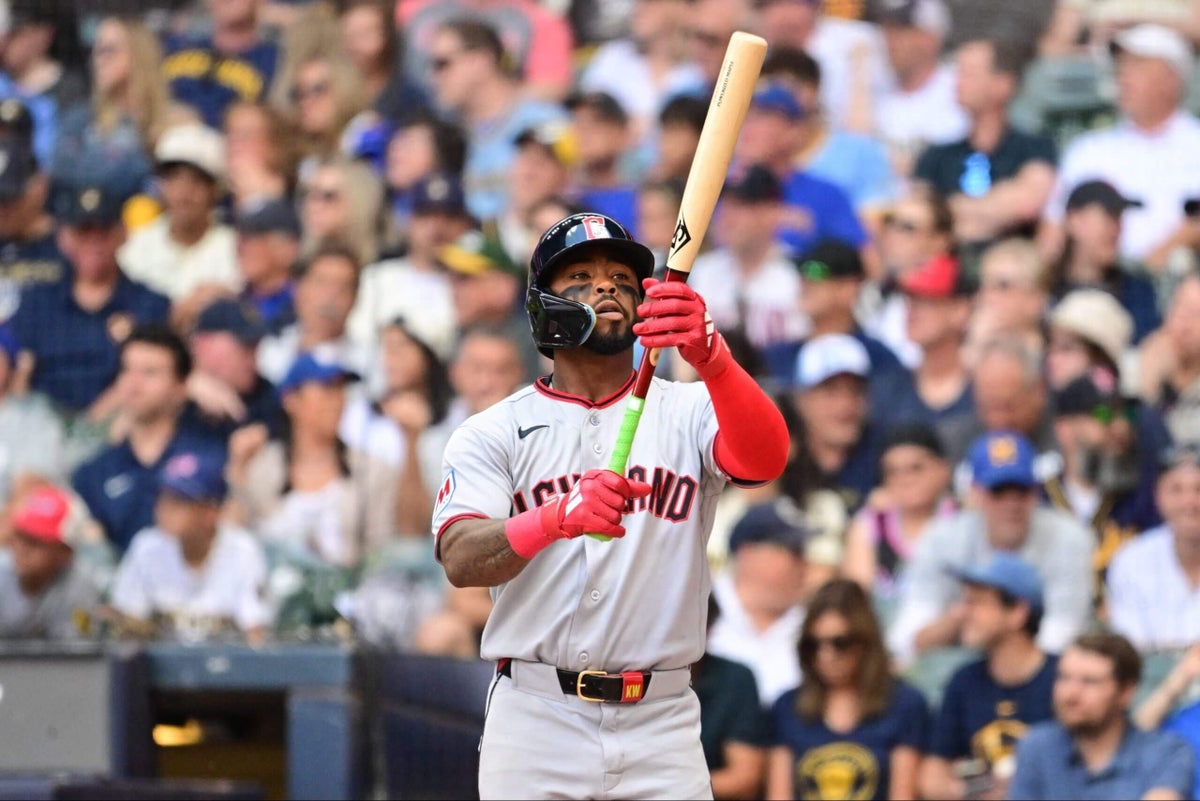
This weekend, Kahlil Watson will settle into the visitors clubhouse in Houston, the same space where Cleveland Guardians coaches relayed news of the trade that brought Watson to the organization three years ago.
Josh Bell, whose name was scribbled into Terry Francona’s lineup that night, was wrapping up a card game ahead of a team meeting scheduled for just after the trade deadline, about two hours before first pitch. And then, he learned he had been traded. Cleveland dealt Bell to the Miami Marlins for veteran infielder Jean Segura and Watson, a once-hyped prospect whose luster had faded because of concerns about his maturity and contact ability.
The Guardians wanted no part of Bell’s $16.5 million player option for the following season. The Marlins wanted to offload Segura’s remaining salary. Initially, the Guardians couldn’t get ahold of him to tell him he didn’t need to report to the Houston Astros or Cleveland; they planned to cut him loose and cut him paychecks totaling $12.5 million.
Watson was the wild card, something of a lottery ticket included for the Guardians’ swapping the cumbersome contract of a player in the middle of his career (Bell) for one who would never appear in another big-league game (Segura).
Can you ‘Name that Dude’?
Derek VanRiper and Eno Sarris
Watson was a first-round pick and a consensus top-100 prospect, and it all makes sense now. He shifted to the outfield and improved at the plate each year and at each level. There’s power and speed. There’s plenty of swing-and-miss, too. The Athletic’s Keith Law told me there’s concern Watson will “get eaten alive given how much trouble he had making contact in Triple A. He’s kind of always had this problem. It got better after the trade, but still, a 79 percent in-zone contact rate in Triple A is not a good sign.” Law’s rooting for him, however.
The trade — plus the swap of Aaron Civale for Kyle Manzardo — brought confusion and frustration to the Guardians’ clubhouse in Houston, to the extent that team decision-makers Chris Antonetti and Mike Chernoff flew in from Cleveland the morning after the deal to conduct some damage control.
Bell’s tenure in Cleveland was a flop, but it appears the Guardians might have found something in Watson. Meanwhile, Segura has presumably been on a yacht in the Maldives for the last few years.
The Daniel Espino story is equal parts heartwarming and inspiring for how the pitcher, who endured a wretched four years, conquered adversity and navigated his way to the big leagues. But this isn’t some fleeting, feel-good moment. This is a feel-great moment — as in, Espino feels great. His stuff is great. It’s still electric.
The pitch-by-pitch breakdown from his debut in Milwaukee on Wednesday can do the talking.
First batter: Strikeout
• 0-0: 99.0 mph fastball; inside (Remember, Espino struggled to muster 70 mph during his rehab following his first shoulder surgery a few years ago.)
• 1-0: 99.2 mph fastball; swing and a miss
• 1-1: 99.8 mph fastball; called strike
• 1-2: 100.6 mph fastball; inside
• 2-2: 99.5 mph fastball; swing and a miss
Second batter: Strikeout
• 0-0: 91.6 mph slider; called strike
• 0-1: 99.7 mph fastball; outside
• 1-1: 92 mph slider; low and outside
• 2-1: 99.9 mph fastball; swing and a miss
• 2-2: 100.3 mph fastball; foul-tip strikeout
Third batter: Flyout
• 0-0: 76.0 mph curveball; called strike (That’s just not fair. Who has the timing down to anticipate a pitch 24 mph slower than his fastball?)
• 0-1: 91.3 mph slider; popout
Espino averaged 99.8 mph on his heater. He induced four whiffs on five swings. There’s a lot to sort out and treat delicately as it pertains to his workload, but he made it easy for anyone to daydream about what’s still possible with his right arm.
Over the last month, the Guardians have averaged 3.08 runs per game, and the vast majority of that (lack of) output came with José Ramírez, Chase DeLauter and Angel Martínez in the lineup. Those three are on the injured list now, and the Guardians are simply trying to survive the next month or so.
Run totals over the last month
0: Twice
1: Four times
2: Three times
3: Seven times
4: Six times
5: Twice
6: Once
9: Once
Perhaps Houston’s pitching will help. The Astros rank No. 29 with a 4.87 ERA as a staff. They rank No. 29 in walk rate, and when the Guardians have functioned well offensively this season, their plate discipline has played a significant part.
The Guardians drew eight walks in their series-finale victory against the Milwaukee Brewers on Thursday. They also hit three homers, only the fifth time they’ve done so this season. They’re 5-0 in those games. Entering Thursday, teams were 193-62 when hitting three or more homers, good for a .757 winning percentage. The Guardians should simply do that more.
Coincidentally, the Guardians, Texas Rangers and Kansas City Royals all entered play Thursday tied for last with four three-homer games, and all three teams slugged three homers Thursday.
Really, though, the Guardians should try anything and everything to generate offense, whether that’s promoting Cooper Ingle, handing Watson regular at-bats for a few weeks or continuing to tinker with the lineup construction. The team desperately needs more from veterans such as Steven Kwan and Rhys Hoskins, too. Hoskins, by the way, can max out his performance bonus of $1.2 million if he reaches 375 plate appearances. He has totaled 210 trips to the plate, with a .178/.319/.355 slash line to show for it.
In the first 21 starts of his career, Parker Messick threw 13 pitches that registered at least 96.0 mph, topping out at 96.6 mph last week against the New York Yankees.
Thursday against the Brewers, Messick averaged 95.9 mph and threw 16 pitches that clocked in at 96.0 mph or higher. He eclipsed his career-best velocity three times in his six-inning effort: once at 97.2 mph and twice at 97.5 mph. His fastball accounted for six of his nine strikeouts and nine of his 13 whiffs, and yeah, there’s more to life than velocity, but Messick already possesses most of those other traits. Consistently sitting at 94-97 mph opens up more ways for him to attack hitters and raises an already lofty ceiling.
Messick has been the club’s most reliable, effective starter this season, and that’s with a heater that averaged 93.7 mph — plus a lethal changeup and a slew of other offerings that he balances to keep hitters guessing. He didn’t learn he would be on the Opening Day roster until a few days before the Guardians left camp in Goodyear, Ariz., in late March. Now, he’s trending toward an All-Star Game nod.