
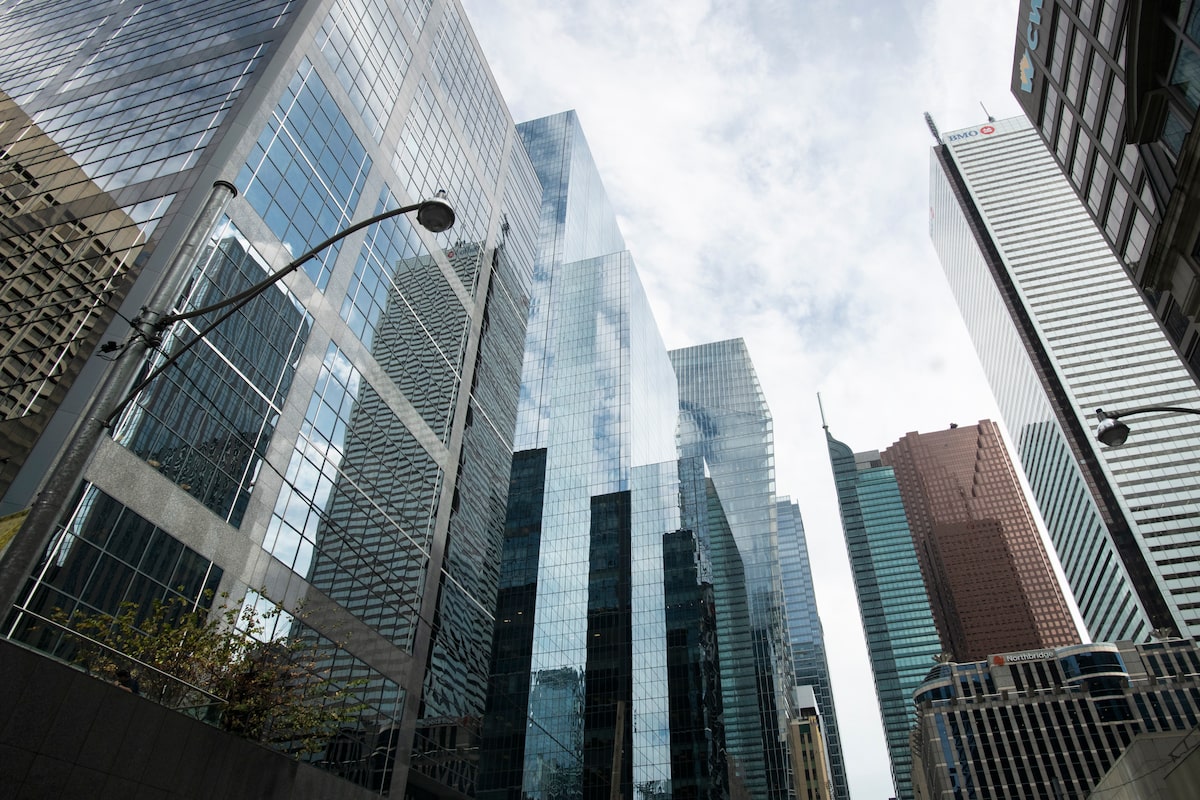
Office buildings in Toronto’s financial district.Fred Lum/The Globe and Mail
Canada’s banking regulator has reduced the capital cushion the country’s biggest banks must reserve, freeing up billions of dollars in excess cash to boost lending for businesses and consumers as Ottawa looks to attract private financing to boost defence and infrastructure.
The Office of the Superintendent of Financial Institutions, or OSFI, said Friday it lowered its required capital levels to provide banks with greater capacity for lending to help Canada’s economy as trade routes and geopolitical relationships shift. In recent years, analysts, bankers and other industry watchers have advocated for loosening capital requirements as Prime Minister Mark Carney seeks to bolster Canada’s waning productivity and economic growth.
In December, 2022, OSFI started ratcheting up capital requirements as a buffer against a potential economic downturn and to reinforce the resilience of the financial system. But the country’s biggest banks – which have posted strong earnings and withstood the threat of loan losses and high inflation – were asking for more flexibility to lend.
Canadian banks have capacity to lend more to small businesses, regulator says
The banks are now holding onto $74-billion in excess cash, about a $30-billion increase compared to the previous capital level. The lenders could add a combined total of $673-billion in risk-weighted assets to their balance sheets, according to the regulator.
“The resilience we’re releasing, the cost of that was very low, and the benefits to the economy of making that statement about the strength of our banking system and the availability of capital for deployment of new opportunities is very high,” said Peter Routledge, Canada’s top banking regulator, in an interview.
In recent months, OSFI has had conversations with the Department of Finance, the Bank of Canada and the Financial Institution Supervisory Committee on the need to unleash investment capital and take opportunities to support the critical “hinge moment” where the economy must “adjust,” Mr. Routledge said.
OSFI said the changes will give banks more room to lend for defence spending, infrastructure and artificial intelligence.
“If we mis-calibrate, if we were overly conservative in our buffers, we might weaken that adjustment, and that would be a bigger long-term threat to prudential health than releasing the buffer that we have now,” he said.
“We don’t want to be an impediment to that adjustment. We don’t want to be seen to be an impediment to that adjustment.”
Toronto-Dominion Bank analyst Mario Mendonca said the decision was a surprise, adding that OSFI’s previous announcements indicated that the buffer would be lowered if economic risks escalated, not as a capital management tool. The move seems to be an attempt to bolster the banking sector ahead of negotiations over the United States-Mexico-Canada Agreement, he added.
“We believe banks are willing and able to lend. The question then becomes how much pent-up loan demand is there. For that, we need to see nation-building projects being approved and/or measures that specifically lower commercial borrowing costs,” Mr. Mendonca said in a note to clients. “Changes in buyback activity from here will be telling of banks’ capital deployment intentions.”
OSFI said the domestic stability buffer (DSB) – capital that banks must maintain to withstand an economic downturn – will reduce to 3 per cent from 3.5 per cent of a bank’s risk-weighted assets. The regulator has held the previous level since June, 2023, after a series of increases, which required banks to hold onto billions of dollars in excess cash.
To hike the buffer, the regulator increased the potential range in 2022 to between 0 and 4 per cent, up from a maximum of 2.5 per cent. This signalled to banks that the regulator could require them to hold onto significantly higher levels of capital.
On Friday, the regulator also lowered the range of the DSB to 0 to 3 per cent from 0 to 4 per cent.
While risks to the financial system that prompted OSFI to previously raise requirements remain elevated, the regulator said conditions have remained stable. Canadian household debt remains high relative to income but below historical peaks. Even as trade uncertainty weighs on consumers and businesses, unemployment and loan losses have stabilized in recent quarters.
Mr. Routledge said the banks wanted more certainty to plan over a multiyear period without the risk of capital requirements spiking.
“This is a decision to communicate to them that they can have the confidence and certainty to make good decisions about deploying capital, and they don’t have to wonder what we may or may not do over the next few years,” Mr. Routledge said.
The industry has pushed back against high regulatory requirements, saying that they limit their ability to lend to key sectors of the economy.
OSFI plans pilot project to streamline process for institutions to join banking system
Last week, Mr. Routledge told a Senate committee that banks did have the capacity to boost lending to small- and medium-sized businesses, even with high capital levels. The committee is conducting a study on access to credit and capital markets for small- and medium-sized enterprises and the implications for growth and productivity in the Canadian economy.
“Capital rules are not an impediment to the deployment of that capital. You cannot say that after today,” Mr. Routledge said on Friday of the decision to lower requirements.
While OSFI can change the DSB at any time, it announces a decision to change or hold the level twice a year. The requirement applies to financial institutions that are considered domestic systemically important banks, including Royal Bank of Canada, Toronto-Dominion Bank, Bank of Nova Scotia, Bank of Montreal, Canadian Imperial Bank of Commerce and National Bank of Canada.
The DSB also determines the overall minimum capital levels that a bank is expected to hold. The common equity tier 1, or CET1, ratio – a measure of a lender’s ability to absorb losses – lowered to 11 per cent from 11.5 per cent.
Banks typically hold on to more cash than required to avoid falling below the regulatory minimum. If sudden issues arise, a bank’s CET1 ratio could fall. If capital levels were to drop to 10.9 per cent or lower, OSFI would require a bank to undertake a remediation plan.
OSFI said the banks are sitting on capital cushions that far exceed the requirement, at an average of 13.5 per cent.
“We are listening to the institutions we regulate. They’re saying that the DSB at 3.5, range 0 to 4, was a contributing factor in their capital deployment,” Mr. Routledge said. “I don’t think that’s the sole explanation for that very sizable buffer, but we understand and accept it’s a consideration, and so we wanted to remove that consideration.”
Editor’s note: This article was corrected to state that OSFI announced a change to its domestic stability buffer on Friday.