
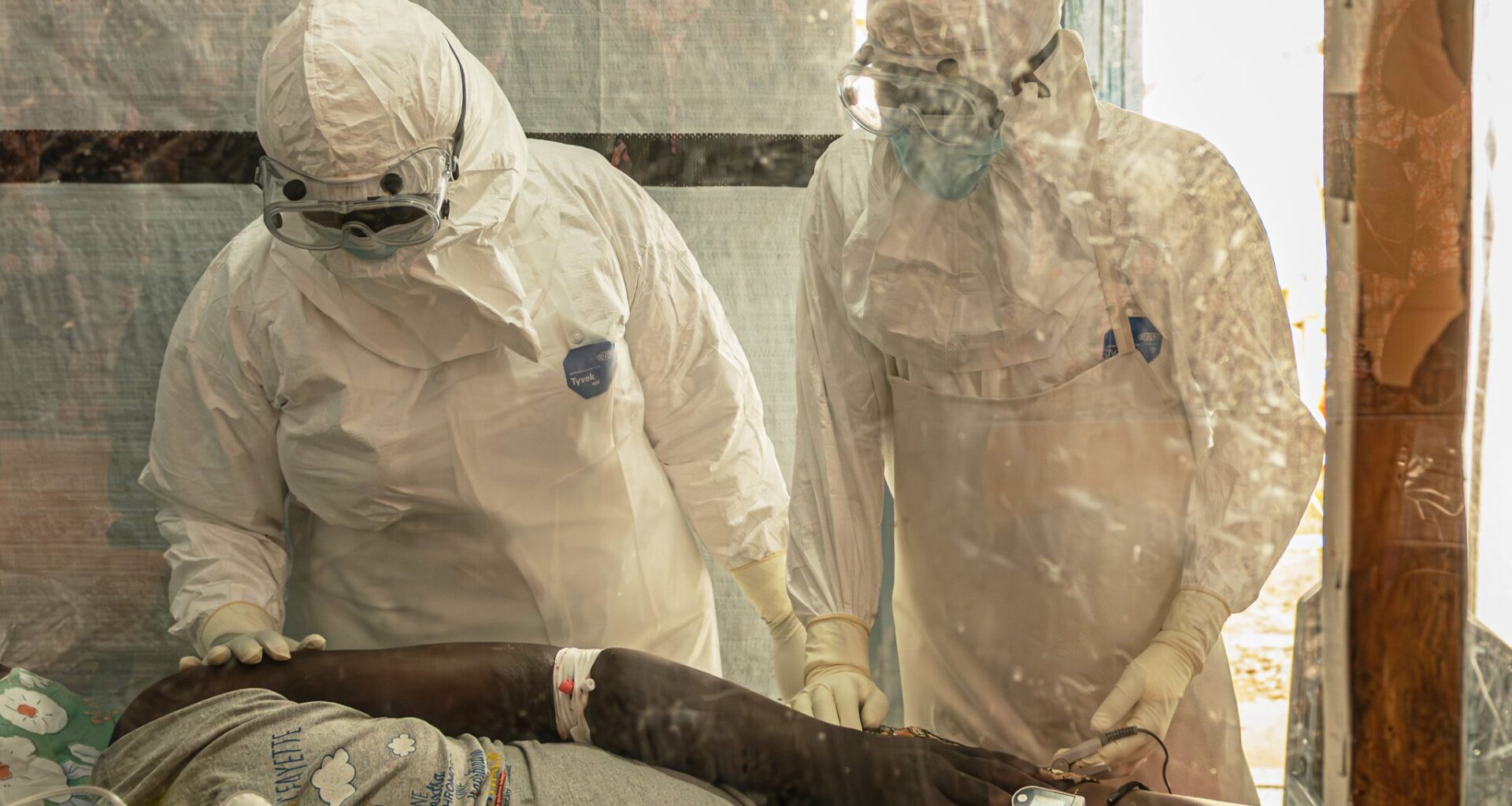
A man suspected of having contracted Ebola following a recent trip to the Democratic Republic of the Congo (DRC) has been hospitalized at Rambam Medical Center in Haifa, the Health Ministry announced on Friday, amid an outbreak of the Bundibugyo strain of the virus in the DRC and Uganda.
The suspected Ebola patient was being treated in isolation, the Health Ministry said, and tracing was underway to alert anyone who may have been in contact with the individual.
As of Saturday afternoon, it had not been confirmed that the man had contracted the disease, and the Health Ministry said he was still undergoing testing, with the results expected some 48 hours later.
There is no airborne transmission of Ebola, and infection occurs through direct contact with a sick person who is displaying symptoms, or with their blood, bodily fluids or secretions.
The Kan public broadcaster published footage of medical workers from the Magen David Adom emergency service being disinfected after contact with the suspected patient.
Get The Times of Israel’s Daily Edition
by email and never miss our top stories
By signing up, you agree to the terms
Israel’s health sector has been preparing for the possibility of treating Ebola patients since an outbreak was first reported in the DRC on May 15, 2026.
תיעוד: פעולות החיטוי של צוותי מד”א שפינו את החשוד הראשון באבולה בישראל@Nov_reuveny pic.twitter.com/ANIHIDbXix
— כאן חדשות (@kann_news) June 20, 2026
The Health Ministry stressed earlier this month that the chance of an outbreak of the Bundibugyo strain of the virus remained low, but said it had distributed protective equipment to hospitals for the safe treatment of suspected cases.
As part of its preparations, the ministry has encouraged hospitals to establish dedicated complexes for treating suspected cases of the disease.
It has also worked to distribute professional guidelines to relevant medical teams and hospitals, which are prepared to receive a suspected Ebola case should it reach Israel.
There has never been a confirmed case of Ebola in Israel, according to the Health Ministry, although there were several suspected cases that turned out to be negative during a previous outbreak in 2014.
The Health Ministry recommends avoiding non-essential travel to areas in the DRC and Uganda where there are confirmed cases of the disease.
Travelers who have returned from the Democratic Republic of the Congo and Uganda and develop a fever or unusual symptoms within 21 days are asked to stay home and avoid contact with others, and to immediately contact the ministry’s hotline.
The current outbreak in the DRC and Uganda has claimed more than 200 lives in its first month, and is the worst known outbreak at this stage, with up to 35,000 suspected potential contacts, Africa’s Centres for Disease Control and Prevention said on Thursday.
With 894 confirmed cases so far, the current outbreak is three times worse than a previous outbreak in Uganda in 2000, which had 281 cases at the same point, said Dr. Wessam Mankoula, a medical epidemiologist at Africa CDC.
The latest number of cases is believed to be higher because the outbreak was confirmed on May 15, weeks after it was suspected to have begun. The number of cases has increased 38 percent since last week and is now in 32 health zones across eastern Congo, said Mankoula.
The rare Bundibugyo strain behind the current outbreak has no approved vaccines or treatments. The more common Zaire virus, for which there is a vaccine, was responsible for most of DRC’s past 16 outbreaks of the disease.
So far, 74 patients have recovered from the disease across eastern DRC and Uganda. Experimental treatments like monoclonal antibodies are being developed for Bundibugyo.
The outbreak is concentrated in DRC’s eastern province of Ituri, which accounts for more than 90% of the cases. Cases have also been recorded in the North Kivu and South Kivu provinces and have spread across the border to Uganda, where 19 confirmed cases have been reported and two people have died.
Contact tracing remains an issue due to the area’s remoteness and ongoing insecurity in Ituri province, Dr. Mankoula said.
“For those 800 confirmed cases, we should have between 17,000 to 35,000 contacts that should be in our contact list,” said Mankoula. Currently, only around 4,000 contacts have been tracked and are being evaluated, less than 15%.
“We are still far from controlling the situation of this outbreak,” said Mankoula.
We can’t do this work alone.

The war with Iran has been draining for all of us in Israel. But when I heard about a high casualty incident – ballistic missile impacts in Arad and Dimona that left nearly 200 people wounded – I drank a cup of coffee, packed a bag, and headed south.
There, I spoke with Shilgit, the head of an after-school program for underprivileged youth. Standing outside her destroyed center, Shilgit said it was a miracle that no children were hurt and spoke about the community coming together in the hours since.
As a Times of Israel reporter, I’m committed to telling stories of resilience like Shilgit’s. But my colleagues and I can’t do this alone. If you value work like this, please consider joining our reader support group, The Times of Israel Community. Your financial support is essential to keep real human reporting like this going.
— Stav Levaton, military reporter
Already a member? Sign in to stop seeing this
You’re a dedicated reader

That’s why we started the Times of Israel – to provide discerning readers like you with must-read coverage of Israel and the Jewish world.
So now we have a request. Unlike other news outlets, we haven’t put up a paywall. But as the journalism we do is costly, we invite readers for whom The Times of Israel has become important to help support our work by joining The Times of Israel Community.
For as little as $6 a month you can help support our quality journalism while enjoying The Times of Israel AD-FREE, as well as accessing exclusive content available only to Times of Israel Community members.
Thank you,
David Horovitz, Founding Editor of The Times of Israel